
by Stefan Lauer, Head of Infrastructure, SimpleSwap
The market came to Prague to talk about the price. I came to listen to what happens after the price — operations, custody, and reliability. Three days, two stages, thousands of people.
Here’s my read of Prague; not by market highlights, but by what will actually last.
1. Self-custody won. Education didn’t.
The best talk of the conference, for me, wasn’t about price at all. Shawn Engleman from Trezor opened with a thesis that lands dead-on: self-custody won, education didn’t. “Not your keys, not your coins” has finally been accepted. But the people coming into crypto now look nothing like the people who built it. They discover Bitcoin through influencers, not whitepapers. They treat setting up a device as the finish line. And almost none of them understand what it means to be solely responsible for their own assets. His conclusion, after 500+ one-on-one consultations, is simple: the work has to start where the user actually is — not where it’s convenient for us to assume they are.
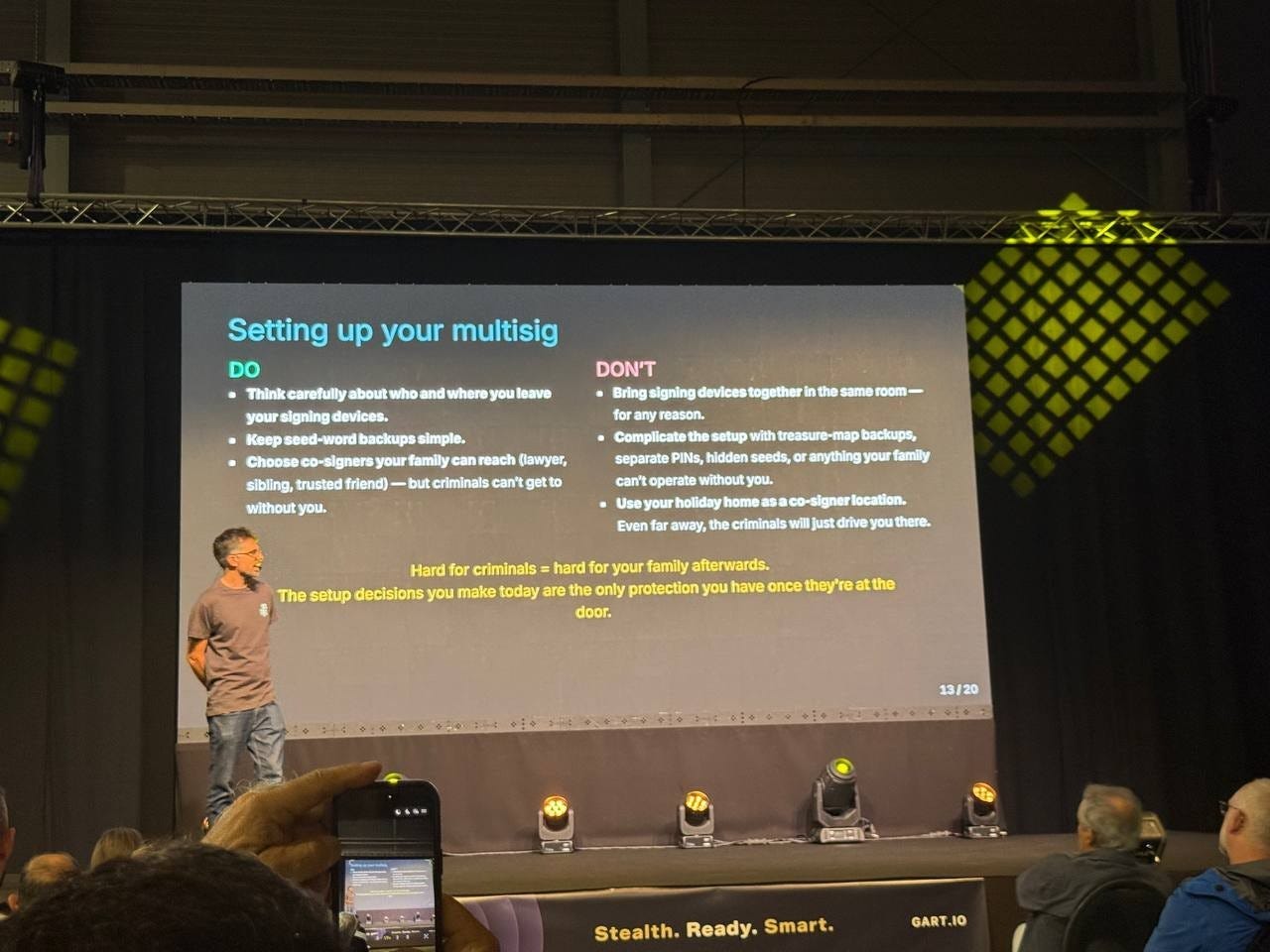
Lloyd Fournier (Frostsnap) hit the same point in “Self-Custody in a Hostile World.” One line I wrote down word for word:
Be your own bank — but don’t make your house the bank.
The bank robbery has been reborn as the crypto home invasion. The attacker doesn’t need to crack the hardware — he needs to crack you. And finding you keeps getting easier: exchanges, tax tools, and data brokers collect more and more identity-linked data. The answer is multisig that distributes keys across people, devices, and locations, so that not even you can send your entire savings away in a minute.
For me, this isn’t philosophy; it’s an engineering spec. Self-custody is no longer a question of ideology; it has become one of UX and infrastructure. Building a non-custodial flow that doesn’t require users to be security experts is exactly what we wrestle with at SimpleSwap every day.
2. Institutions brought TradFi discipline — and TradFi valuation, too.
The “Corporate Fortress” panel ( Adam Back / Blockstream, Yves Choueifaty / Tobam, Oleg Mikhalsky / Fulgur Ventures, Thomas Doyle / Xapo, moderated by Sean Bill) was about corporate Bitcoin treasury with the “magic internet money” stripped out — just the cold mechanics: how to build a financial fortress out of Bitcoin, and what standards and best practices the next generation of institutions will need.
Then came Michael Saylor, “Digital Capital, Equity, and Credit.” His lines, as always, are minted: “Bitcoin represents the transformation of capital from its physical form to its digital form.”
And on gold versus Bitcoin:
“Gold is the capital of the last thousand years. But because gold is naturally inflationary, it has a half-life of about 35 years at a 2% inflation rate. Bitcoin has a half-life of infinity.”
You can argue with the metaphor, but the direction of the argument is telling: institutions now evaluate crypto like settlement infrastructure — SLAs, audited uptime, regulatory standing. I was saying this before Prague: crypto’s second decade will be built not on promises but on uptime. In Prague, it was already being said from the stage as a given.
3. The cycle, the macro, and the rotation.
The “Where Are We in the Bitcoin Cycle?” panel ( Matt Cole / Strive, Bradley Duke / Bitwise, Richard Byworth / Future, Scott Ellam / XCE, moderated by Niko Jilch ) produced the most quotable lines.
Richard Byworth, on gold as the leading signal:
Gold was the canary in the coal mine.
His logic: central banks have realised the fiat game is getting a bit broken, and in previous cycles, gold always moved first while Bitcoin caught up. Right now, he says, Bitcoin is sitting on its 200-day moving average — and that’s significant relative to every other asset; the next step in allocations is a rotation into Bitcoin out of overheated AI stories.
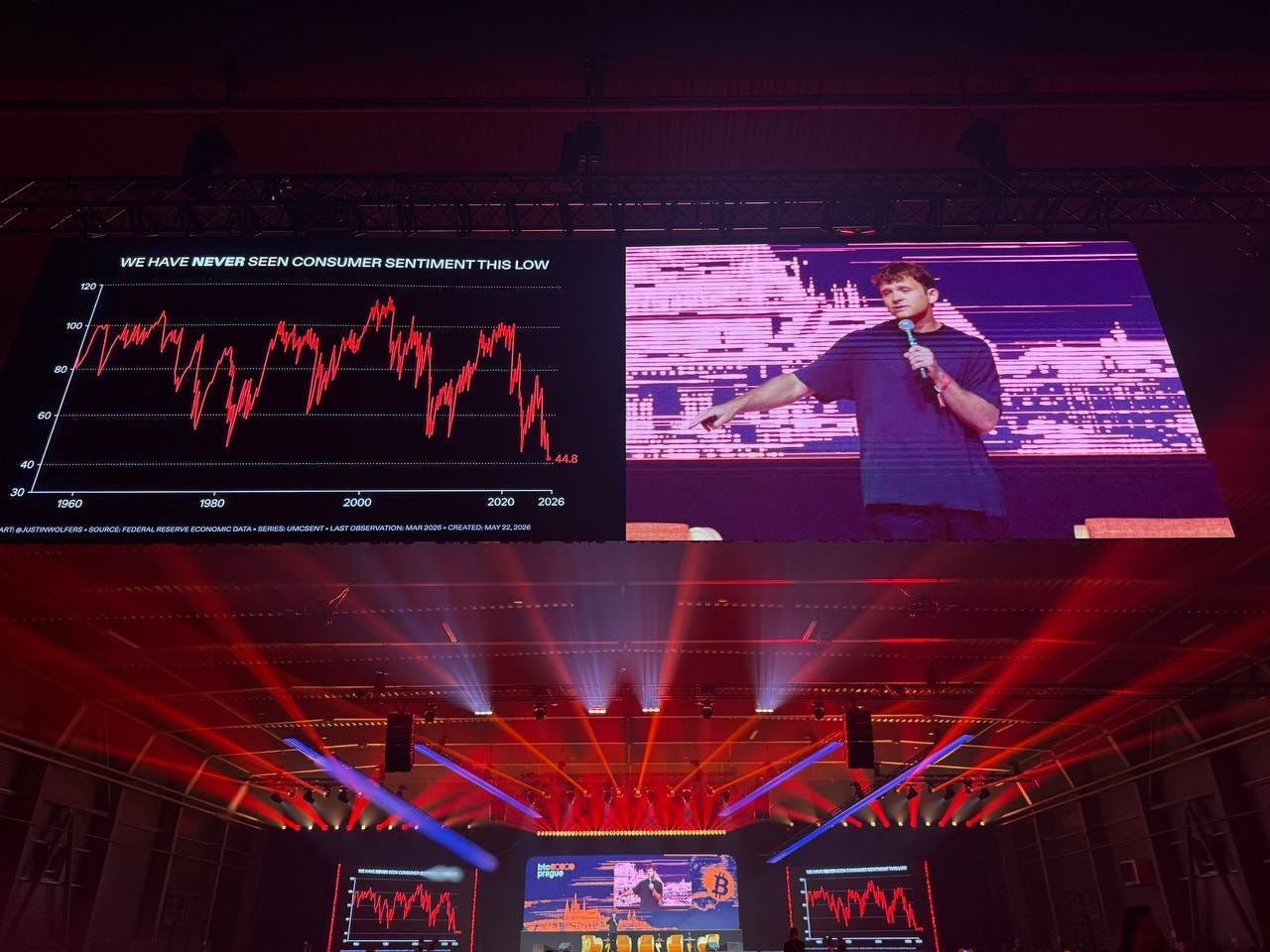
Matt Cole (Strive) made the sobering point that market sentiment is low even though prices are high. Wealth is accumulating at the top, and the median person is diverging from the market. Hence the tone — “go on X, everyone’s yelling at each other.”
The panel’s common thread, picked up by Niko, was a re-rating: people are looking for real value, re-examining even the large coins, and institutions are applying TradFi metrics. Go down the top 50, and you very quickly start to question their value — unlike Bitcoin, which remains unique.
Scott Ellam held the risk-management line: don’t end up over-allocated; keep capital available in case you need it tomorrow. Boring — and absolutely right.
4. Operations: the part nobody sees.
My personal favorite in spirit was Nicolás Rincón (EMCD) on the behind-the-scenes of mining: logistics, customs, in-land transport, mountains of paperwork. Not a word about the hash rate price; only about the complexity that grows depending on where you physically are on the map.
This is exactly my world, just in a different industry. In swaps, the truth is the same: all the “magic” is in the operations nobody sees. Uptime every Tuesday morning, when nobody’s thinking about you — that’s what people actually pay for. Boring takes years to build. There are no shortcuts.
5. And then Jack Mallers came on and reminded everyone why we’re doing this at all.
Jack Mallers’ keynote was the emotional counterweight to all the engineering. He opened with: we’re beginning what I think is a Renaissance. And he walked the room into Florence: Brunelleschi, Michelangelo, Botticelli, Machiavelli, Leonardo da Vinci — genius within the radius of a single town, in one generation. The Sistine Chapel, the Creation of Adam.
His thesis: the greatest, most giving, highest-contributing people to society weren’t bankers and weren’t venture capitalists.
“They were artists. They inspired. They didn’t rent-seek and extract from our kids. They were natural creators.”
And in the second half — a cold shower about today: real wages are falling, inflation is back, even if you’re getting a raise, your money’s buying you less. Plus, the anxiety around AI: 77% fear political chaos from AI, 71% fear AI will take their jobs, and 66% think AI will replace the need for a real human connection.
I listened to this as an engineer and thought about one thing: a Renaissance is beautiful, but even a Renaissance needs plumbing. Beauty rests on infrastructure that doesn’t go down.
What I took away from Prague
The conference honestly showed both of its halves. On stage — optimism. In the hallways — consequences: conversations about custody, compliance, operational resilience. Markets run on optimism. Infrastructure runs on consequences, and Prague was exactly about that split.
Self-custody won. Which means we now owe users infrastructure that makes that responsibility survivable. Crypto built its first decade on promises. It’s building its second on uptime. That’s the boring work we get up for every day.

This article was written by Stefan Lauer, Head of Infrastructure, SimpleSwap. SimpleSwap — a self-custodial multi-source swap aggregator. 2,800+ assets, 20+ liquidity providers across CEX and DEX sources, 20M+ swaps since 2018. Wallet-to-wallet by design, with routing handled under the hood.






