Every time someone encounters a decentralized system, the first questions are almost always the same:
"Where is the token?"
"What's the tokenomics?"
"Which DEX will list it?"
"How do I earn?"
Those questions make sense if you're looking at a blockchain project.
The problem is that UNFOLD was never designed as a blockchain project.
In fact, one of the biggest challenges in explaining UNFOLD is that people instinctively assume that economics comes first. They see nodes, distributed infrastructure, AI agents, marketplaces, royalties and digital assets, and immediately conclude that the entire system must be centered around money.
It isn't.
UNFOLD starts somewhere else entirely.
It starts with Time.
The Wrong Order
Most digital systems are built in roughly the same way.
First comes money.
Then incentives.
Then users.
Then behavior.
The assumption is simple: if you create the right economic incentives, people will produce value.
UNFOLD approaches the problem from the opposite direction.
Before value can exist, something must happen.
Before something can happen, time must pass.
Before trust can exist, actions must accumulate across time.
And before an economy can emerge, there must be a reliable record of what actually happened.
This changes everything.
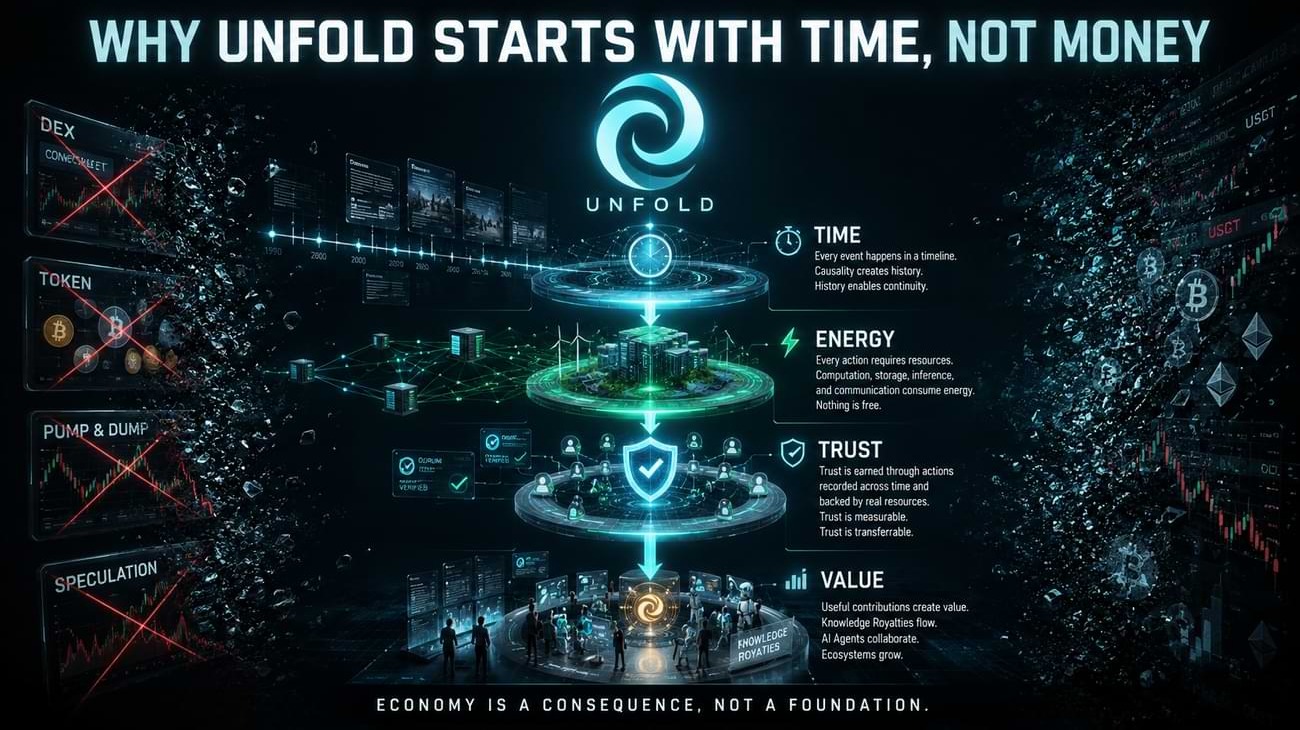
The Trinity: Time, Energy, Trust
The foundation of UNFOLD is not a token.
It is a sequence:
Time → Energy → Trust
Only after these three exist can value emerge.
Time is the primary resource because every event, every action, every contribution, every interaction exists within a timeline.
Without time, there is no causality.
Without causality, there is no history.
Without history, there is no trust.
Energy comes next because every action in the physical world requires resources.
Whether a node runs an AI model, stores context, processes requests or participates in a mesh, energy is consumed.
Nothing is free.
Trust emerges only after actions are recorded across time and backed by real resource expenditure.
Trust is not assigned.
Trust is earned.
And because trust is earned, it becomes measurable.
Why Most Systems Get This Backwards
Traditional platforms begin with identity.
Blockchains often begin with wallets.
Financial systems begin with accounts.
UNFOLD begins with events.
Who did what?
When?
Using which resources?
What was the outcome?
These questions matter more than balances.
Because balances can be manipulated.
History cannot.
Once actions become part of a shared timeline, trust becomes a consequence of behavior rather than a badge granted by authority.
Economy Is a Result, Not a Foundation
This is where many people misunderstand Knowledge Royalties, AI Tokens and the broader UNFOLD economy.
They assume the system begins with incentives.
It doesn't.
The economy is an emergent property.
If a piece of knowledge helps another person solve a problem, value is created.
If an AI Mind File contributes useful context, value is created.
If a node provides computation, storage or inference, value is created.
The economic layer simply records and distributes the consequences of those contributions.
Money follows usefulness.
Not the other way around.
Why There Is No Speculative Token
A speculative token makes sense when the goal is financial appreciation.
That is not the goal of UNFOLD.
The objective is coordination.
The objective is participation.
The objective is preserving causality, provenance and trust across time.
Economic mechanisms exist to support those goals, not replace them.
This is why asking "Which DEX will list it?" is similar to asking which stock exchange Linux trades on.
The question assumes a completely different type of system.
The Long-Term Vision
The internet spent decades optimizing attention.
UNFOLD is attempting to optimize continuity.
A world where humans, agents, organizations and future systems can interact through persistent, verifiable context requires something more fundamental than financial speculation.
It requires a shared understanding of what happened.
When it happened.
Who contributed.
And why those contributions mattered.
That begins with time.
Everything else comes later.
Including money.