
Do you remember the times when cryptocurrencies just began to conquer the hearts of people? Many users were hoping that crypto will become a symbol of freedom and independence, and it will make our life easier. Sadly, not everything has worked out yet.
For instance, some of the brand new exchanges decided to base their work on the rules from the traditional banking sector, and they’ve supported every regulation. Yes, crypto is developing, but with every step forward in the Crypto Universe appears some new rules, restrictions or obstacles. Probably one day cryptocurrencies will become as popular as fiat, but at what price?
So far, this is only a plan, which is not easy to put into practice – there are too many participants in the market, and individual altcoins do not behave in a ‘right’ (for the government) way. For example, there are projects, like Monero, where it’s impossible to track transfers. Some think that the “cleaning” of the crypto market is on its way, when major companies will absorb small ones. For example, a few days ago Binance almost purchased a FTX exchange.
Let’s take a look at what’s happening between Binance and FTX exchanges right now, because it affects the market in a crucial way.
What’s happened with the FTX exchange?
It all started last week after Changpeng Zhao wrote on Twitter that Binance intends to sell its remaining FTT tokens within a few months. The founder of the exchange noted that this step is just a “post-exit risk management”.
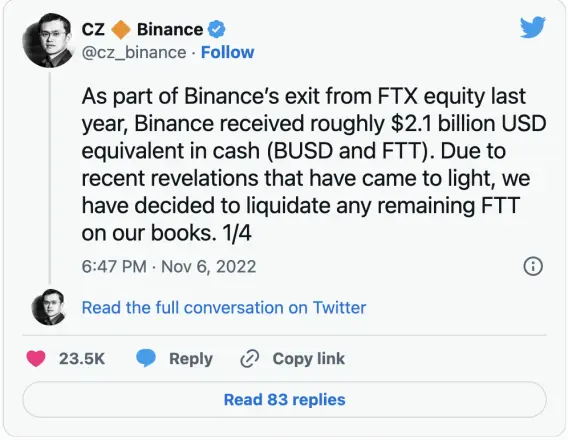
CZ added that the liquidation process will not be quick, and Binance will do everything possible to secure the market from falling.
FTX CEO has denied rumors amid mounting speculations that his exchange is facing liquidity issues. FTX officials really tried to keep the situation under control, but it was too late. First FTX announced that it had enough liquidity to buy out all client obligations and was even ready to take all FTT altcoins owned by Binance, then by the evening of the same day the mood had changed. Why? Probably because of the fact that thousands of FTX users immediately started withdrawing their money, and in a few days the amount of withdrawn funds equaled $6 billion!
The cry for help
It was no longer possible to pretend that everything was fine, so FTX decided to take a desperate step – the exchange called Binance for help. Changpeng Zhao's reaction was quick – he immediately said that he was ready to buy the exchange. In this way, the lack of liquidity will be resolved, and clients will not suffer.
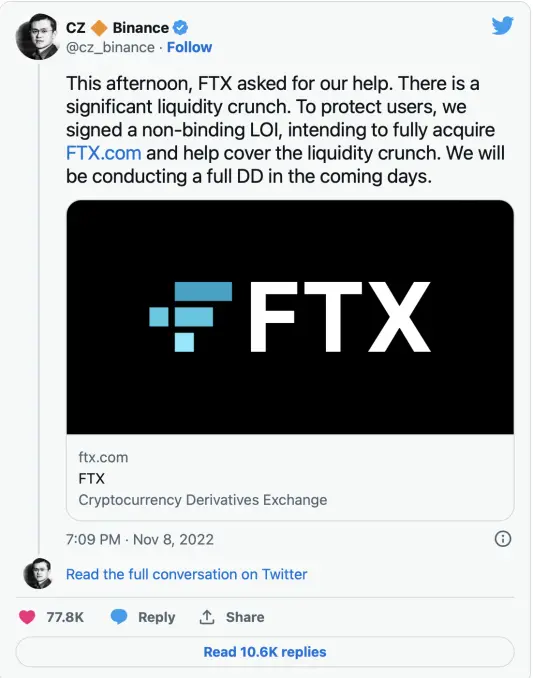
According to Changpeng Zhao, so far this is only one of the likely scenarios, because the situation is developing so quickly that it is not possible to predict the outcome.
Why did Binance change its mind?
Binance announced its intention to buy FTX on November 8th. Binance exchange hoped that the absorption would be able to cover liquidity. If the deal went through, Binance could gain control of more than 80% of the global crypto market, analysts pointed out.
On November 9th, the value of the FTT token collapsed by more than 70%. The price of Bitcoin also dropped down - for example, on November 8th it was less than $17.6 thousand for the first time since November 2020.
Before the purchase, the procedure of corporate review was initiated. According to Bloomberg, it turned out that the gap between liabilities and assets of the exchange could be over $6 billion.
On November 10 Binance wrote, that it won’t purchase FTX at the end:
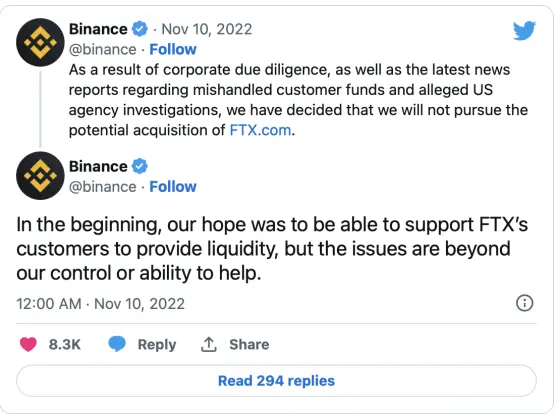
According to Reuters and Bloomberg, the Securities and Exchange Commission (SEC) has been investigating FTX for several months. The regulator is checking the exchange's ‘handling of customer funds amid a liquidity crunch, as well its crypto-lending activities’. Bloomberg also writes that another regulator, the Commodity Futures Trading Commission (CFTC), has become interested in the FTX.
That’s what happened on the crypto market recently. FTX CEO Sam Bankman-Fried said that he is sorry for everything. For sure, there’ll be more to this story – soon we might find out what will now happen with FTX and how these events would affect other exchanges, for instance.





