
In the first part (see [1]) we estimated returns on investments (ROIs) you need, to become a millionaire from investing an initial capital S and reinvesting it for N years with the same ROI.
For small initial capital and contributions, the ROIs are high, which means that investments need to be risky to generate high rates of return. Young people can afford to invest all their savings in risky assets, because they have time to recover loses in the case if they lose their risky investments.
Older persons do not have such option, therefore they should keep a part of their investments in non risky assets. The classical ratio, which most financial advisers recommended for decades is 60/40 portfolio (see [2]). This means that 60% go into risky assets (stocks, indexes, crypto, etc.) and 40% go into non risky assets (US treasury bonds, notes, gold, commodities, real estate, etc.).
In this post, we estimate returns on investments (ROIs) you need to become a millionaire from investing an initial capital S and reinvesting it for N years with the same ROI, in the case of splitting all your investments into two parts: risky part and non risky part. As in the part 1, we assume that all yearly contributions are in the same amount as the initial capital.
To accomplish this task we go to this URL https://www.dynpass.online/tools/1m/1mp.html, enter input data and click on the “Calculate ROI!” button.
For the classical portfolio 60/40 with 4% rate of return on non risky investments part, we get the following table.

For the 50/50 portfolio with 4% rate of return on non risky investments part, we get the following table.
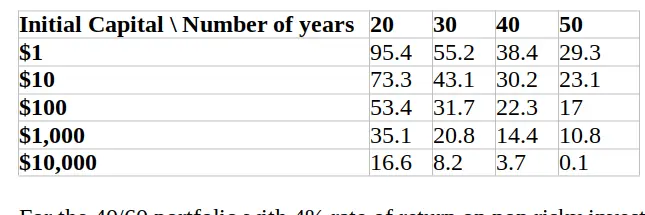
For the 40/60 portfolio with 4% rate of return on non risky investments part, we get the following table.
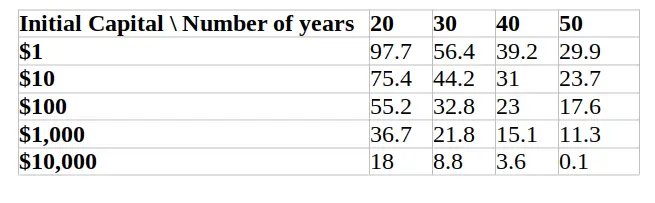
For the 30/70 portfolio with 4% rate of return on non risky investments part, we get the following table.
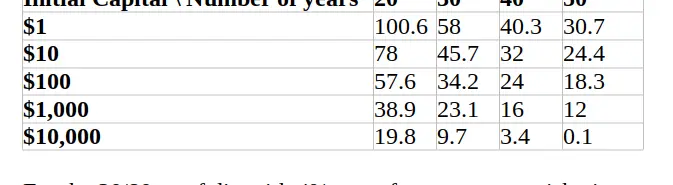
For the 20/80 portfolio with 4% rate of return on non risky investments part, we get the following table.
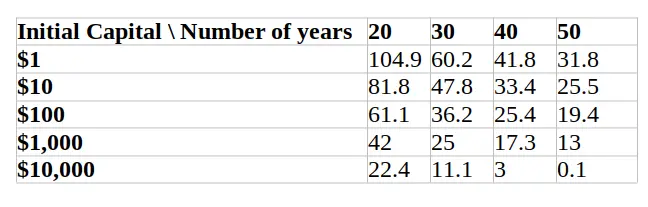
For the 10/90 portfolio with 4% rate of return on non risky investments part, we get the following table.

Pre-retirement or retired people should not have more than 10% in risky investments for the reason that they may not recover their loses if they invest in risky assets and lose those investments.
References:






