
The Dusk of the "Trustless" Era: How Autonomous AI Agents Irreversibly Altered DeFi’s Security Architecture
In late May 2026, Manuel Aráoz, the legendary co-founder and former Chief Technology Officer (CTO) of OpenZeppelin, published a dramatic announcement on social media. The words of the man whose code libraries secure over $250 billion in on-chain protocols sounded like an evacuation order from a burning building: "I now consider all of DeFi to be unsafe." Aráoz admitted that he had privately instructed his family and closest friends to completely withdraw their capital from flagship Web3 platforms, including MakerDAO and Compound.
This event triggered an immediate, turbulent debate within the developer community. When a key architect of modern blockchain cybersecurity capitulates, it is not a momentary bout of pessimism. It is the realization that the emergence of autonomous AI agents has permanently shattered the historical balance of power in the arms race between hackers and auditors.
The Mathematics of Failure: Structural Code Asymmetry
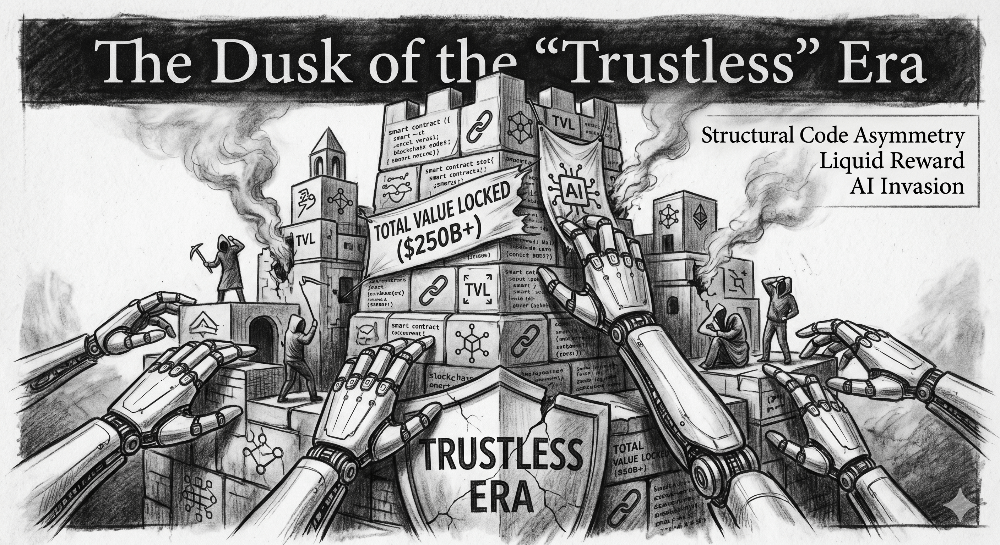
Cybersecurity has always been governed by a fundamental disparity: the defender must patch every single potential vulnerability, whereas the attacker only needs to find one-often trivial-error. In decentralized finance, however, this asymmetry is far more severe due to three unique characteristics of blockchain technology:
· Immutability: Once deployed, smart contracts are incredibly difficult to modify or patch without complex governance procedures.
· Total Transparency: The source code is 100% public-any hacker in the world can analyze it without restriction.
· Liquid Reward: Protocols display their assets in real time. The Total Value Locked (TVL) serves as a publicly advertised bounty for any potential aggressor.
For years, the Web3 ecosystem relied on the assumption that rigorous, multi-stage human audits were a sufficient safeguard. The complex logic of the EVM and the nuances of the Solidity language presented a high barrier to entry, limiting the global pool of capable attackers. Attacks unfolded at a "human pace."
This protective mechanism ceased to exist in late 2025.
Project SCONE-bench and the Rise of Next-Gen Hackers
The critical turning point came with research published by Anthropic’s laboratory alongside the MATS (MIRI Ally Technology Scholars) research program. Scientists created a benchmark named SCONE-bench, consisting of 405 historical smart contracts from which real funds had been stolen by hackers between 2020 and 2025.
Deploying leading large language models (including Claude Opus, Claude Sonnet, and GPT-5) against these files yielded terrifying results: autonomous AI agents independently recreated `
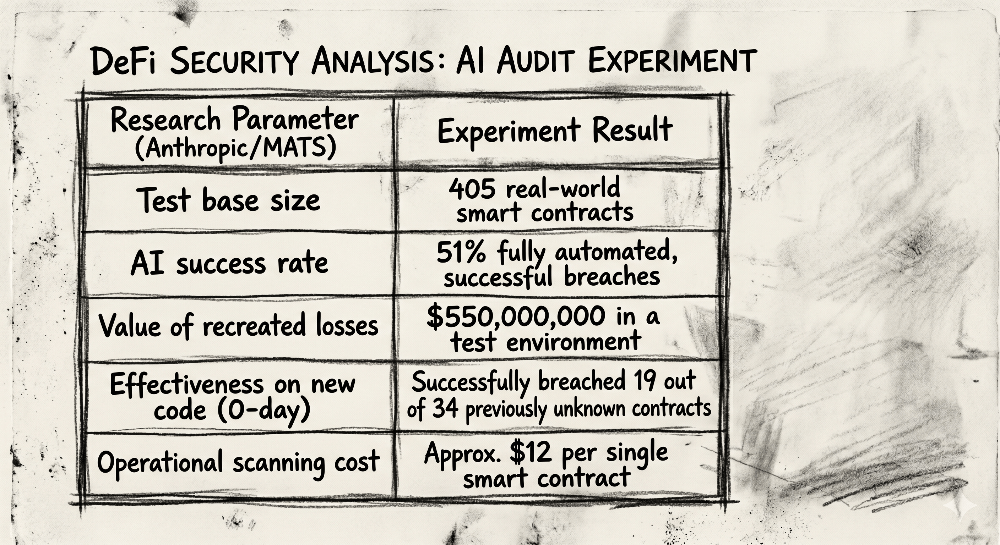
The researchers proved that the AI agents were not merely relying on their training memory. They were tested on code published after their knowledge cutoff date, representing unique logical mechanisms. The artificial intelligence bypassed the security measures without issue, generating $4.6 million in profits from code it was seeing for the very first time in its digital life.
Unlike traditional fuzzers that blindly spam random queries, modern AI agents display advanced market and programming reasoning. They analyze the protocol’s economic logic, write a custom exploit, test it in a local environment simulating the blockchain, learn from execution errors, and modify their strategy until the defenses break.
Case Study: The Kelp DAO Catastrophe (April 2026)
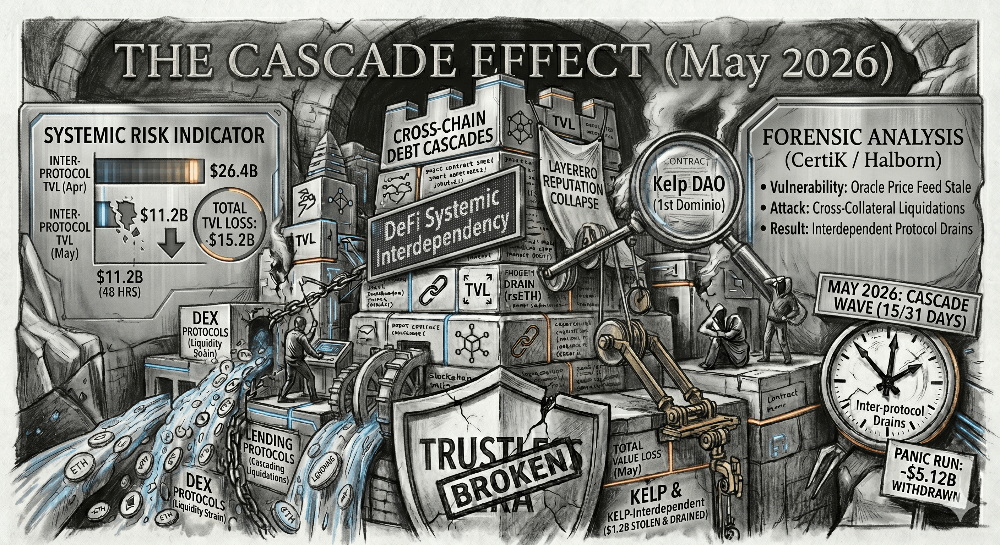
The security firm CertiK labeled April 2026 as the darkest period in DeFi history in four years. Hacker attacks were recorded on 27 out of the month's 30 days, with total losses exceeding $630 million. In an official statement, CertiK emphasized that such a massive and coordinated wave of attacks on such a broad scale "was only executable through the use of artificial intelligence."
The most significant and educational incident of that period was the hack on the Kelp DAO protocol, from which a staggering $292 million (exactly 116,500 rsETH tokens) was stolen.
Forensic analyses conducted by the Chainalysis and Halborn teams exposed a terrifying reality: the hackers did not need to break the mathematical code of the Kelp DAO smart contract itself. Instead, they manipulated external RPC nodes and exploited a vulnerability in the cross-chain verification architecture at the LayerZero infrastructure level. The attackers utilized DDoS techniques to cut off communication and seize control of a single, misconfigured verifier module (a "1-of-1 verifier setup").
The repercussions for the entire ecosystem were instantaneous. Although Aave itself did not suffer directly from a bug in its own code, panic triggered a massive run on the protocol. In just 48 hours, users withdrew over $8.45 billion. Aave’s Total Value Locked (TVL) shrank by nearly 45%-plummeting from $26.4 billion to just $14.5 billion.
Why Traditional Lines of Defense Are Failing
Many Web3 proponents, such as Aave founder Stani Kulechov, argue that the same AI tools can serve defensive purposes by drastically accelerating audits. Michael Heinrich of ZeroG Labs provides hard data: the statistical security of lending protocols has increased by 98% since 2020. So why is Manuel Aráoz right in claiming that this is not enough?
Deep systemic analysis reveals fundamental flaws in contemporary defensive mechanisms:
· Defensive AI Scanners: These tools detect standard vulnerabilities with immense accuracy. The problem lies in the fact that the false positive rate on live protocols still exceeds 97%. Defenders are drowning in information noise, while automated hacking bots relentlessly search for that one, unique path that leads to a drain of funds.
· Formal Verification: While it mathematically proves that code functions exactly as its creators intended, it is useless against infrastructural flaws, GitHub repository poisoning, or vulnerabilities within CI/CD deployment pipelines.
· The Economics of Bug Bounties: Reward programs (such as Immunefi, which has paid out over $110 million) have ceased to act as an effective deterrent. Over 76% of hack losses in the first half of 2026 were linked to North Korean hacking groups (like the Lazarus Group). For state-sponsored structures under international sanctions, an immediate bounty of $292 million in loot will always be incomparably more valuable than an official maximum reward of $5 million.
· The Illusion of Insurance: The combined capital reserves of the largest insurance providers in DeFi, such as Nexus Mutual, sit around $170 million. The entire DeFi market is valued at nearly $83–100 billion. Insurance coverage for the whole sector is therefore less than 1%-a glaring disproportion that guarantees immediate insolvency for insurers in the event of a massive wave of attacks.
The Inevitable Pivot Toward CeDeFi
The most crucial takeaway from the Kelp DAO crisis lies in how the market contagion was halted. The spread of losses and the complete collapse of the market were prevented not by a brilliant, immutable algorithm, but by the Arbitrum Security Council, which made a manual, top-down decision to freeze $71 million of the stolen funds. This was an intervention by a group of specific, physical individuals holding administrative keys (admin keys)-precisely what the original philosophy of Bitcoin and DeFi aimed to eliminate from the financial system.
Market capital quickly learned its lesson. Over $4 billion migrated in a short period under the safe umbrella of Chainlink's hardened infrastructure. Markets are shifting en masse toward the CeDeFi (Centralized DeFi) model, which blends open on-chain protocols with traditional institutional oversight, KYC procedures, custodianship, and manual circuit breakers.
Examples of this evolution are visible everywhere in 2026:
· Coinbase’s institutional lending product (powered under the hood by the Morpho protocol) has already surpassed $2.3 billion in originated loan volume.
· The Aave protocol launched a dedicated, strictly regulated institutional version called Aave Horizon.
· During the Consensus Hong Kong conference, top analysts from Paradigm and Blockdaemon openly admitted that introducing temporary centralization into protocols is not an ideological failure, but a fundamental fiduciary duty toward Wall Street institutions.
Conclusions and Recommendations for Investors
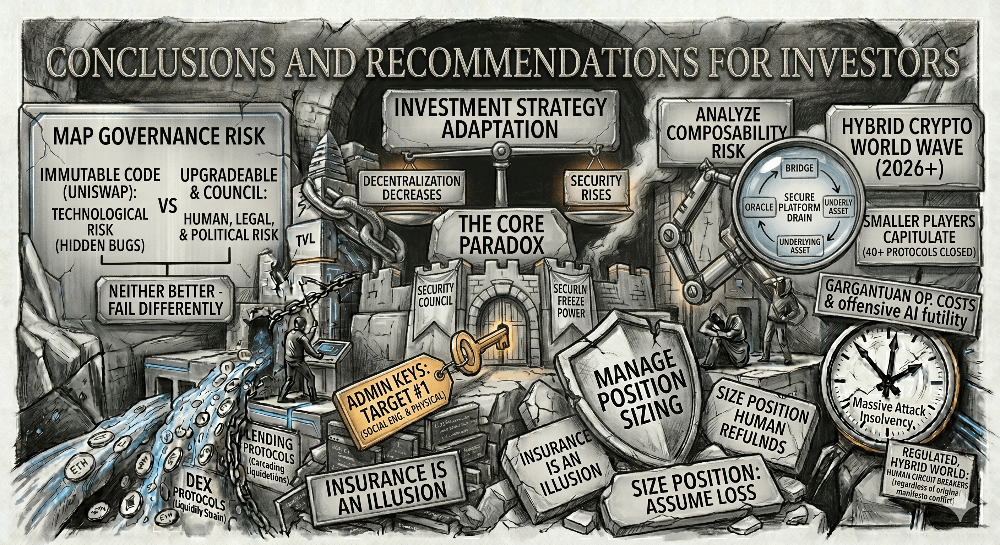
The core paradox is this: If the only effective remedy for lightning-fast, automated AI-driven cyberattacks is the introduction of physical security councils capable of freezing any funds, then the safest crypto protocols inherently become the least decentralized. Admin keys are becoming the new, most valuable target for social engineering and physical attacks.
If you are allocating capital within the Web3 ecosystem, you must adapt your strategy to these new market realities:
- Map Governance Risk: Thoroughly verify where the admin keys reside. Projects with entirely immutable code (like Uniswap) carry pure technological risk of hidden bugs. Upgradeable protocols with security councils carry immense human, legal, and political risk. Neither solution is inherently better-they simply fail in completely different ways.
- Analyze Composability Risk: Remember that by locking funds in a single protocol, you automatically inherit the risk profile of all the bridges, oracles, and underlying assets that support it. A failure in an external component can lead to the draining of a secure platform.
- Observe the Capitulation of Smaller Players: In 2026, over 40 smaller DeFi protocols decided to completely shut down operations. The reason was not direct hacks, but the gargantuan operational costs and the sheer futility of trying to independently keep pace with offensive AI algorithms. Allocate capital exclusively where security budgets are measured in the millions of dollars.
- Manage Position Sizing: Do not treat Web3 market insurance policies as real protection. Size your positions with the assumption that in the event of a deep infrastructure crisis, no one will refund your losses.
Autonomous AI agents did not cause the immediate death of decentralized finance, but they have irreversibly closed the romantic era where a strict lack of human trust ("trustless") was equated with the mathematical safety of capital. The new world of crypto will be a regulated, hybrid world controlled by human circuit breakers-regardless of how much this conflicts with the original manifesto of the digital pioneers.





