
The crypto market, once created with the vision of full decentralization and a total lack of top-down control, is undergoing the deepest transformation in its history. Tightening regulatory loops in the US, the entry of top-level politicians into the arena, massive pressure from the artificial intelligence (AI) sector, and cybersecurity threats mean that crypto as we know it is slowly becoming history.

Market Situation: The Long Shadow of a Slowdown and the Calm Before the Storm
Digital asset market analysts have no doubt—the current market structure is not a sudden, single crash, but a grueling, months-long decline in liquidity:
· Bitcoin (BTC) remains bounded in the $62,000–$65,000 range (currently around $64,000). While still a high valuation for many, looking at the chart more broadly reveals a severely exhausted market. From its peak of $114,000 in September 2025 to its June low of $58,000, the market has consistently lost momentum.
· Ethereum (ETH) is hovering around $1,900, Solana (SOL) is holding at $75, and XRP has dropped below the psychological $1 threshold to approximately $0.99.
Three key indicators point to a dangerous market dynamic:
· Institutional Capital Flight: US spot Bitcoin funds saw over $390 million in outflows in a single week, ending a prolonged streak of inflows.
· Financial Leverage: Open Interest on futures contracts exceeds $48 billion. Paired with thin liquidity, this poses a risk of massive, cascading liquidations in either direction.
· Low Implied Volatility: The options market is pricing in inactivity, which in technical analysis (e.g., according to FXPro) signals an impending sharp breakout—a classic "calm before the storm."
Against this backdrop, only Solana stands out, attracting direct capital inflows shifting away from Bitcoin.
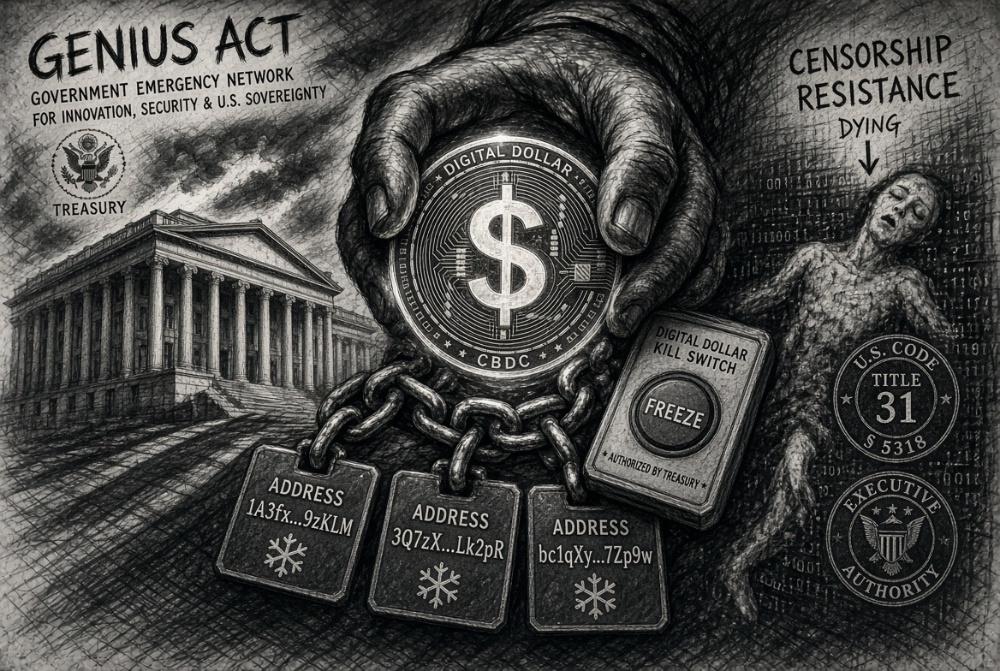
The GENIUS Act and the "Kill Switch" in the Digital Dollar
The US Department of the Treasury issued a Notice of Proposed Rulemaking for Section 3 of the landmark GENIUS Act Regulations on Payment Stablecoin Issuance. Industry outlets emphasize that this legislation is entering a critical implementation phase.
Implementation Timeline:
- 60 days from publication (October): Conclusion of public consultations and feedback submissions.
- January 18, 2027: Mandatory federal or state licensing takes effect for any entity issuing "payment stablecoins" within the US.
- July 18, 2028: Crypto exchanges and brokers will be prohibited from offering unauthorized, unlicensed stablecoins to US clients.
The most critical and controversial change, however, lies in the underlying technology. The new legal framework mandates that digital dollar issuers possess the technical capability to remotely freeze and block addresses at the request of law enforcement. Treasury Secretary Scott Bessent argues this will solidify the dollar's position as the world's reserve currency, but for the crypto market, it marks the end of censorship resistance. In Europe, similar rules have already been operating under the MiCA framework since 2024.
The Political-Financial Empire: Controversies Surrounding World Liberty Financial
The primary political and business event of recent days is the preliminary conditional approval granted by the US Office of the Comptroller of the Currency (OCC) for the creation of World Liberty Trust Company.
The new entity (a de novo national trust bank) will issue and manage reserves for the USD1 stablecoin, whose market capitalization has already exceeded $4 billion.
Web of Connections and Conflicts of Interest:
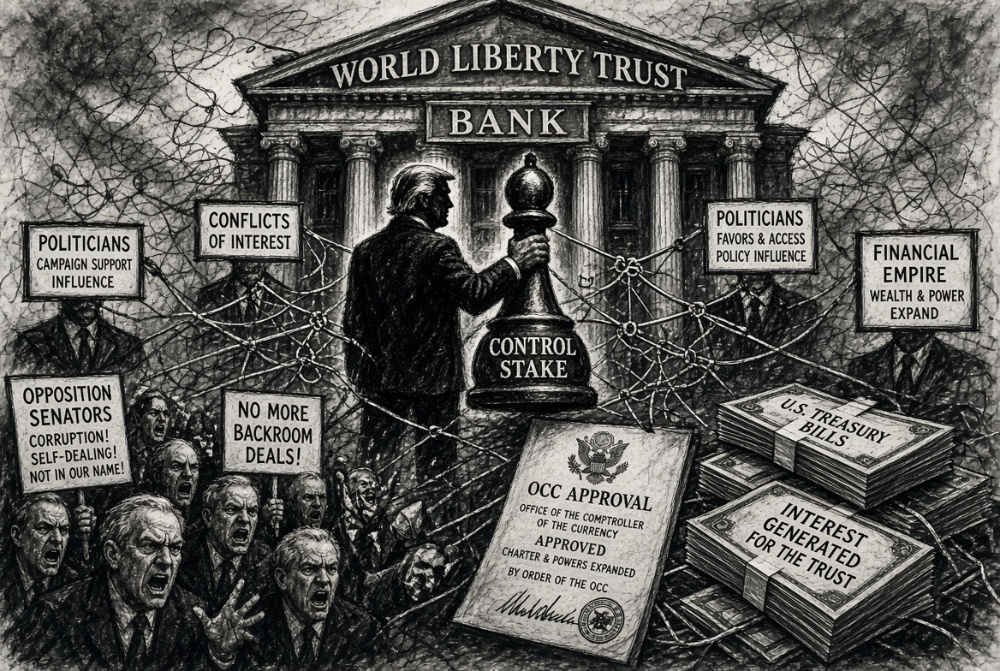
- An entity affiliated with Donald Trump and his family holds a 38% stake in the parent company, World Liberty Financial.
- The head of the OCC issuing the approval is Jonathan Gold—a direct appointee of the President.
- The approval itself relies on provisions of legislation previously signed into law by Donald Trump.
- Reserve management (invested primarily in US Treasury bills) yields massive interest income on $4 billion—worth hundreds of millions of dollars annually—flowing to a private-political entity.
Opposition lawmakers are outraged. Senator Elizabeth Warren, alongside eight other senators, introduced the Ending Presidential Corruption in Banking Act, noting that this is the first time in US history a sitting president is overseeing and co-creating his own bank. The political battle over this issue has stalled Senate progress on the Clarity Act, which aims to divide regulatory powers between the SEC and CFTC—drastically reducing its chances of passage, according to Alex Thorn of Galaxy Research.
The Miner Exodus: AI Wins the Fight for Cheap Energy
Fundamental shifts are taking place deep within Bitcoin's infrastructure. Publicly traded mining companies have reduced their computing power (hashrate) by 21% over three quarters.
The driver is brutal economic reality. Both a Bitcoin mine and a data center used for training AI models require the exact same resources: massive facilities and access to the cheapest electricity available.
At current Bitcoin prices and following the recent halving, crypto mining margins have squeezed to razor-thin levels. Conversely, AI giants command virtually unlimited capital and patient investors, enabling them to outbid miners for megawatt energy contracts.
Miners are pivoting their hardware infrastructure away from crypto mining and toward leasing computational capacity to the artificial intelligence sector. Symbolizing this shift is Erik Voorhees (founder of ShapeShift), whose new AI platform, Venice, has surpassed $100 million in annual revenue.
An $11 Billion Bet: The "Alchemy of 5%" Strategy
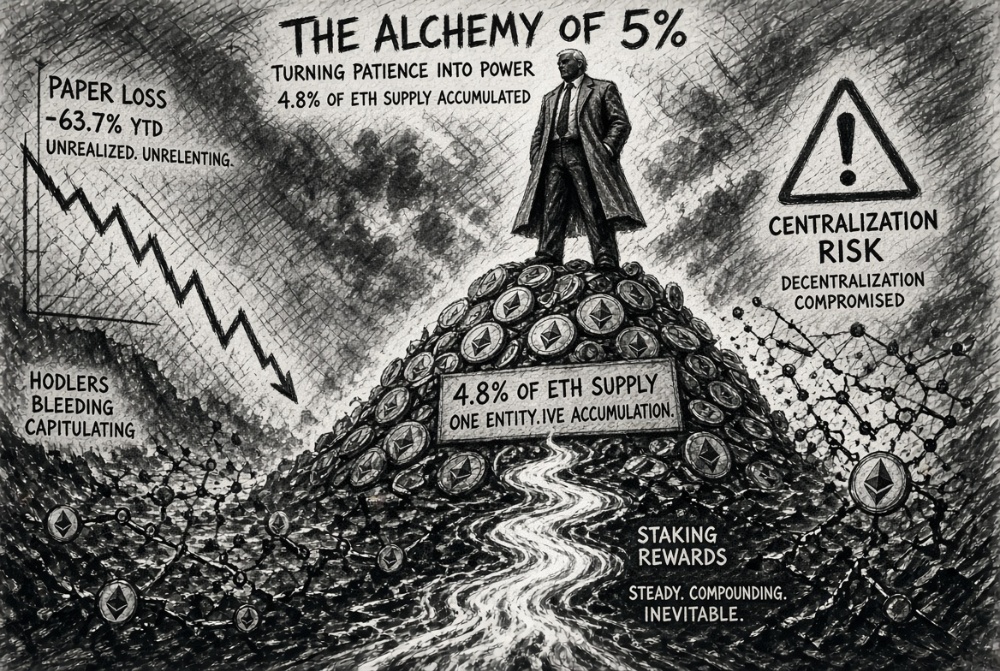
Concurrently, one of the most aggressive accumulation efforts in digital asset history is unfolding in the Ethereum market. Bitmine Immersion Technologies, managed by well-known Wall Street analyst Tom Lee, is executing an ETH accumulation strategy dubbed The Alchemy of 5%.
According to recent company reports published via Morningstar / PR Newswire and TradingView:
- Position Scale: Bitmine holds over 5.82 million ETH.
- Dominance: This reserve accounts for a staggering 4.8% of Ethereum's total circulating supply.
- Paper Losses: Due to ETH dropping from over $4,100 to roughly $1,900, the company's unrealized portfolio loss stands at a massive $8.4 billion (over 43%).
- Funding Source: Despite negative market performance, the company continues its purchases—over 87% of its tokens (around 5.07 million ETH) have been staked. This generates a stable passive yield of approximately $287 million annually for the firm.
However, this situation raises serious centralization concerns: a network designed for dispersion will soon see 5% of its entire supply held by a single public corporation directed by one individual.
Summary
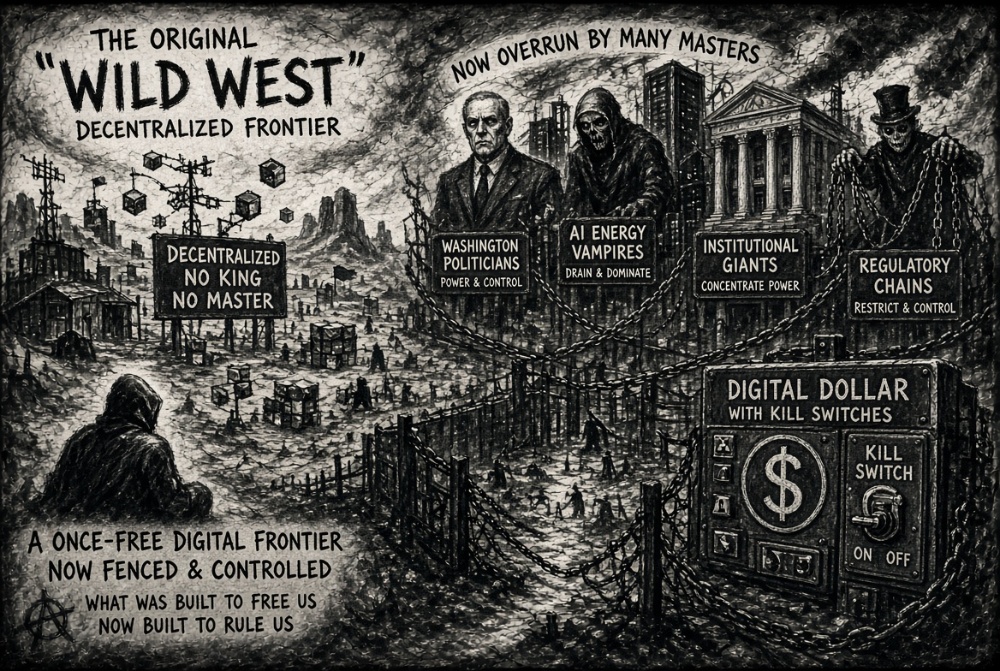
The landscape of the cryptocurrency market has changed dramatically. It is no longer a digital "Wild West" governed solely by independent code and free from government influence. Today's crypto market is shaped by decisions out of Washington, political conflicts of interest surrounding the digital dollar, the power-hungry demand of AI server farms, and massive capital concentration among a handful of institutional giants. A market originally designed to have no master now finds itself with far too many.








