
I’ve been trading using Bollinger bands for a long time. I started this with regular shares, then applied what I learnt to forex trades, and now am using it with crypto. Regular markets are very slow to move, and forex was too fast (especially with high leverage) so I find crypto to be a happy middle ground.
Trading cryptocurrencies is a wild ride, and over the years, I’ve found Bollinger Bands to be one of my most reliable tools for navigating the volatility. Developed by John Bollinger in the 80s, these bands help me identify not just price trends, but also when the market is primed for a big move or a reversal. Here’s how I use Bollinger Bands in my crypto trading strategy.
Understanding Bollinger Bands
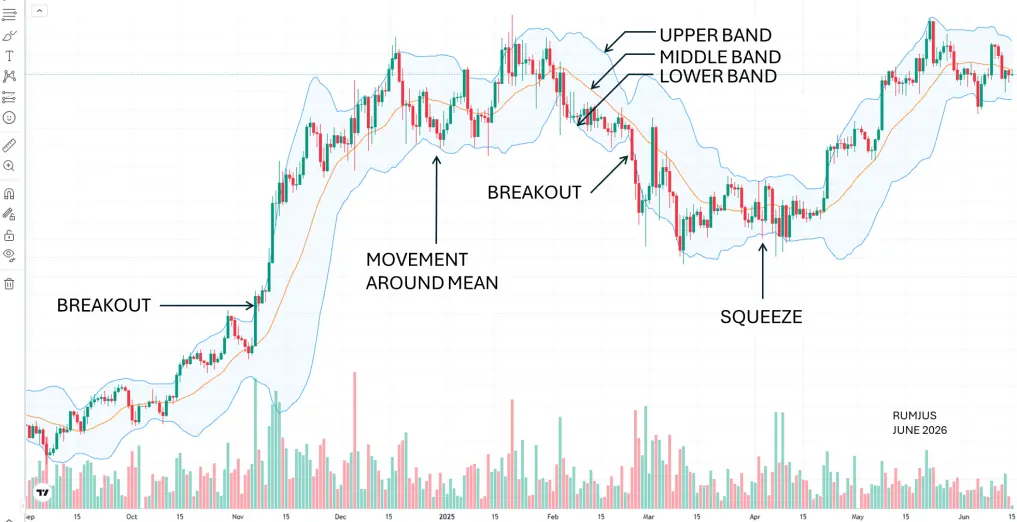
Bollinger Bands diagram showing middle, upper and lower bands, squeeze and breakout
Bollinger Bands consist of three lines plotted on a price chart:
- Middle Band: A simple moving average (usually a 20-period SMA)
- Upper Band: Two standard deviations above the middle band
- Lower Band: Two standard deviations below the middle band
These bands expand and contract based on market volatility. When the bands are wide, volatility is high; when they’re narrow, volatility is low, and a breakout could be imminent.
My three Bollinger Band Strategies in Crypto
Bollinger Bounce (Mean Reversion)
The idea is simple: buy when the price touches or dips below the lower band (oversold), and sell when it touches or rises above the upper band (overbought). This works in times when the price is fairly steady. However, I’ve learned the hard way that this strategy can fail during strong trends. If the bands are flat or nearly parallel, it’s a good sign the market isn’t trending, and the bounce strategy is likely to work.
How I do it:
- Buy: Price touches or crosses below the lower band and starts to move back up.
- Sell: Price touches or crosses above the upper band and starts to move back down.
- Confirmation: I always look for a bullish or bearish candlestick pattern for extra confirmation before entering a trade
Bollinger Breakout (Squeeze)
When the bands squeeze together, it signals low volatility—a sign that a big move is coming. This is my favorite setup for catching breakouts in crypto, which can be explosive
How I do it:
- Identify the Squeeze: The bands become very narrower
- Wait for the Breakout: Watch for a candle that closes outside the upper or lower band. Ideally the body of the candle should be crossing the Bollinger band.
- Enter the Trade:
- Long: If the price breaks above the upper band.
- Short: If the price breaks below the lower band. (lots of places won’t allow you to short, but you can sell if you have and buy back later_
- Stop Loss: I place my stop loss (this is subjective and based on my personal risk tolerance and will vary for you).
- Profit Target: Again this is subjective, but I usually want to double the profits.
Trend Identification
Bollinger Bands also help me spot the trend. If the price is consistently hugging the upper band, the trend is up. If it’s hugging the lower band, the trend is downwards.
Combining Bollinger Bands with Other Indicators
To reduce false signals, I combine Bollinger Bands with my two other favourite indicators the Relative Strength Index (RSI) and MACD. Looking at the volumes though is a must no matter what indicators you are using.
- RSI: If the price is at the lower band and RSI is below 30 (oversold), it’s a stronger buy signal.
- MACD: If MACD is above its signal line and the price is at the lower band, it’s a good time to consider a long position
Always bear in mind the crypto markets are notorious for sudden moves. Always set stop-loss orders and stick to risk-reward ratios. Never risk more than a small percentage of my capital on any single trade. Also, make sure you can afford to lose 100% of the trade without being pushed out into the elements. You may have won the previous 5 trades but that doesn’t mean the strategy won’t fail at times.
Summary
Bollinger Bands are one of my crypto trading indicators. They help me identify volatility, spot trends, and find high-probability entry and exit points. I use Bollinger Bands in combination with other tools and keep my risk management tight.
Rumjus June 2025





