
Why I write.
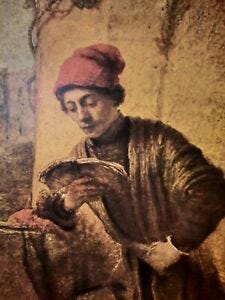
A portion of the picture ‘the student’ a pseudo Rembrandt.
First of all, to simplify this complex question to a stranger, I’ll start by clearing away some debris, the common motives that many people will suspect, because these are the spurs and dreams that cause the lucky few, born with good minds and educations, rich imaginations or strong passions and agendas to put pen to paper and display themselves.
I don’t write for money. I’m fairly well off after a life of work in the electrical trade, a construction field that required skill and concentration, working with my hands and satisfying me to my core because I was good at it (everyone likes to do what they're good at, because it's praised by others and self-pleasing). It combined manual skill and thinking, healthy for body and mind, not overtaxing any one part, like bricklayers or roofers who lose their backs and arms in twenty years, or dull and repetitive, (like many parts of construction, filled only by those who barely finish high school). It's a trade that has some unique qualities that constantly employ both the mind and eye. When working on live systems, a mistake will get you a shock, possibly mortal. But most work above the residential level, in commercial and industrial buildings, where I spent nine-tenths of my career, involved getting power from point 'A' to point 'B' with obstructions of all sorts in between. Such details are not on prints, so it's up to the electrician to devise the best route, which is always the shortest and the most versatile for future expansion, branch circuits, and most pleasing to the eye wherever visible i.e. not buried in slabs or walls. Much of this work involves bending conduit, which is an art, especially with hand benders. The speed, economy and looks of the result is apparent to your client and company, conduits in beautiful arrays of parallel runs streaming across walls and ceilings, then fanning out to their destinations, visible to all who enter these commercial and industrial facilities for the next fifty years. I was good at it and constantly improved. I learned tricks and techniques in my fifties even. They would come to mind in a flash one day and I wondered why I'd never realized them twenty years earlier. So, just as with writing, it's an art that can be constantly improved by those few who constantly think.
The best thing about it is that it's a mistress who never lies. It's a dumb, cold piece of metal, and when smoothly shaped and installed and beautifully matches the contours of its surroundings, no one, however powerful, can tell you it was not well done. It speaks for itself, like the lines of an early Mustang. No one can tell you it's ugly or diminish your pride of workmanship. But that's rare. I most often won praises from early on. So I enjoyed that career and now this one, even more complex in subtleties and possibilities.
But I’m not looking for praise or fame, (‘the last infirmity of noble mind’ as Milton phrased it). I'm just trying my hand in this arena, and so far I haven't made a dollar. But I do gain inward satisfaction and personal insight and an endless occupation I enjoy, rare among retirees.
I think that would be bothersome, fame, plagued by notices and requests, the same with too much wealth. I’m old and I treasure solitude and quiet.
But I love good literature and it's inspired me to try at this art and emulate those I admire (or at least come close enough to inspire others to this attempt), to write elegantly, with clarity of meaning and clear reasoning, to convey complex feelings and ideas in the most succinct words, and, as one of the greatest authors once said: “to elevate us in the dignity of a thinking being”.
Another once said that a great poem is ‘a miracle of condensation’. That applies equally to prose.
I was blessed to attend the University of Berkeley in its heyday, the early seventies. I had no agenda, so I floated through English literature and French and Latin and Greek, and soon half the books I read then were no part of any course I took. They were books praised by the authors I loved. I often read ten hours a day, over many years, all the best from the earliest classics on. I went to Toronto for a graduate degree. But they didn’t offer the great Renaissance authors I was fascinated by.
So I quit academia forever, wandered with a backpack full of old student editions of classics, filled my pockets with them, and without money or purpose, led the most random life, often in the slums for lack of a job or money.
This reading odyssey lasted ten years. I kept gravitating back to Berkeley and my friends there. I began a career as an electrical apprentice at twenty eight. But even then my reading only slowed in pace. My work was a distraction and never full-time. I kept up old acquaintances and shady ventures and an acquired taste for dangers and risks, through another three years, until I met the woman who tamed me, so to speak, to start a family, after many disastrous love affairs. Then again, even that turned into a disaster after ten years, on a Caribbean island.
I was far more fortunate in male friendships then with women. Few could gauge my intellectual talents. They could see my love of Classics but they didn't understand or share it, the passion of my life, greater than my regard for them.
Who reads great books? I'm not talking bestsellers but Euripides and Tacitus. Like Petrarch, I'd jump into a fire to retrieve a rare volume. At least my male friends loved to listen, when I occasionally went off on a late-night, drug-fuelled effusion.
I’ve written about those years of innocent youth and adventures from the numerous journals I kept, a dreamer in a dangerous land, naive but with a purity of character others saw. I walked unharmed, barefoot over the glowing coals, taken into partnerships with many that society labels 'criminals'.
I know this story is unique because I was such an anomaly. All my companions at school parleyed their degrees into lucrative jobs, while I played the hobo and bohemian poet, a walking encyclopedia in rags. My vocabulary comprised twenty thousand words among many who could barely command three thousand. But I was humble by nature, never arrogant, and they appreciated my respect for them as equals, my company in the same jungle, and our fortunes tied together.
I was lucky in averting a hundred scars and pitfalls, a few bullets too, in part earned by my wits in dangerous situations. And it took me from the worst slums to a good deal of wealth, because I befriended someone no one else would go near. But I saw talent and even genius in him. Even my ghetto friends thought me crazy. But I escaped unscathed in that year and a half with enough money to last me another ten. I also knew when to quit. Most of my other associates kept going till they fell to drug abuse or arrest, while I was in Paris with my future wife. I was fluent in French and French culture.
Our friendships were always mutual. In their characters and quirks, even in the most abused and crippled by fate, I found fleeting moments of grace and nobility, in prostitutes and drug addicts, soon to die before thirty. I recorded such glimpses into their minds and the sordid realities they had to deal with every hour, in many journals, scribbled late at night. I rewrote their stories and my own in what follows.
There’s a deep well of humanity in the vast majority of us, unlettered, coarse, crippled in part by poverty and misfortune. It seems dried up, but surfaces like a fountain when it unexpectedly meets another with kind words and respect and the simple acknowledgement that we are all the same flesh and heart, and spirit.
There is a far higher goal in preserving a record of one's life and friends, than 'entertainment'. We all die and are forgotten, sooner or later, in the sands of time. The common man or woman tread their paths, part happy, part sad, into old age and death. They are remembered by their children vividly, by the stories and lessons they teach, by word or example, the young ones in their lap looking up in wonder, all ears. The older ones looking down at character flaws.
But they'll be remembered by their grandchildren through a smoked lens, from hearsay and the imperfect recollections of early childhood, in the fog of 'long ago'.
To their great-grandchildren they'll be only names, myths so blurred as not worth repeating to their children. So they'll be forgotten, permanently.
I calculate this span to be forty to sixty years after one dies. I'm not happy in this digitized age of terabyte storage the size of a pack of cigarettes and almost as common, or trillion terabyte clouds everywhere, with this short span. So I'll defy it with this record, as complete a picture of my life as I can, and throw it into the winds of the internet.
Most likely it will be buried like a single straw in a haystack. But a few may notice some qualities that strike them and remember and preserve the image in parts. I will have beaten time and mocked the common grave. Who could hope for more?
In one of my few poems, "The Mantel" I mention an artist who carves a horse from a piece of wood with infinite care to every detail. The reason for his painstaking effort is the same as mine composing these memoirs:
"The dusty vessel where some spirit spilled
That would not happily be sunk in clay".






