
The island’s people produced nothing. The place was a crack sewer, projects and slums while the empty mansions of the former white residents dotted the hillsides around Christiansted. In the fifties and sixties it was an island paradise. John Wayne and Maureen O'Hara had a beautiful mansion there. But when cocaine and then crack hit the streets in the mid-nineteen eighties it was as if a plague had struck the populace. Their attitude changed towards the white visitors that brought money to the island. It turned ugly and resentful. Tourism shrank every year. There were blatant murders of some of the white inhabitants by blacks that went unpunished. Three blacks shot and killed two older white golfers on a golf course in broad daylight and each of them were released from prison in two years, boasting of their deed to their fellow islanders after release, considered heroes. A white family visiting and sunning themselves on a remote beach on the south-west end of the thirty mile long island were attacked for no reason but racial hatred by a group with manchettes, the man and the two young children were butchered. The woman saved her life, what was left of it, by swimming far out to sea, until the blacks (most of whom can't swim) got tired of standing on the beach watching her and went home. They were never pursued by the law there or caught, though everyone knew who they were.
These crimes happened before we arrived. We didn't know what we were walking into but soon found out. The numbers tell the story. I'm not making this up. St. Thomas, twenty miles away, still maintained a tourist industry in Charlotte Amalie and received over a thousand luxury tour ships a year. It was a port of call for most Caribbean cruise tours. St Croix on the other hand received two or three cruise ships a year, in part because the only long wharf that could dock them happened to be on the west end in Frederiksted, one of the worst ghettoes on the island. Most of the whites were leaving in droves, for good. But there were two companies, Hess Oil and Vialco, the Virgin island aluminum company, that needed a few hundred white technicians and operators to run their huge, profitable facilities. The blacks were all on welfare, or worked for their government, doing next to nothing. The older ones sat on their porches each day, drinking rum. The younger ones smoked crack.
These two companies were situated in that unlikely place because there were no pollution laws there. The wind always blew west, or at least three hundred and sixty four days a year. The nearest landmass west was Jamaica, three hundred miles away and far enough for any smog to dissipate well before reaching it. So Hess Oil saved millions, belching out black smoke, and Vialco could ship in and pile up mountains of white bauxite powder right on the shore, to feed its processors. This powder was dangerous to breathe and the one day a year the wind did shift direction the schools inland were all closed and emptied, no big problem, with so many millions saved in complicated storage facilities if anywhere else.
One thing about these plant jobs, the white workers there were qualified journeymen but mostly what one would call ‘white trash’. We were paid every Friday afternoon by check. Right outside the gate was a large, black man and another beside him holding a shotgun, standing by their station wagon, with a box full of money in the open trunk. They would cash our checks for a two percent fee, and almost everyone lined up to do so. A hundred yards past this car were a few other parked cars, manned by Puerto Ricans. They made up five percent of the population and controlled most of the drug trade on the small island. From them you could buy heroin, cocaine, crack, or pot, at very reasonable rates, all uncut, as drugs were so easy to sneak into the islands, straight from Mexico or Columbia. The police there were all black and either didn't care or received kick-backs. No one was ever arrested for dugs, unless you were white.
I would guess, (an educated guess, from firsthand experience) that all drugs were at least four times cheaper and five times purer than anything in the states. After that stop, another quarter mile down the road stood two large bars/strip joints. Many a paycheck never made it past those obstacles and many a worker came home to his grieving (or screaming) wife at four a.m. with fifty dollars left in his pocket, a half empty bag of powder and a wicked headache.
Most of these boys didn’t have girlfriends, just stripper/hooker acquaintances, a cheap motel room and junk car. They were married to their crack habit, sat in their empty rooms each Friday night, door locked, smoking it. I met many such co-workers. Some were intelligent, decent guys during the week at work. A few were rescued by friends, put on a plane and sent back to the States. Others simply rotted away there over the years. I met two, (one of whom I worked with for a month), both, by coincidence named ‘Norman’, (not the one I worked with at first) who were killed there, shot and thrown in a jungle ditch for drug debts during our fourteen month stay on the island.
You might think this a pretty depressing situation which I’d want to escape. But Sanita and I made a little enclave of friends and lived and socialized in a sort of ‘bubble’. The beaches were beautiful. She had seven or eight girlfriends, half with children Willy’s age, and they could sunbathe and talk all day long, everyday. We had a great bar on the West end called ‘the Green Flash’ on another fine beach, catering to whites with great bands every Friday night.
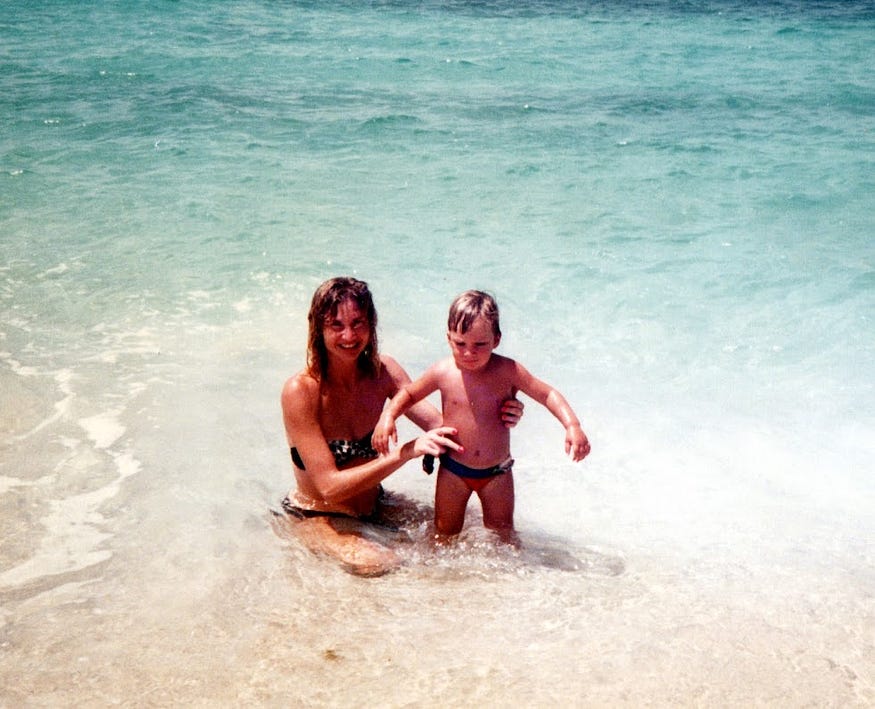
the beach a hundred feet from our house. where Willy learned to swim.
Just down the street from our free residence Sanita discovered an excellent Montessori school, run by a middle-aged black woman, heavy-set but wise and very competent, (contradicting some of my earlier statements) where we quickly enrolled Will, his first school. It was far better run than the one we found for him in Seattle, as he’d come home after the half-day full of talk and excitement for the things he’d learned, unlike the bored and silent look on his face at the Seattle school. After talking with a few of those teachers, compared to the black woman, I realized it was little better than a day-care center, a Montessori school in name only, and twice as expensive.
I also lived in a bubble with my own set of friends, at work and at play. I liked my jobs and my companions, Vance, his brother Bobby, Gary upstairs, even Norman at first, till our fallout. And a few months later we were friends again, meeting at Marjorie’s and he apologizing. None of us, (except Norman) were drug addicts, though surrounded by them. Vance and I would do the occasional line, so would Gary. But we all despised crack. Sanita tried it once, upstairs with Judy and Gary and me, the four of us enticed by a real crackhead into buying and trying a rock. He, of course, toked first and smoked most of it. None of us felt any real thrills with the left-overs. She would get drunk maybe once a month with her girlfriends, (the full moon syndrome). Other than that she was abstinent, cooked healthy meals, was level-headed in household matters, exercised with daily swims, teaching Will along side her. We had barbecues on weekends and threw a few parties in our large yard.
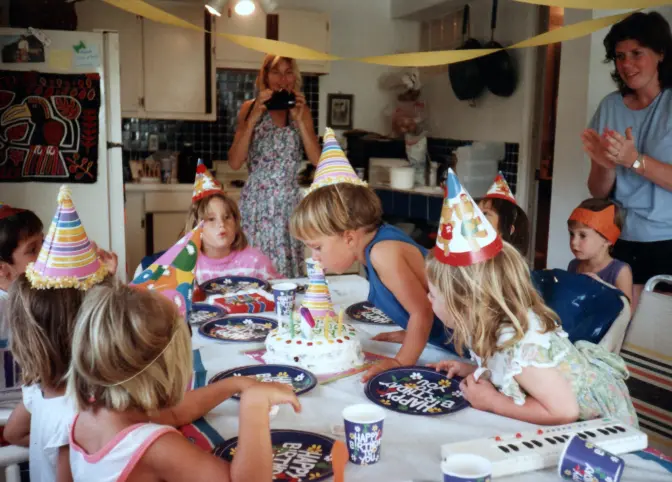
Will's birthday in our kitchen, 1990.
One Friday, feeling very sick at work, I came home at noon. The Saturday night before we’d thrown one of our big parties, with a bonfire and maybe thirty guests. When I stepped in the door I saw Sanita standing with an Australian fellow in the kitchen and talking away. I recognized him from the party. He beat a hasty retreat. She told me he’d just dropped by a few minutes earlier. But it put suspicions in my head, bringing other strange instances to mind, like a night a month earlier and another smaller party where Sanita and her friend Judy disappeared in the car and didn’t come home till dawn. Such is marriage. Vance had the same problem with his wife, whom he caught in several acts of infidelity. I can honestly and proudly say that I was never unfaithful to her, though I was tempted more than once, with obvious hints in discreet places, by alluring women who liked me for my personality or knew I had money.
Will was in paradise, swimming everyday in the ocean. A half-dozen of my workmates had wives with children his age. They’d congregate and sunbathe all day on some beach, watching the children play. The only jobs there for a white woman were in a bar or restaurant, behind the counter or stripping, always around drugs and propositions, big tips and one-night flings. Most of the single men on the island were drifters, temporarily landed there by some wrong turn and bad luck, soon to leave when they came to their senses, unless serious drug addiction set in. They had no time for children, no stability, and were a far different set than our group.
But after fourteen months on the island I saw it was time to leave. Sanita agreed. Will was now four and we didn’t want him to see the racial hatred, the trash everywhere, the ghetto aspects of the place. After dusk, on the streets of Christiansted, blacks would walk right up to us and hold out sugar cube sized pieces of crack and insist we buy them. We’d have to shove them away to get by. Other times one would shout out: “Whitey, get off my island.” The streets were unsafe for anyone alone. We traveled in groups at all times. This was no environment for a white child to grow up in. We talked about this with Gary and his wife Judy. They agreed and left when we did, back to the States.
Gary had one incident a few weeks earlier which precipitated our departure. He bought a horse from some native for a few hundred dollars, a bargain, he thought, which he tied to a stake with a long rope in our large yard. He could ride well and wanted to teach his wife and children. The brief lessons lasted a few days. Then the horse disappeared while we were at work, the women on the beach. He drove around the neighborhood that evening and saw the horse tied up in a projects less than a mile away. So he went to the police and explained the situation. They did nothing. He went back to the station a few days later to enquire why. They told him that if he ever came back again, he’d be arrested and thrown in the cell right behind them, for an unknown length of time, as a troublemaker. So he gave up on the system. He did think of stealing the horse back but figured it would only lead to more serious crimes and danger to his family. We were the distinct minority there, the only place I ever felt so, and the only place I always advised every traveler to avoid at all costs, once back in the States.






