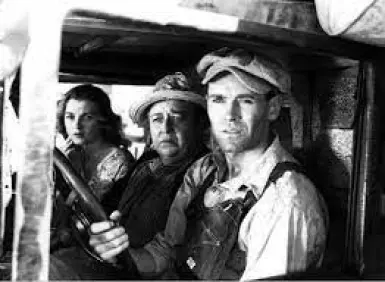
The Grapes of Wrath, numerocinqumagazine.com
Naomi had made contact with Australia, with some official in Sydney, delighted to hear from California. She had Jason inform Sacramento, but they couldn’t catch the signal so we acted as a relay station. The news for the governor was that Australia had escaped the war, so far unharmed, except for its computer network. The fleets had been recalled. The American ships in the Pacific were heading back to Hawaii or the west coast at full speed. But we were told that they were driving blind, as far as technology went. More than ninety percent of the satellites in the sky were dead after passing through the radiation belts caused by the upper atmosphere explosions. All directional systems, all computer systems were down, the world around. Ships were now navigating by compasses and sextants and paper maps but fully confident they would make it to their home ports. That way of sailing was not completely forgotten.
Once again ‘Roland house’ had come through with critical information for the governor, who seemed to be vying with military officials over who exactly was in charge of this dire situation. Earlier in the day, Charlie had tapped into a low-frequency Army band. A general was issuing orders that operation ‘Babel’ was going into effect, that civilians would all be assigned locations and that ‘blue’ and ‘green’ zones would be set up within the next few days.
When Charlie mentioned this intercepted transmission earlier, it didn’t raise any alarm bells. But as my mind chipped away, so to speak, at a wall of vague words and the possible meanings behind them, all in a flash I realized that they, the military, intended to protect and relocate the useful citizens and that the rest would be cordoned off into one big pit of their fellow rabid, starving, human castaways.
I immediately contacted the governor’s office with this news. Within an hour I was talking to him. He thanked me again for all the intelligence but told me that in this fluid situation nothing was sure. He had no authority over the military and very few resources at hand.
He told me, as a friend, that I should get out of town, find some spot high up in the Sierra Nevada and ride this thing out, as far away from other people as possible.
I thought of Abbott’s cottage in the mountains, in the middle of nowhere, and their camper which we might get running. But then we had little food to take, and there were too many of us and none of us hunters, except possibly Charlie. We would all be dead of starvation before the next Spring.
“No” I realized, “our situation is doomed. The whole northern hemisphere is going to ruins and us with it. The southern hemisphere can wait a year or two and migrate north and repopulate an empty or nearly empty continent, a desolation row.”
I didn’t tell any of this to my companions that afternoon. I didn’t have to. They could all see I was agitated. All the added brain power from the wafer did wonders with something positive, like holding Claire in my arms and kissing her, a thousand added sensory nerves relishing each kiss. But throw me an insoluble problem and I was in hell, right next to Tantalus. My head was racing with thoughts at full tilt and getting nowhere. What do you do with a few million starving people? The central valley was one of the breadbaskets of the world, lying just on the other side of the coastal range, not a hundred miles away. But with no transportation, no farm machinery running, the irrigation system damaged, it would all be one big fallow field pretty soon, useless to all except a few lucky farmers who could revert to old-school methods and reap some small life-sustaining harvest.
Then the first of the bad news came in. On police frequencies we heard of out of control looting in Richmond and Hayward, and there were no resources to stop it. The food stores had posted men armed with rifles on their rooftops, lots of them. But now gun battles were breaking out and wherever there were higher spots overlooking the stores, they were losing. Molotov cocktails were being tossed, and fires were breaking out with no firemen responding. Who would, between bullets and flames.
I knew that Oakland would follow suit and it did, that evening. We could see several fires burning from the Abbott’s back deck as we shared one more dinner there. I would have said ‘enjoyed’ but the food was guilt-ridden and cloyed in our throats. We ate silently and quickly, going back to our posts as soon as we finished. I went alone to the top floor of my house, the old servant’s quarters, now dim and silent and full of shadows with the setting sun, to look out one back window that commanded a view of the flatlands below. The fires were miles away and still relatively small, a few city blocks here and there. This was just the start.
I retreated to my library to ponder our dilemma some more. Surely if the governor didn’t take some action soon the military would step in and start handling people problems with bullets instead of words. Radical steps had to be taken as this was a critical situation, but what was it?
In the midst of these thoughts I noticed through a window that it started raining and it struck me what a lucky chance this was, the fires being put out from heaven. It seemed like nature and the good earth could still be on our side. I wondered if it was raining in the valley, watering the crops.
Then a second miracle of sorts happened. It was ten fifteen that night, on Naomi’s radio unit. It was the voice of Mr. Tanaki.
“Roland house, Roland house, come in.”
Naomi answered and Mr. Tanaki immediately recognized her voice. Scout ran to the library to summon me downstairs. All of us crowded around the set. It was from Papeete, Tahiti. He was safe with his daughter. He had flown there in his jet just before the attack. He asked us about our situation. I took the mike and told him it was not looking good. I described to him our radio post and our talks with the governor and others and the advice the governor had given us, just to get away. He asked for the governor’s band and told us to hold on, that he would move heaven and earth to help us. He would contact us again the next morning.
We were happy that he and his daughter were alive and safe. But we wondered what he could do to help us, being so far away. It was late. We all went our separate ways to bed except Charlie, who just dimmed the lights and turned his radio volume down, taking cat naps on the couch, ready to jump up and answer at the sound of any voice.
That night, sleeping next to Claire, I had a beautiful dream and a solution to the problem that had been nagging my brain all day, at least in part. My mind had been replaying scenes from an old movie ‘The Grapes of Wrath.’ In particular, it focused on the long, hard migrations of broken sharecroppers all trying to reach the golden state and then the cruel privately run camps in the valley and the one good government camp at the end of the movie. I could see the face of the manager again there in his gray suit and glasses sending the starving people to their new life of dignity and fair pay for their hard work, picking fruit from endless fields of trees, and Ma’s final speech in the truck about ‘endurance'. And it all took place in the nineteen thirties, which was where we stood now, technologically.
If we could get the masses of starving people from the Bay Area to the valley, we could settle them in thousands of makeshift camps, in tents if it had to be, but evenly distributed throughout the whole huge valley. We could set them to work hand farming the acres around them. Their reward would be that they and their children would eat the crops they grew, and live. Perhaps hundreds of thousands, maybe millions could be saved.
I woke Claire up before dawn to tell her my vision. It even clarified itself as I repeated it excitedly. Then I ran downstairs to Charlie, waking him up, to raise the governor’s office. That took several minutes, but finally, a sleepy-headed clerk was on the other end. I told him to take pen in hand and copy out for the governor’s eyes exactly what I said.
It was hard for me to tone down on the adjectives and flowery prose as I dictated this visionary plan but I think the poor clerk started to catch some of my enthusiasm as he scribbled away. At least he was wide awake now, after a page or so, because he started asking me questions, framing to his mind insurmountable problems.
“Now you say” he began, “that we have to implement this resettlement right away, before the masses in the bay area run out of food, which is already happening. All of our transportation systems are down. We don’t have one in five hundred vehicles running. At best we might relocate five hundred people a day.”
“We don’t need vehicles” I almost shouted. “This is an exodus, like in biblical times, for the biblical crisis we’re now facing. It’s less than a hundred miles away to the closest tracts of farmland, two hundred to the furthest. They’re going to walk it with knapsacks on back and suitcases in hand and they’ve got to start today, while they still have the strength.”
There was, at this point, from the other side of the line, a long pause and some deep cogitation going on.
After about twenty seconds he began again, still full of objections. “Now first of all, how are you going to inform all the people of this plan?”
“You tell who you can with bullhorns from cars” I replied, “and let me tell you when it’s life or death in densely populated areas, word spreads fast. You tell them that if they can make it to the valley, to temporary camps, they’ll be set up where they can grow food and survive. It’s mid-July, the crops are ripening as we speak. You tell them that power can’t be restored until fall at best and that with transportation paralyzed there’s no way we can provide near enough shelters and food in the Bay Area. When a few start walking, you watch, the others will follow in hordes.”
Another short pause and another rejoinder: “Look this all sounds so fine and dandy, but few of these people will have the strength to make the long trip, especially with small children in tow. They’d make fifteen or twenty miles a day at best, so you’re talking a five to ten-day trek. No one can carry that much food, and few would have it on hand. So your plan is dead in the water.”
At this point, I got a little bit excited and exuberant, like a chess master who’s just drawn his opponent into a perfect trap.
“This is where your administration and our military pitch in. I’m sure you’ll agree you’re both here to serve the people. You set up wayside stations, lots of them every few miles along all the freeways and highways heading into the valley, offering food and water and assistance for all who need it, just like a rest stop for motorists, only now for pedestrians. We close off all lanes going west for them and make those into one giant sidewalk. There are only four routes you’ll have to stock, the 80, the 580 the 4 and the 130. If you announce to the people that you’ll be feeding them every step of the way to their relocation they’ll eagerly begin the trek, many of them just for the prospect of a few more days of food.”
“I think the military will concur and give their full support to this plan. They’d much rather see seven million people spread out across the open valley in small groups, spending their energy to work the land and be productive, like good citizens, rather than cooped up in huge hordes in cities and buildings, starving and rabid and extremely angry at the government that has abandoned them. Imagine this whole bowl of the Bay Area one giant, boiling cauldron and it’s about to blow. Siphon off the people and the steam is gone. They can all start returning in a few months to the homes they grew up in when the lights are back on.”
Another long silence, but breaking it was our clerk, not talking to me but one of his higher-ups and he’d clicked his mike button so that I could overhear the conversation.
“It’s Roland House, they have a plan” he was telling someone, “a kind of crazy plan but a great plan and it might work. It could solve everything. We have to wake the governor right away.”
I continued talking to the clerk with pauses, as he told me he was penning down everything I said for the governor to look over. I told him that if people were reluctant to leave their homes the main thing to stress was that this was a temporary arrangement, that as soon as the grid was up and transportation restored in a few months they’d be returning home. You could call it a forced summer vacation. I also pointed out that at this time of year they wouldn’t need much for shelter, tents or even a lean-to would suffice, built out of plastic sheets and a little lumber or branches of trees for that matter. They could also live in the thousands of dead vehicles everywhere. They only needed protection from the rain.
Now the governor took the mike. “Roland, I’ve just been reading your proposal. I must say it’s a bold and daring plan, but I like it. We were so bogged down in our deliberations with the transportation deadlock that no one thought of having people just walk. The idea is brilliant and I think it will work. I’m calling a meeting with all my staff and our military liaisons right away. If they agree it’s viable, we’ll start implementation today. Once again, Roland, I’m deeply in debt to you and if you have any further refinements to this plan or any other great ideas, keep talking to Bill here.”
“Bill did you mention in your notes ‘The Grapes of Wrath’ camps,’ I asked? That’s the kernel of my whole idea. It came to me last night in a dream.”
“Ya, I got that in. I had two full pages written up, and you should have seen the way he rushed out of here. He’s as excited as I am. The mood in all our staff meetings the last two days ranged from bleak to black. We were talking about the military securing parts of San Francisco, the port, the islands, some slices of Marin and possibly Alameda, moving our essential people there and letting the rest of the bay area melt down and wait for the storm to subside, hoping it didn’t consume us too. You see we have some stockpiles of food, and boats are the best means of transport right now. But we don’t have near enough food for everyone. It would run out in a week, and every place we might set up a shelter or a camp for five thousand, another fifty thousand would be knocking at the gates. The whole thing would go to hell. But your idea is brilliant, make the whole goddamn central valley the camp. Roland, it’s an honor to talk to you. You think big.”
“Thanks Bill, I hope we meet someday.”