
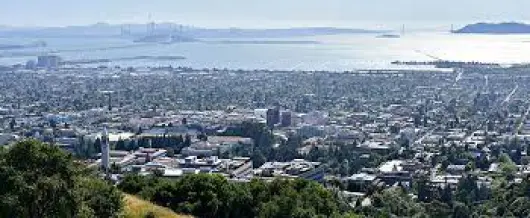
Oakland and Bay, en.wikipedia.org
Although our nation had been hit by surprise, with our computer networks and our defences seriously compromised and all electronics taken out by four EMP blasts across the continent, Claire’s prewarning had not gone completely unheeded.
After scrutiny by the heads of the CIA, her brief, recorded phone call was passed on to the other agencies and the president’s office. At that level they decided to issue to state and local authorities a level two (or code blue) alert, along with a vague memo of a possible EMP event. The fleet off North Korea went on high alert and surveillance directed to the area of the Russian Korean border looking for any suspicious movement. But it was all too late. The missiles were already in place.
One of the governor’s aides was a radio buff and took action. They had two fully functional, powerful sets. Most of the mayors of larger cities could make no sense of the advisory because if an EMP strike was imminent or even possible, the code level should have been much higher. So they did nothing, much to their chagrin. The mayors of the smaller towns hadn’t even been informed. That’s why, after the attack, the only radios still functional were those precious few shielded from the blast or sitting in the deep basements of police stations or some odd antiques kept in closets or behind glass cases in museums. Nobody knew about those except the real hams, whose numbers were far more than I would ever have imagined. These people crawled out of the woodwork, so to speak, and came to their country’s aid in its hour of need.
The military forces were a little better prepared, being on constant alert. They stockpiled thousands of shortwave radios over the last fifty years, ever since the EMP phenomenon was discovered in the early sixties. But that was a cold war move now thirty years dead. They had to dredge them up out of mothballs from their deepest bunkers. Now they were busy getting these units spread around to their various bases, driving them in small convoys, in the few vehicles they could get running. There were no planes in the sky yet, but mechanics everywhere were scrambling to repair whatever they could. And they were making progress. By rewinding starters or replacing damaged parts they were able to get older trucks and planes running. Newer vehicles with their complex systems of sensors and chips and wiring were impossible to fix.
By day’s end we’d made over thirty contacts, and every one of us had taken part in the business. We called it quits about midnight, tired out, telling our correspondents we’d be back online in the morning. We’d eaten dinner at our posts, Lucille and Mary bringing over the plates of food from the Abbott’s kitchen. Lucille was living with them now, taking care of them and their house, the three of them already close friends. They even dropped by after dinner to see all the activity in our basement firsthand. They said they both felt years younger since taking our medicine. They helped clean up the dinner plates to carry them back to their house and as they said their ‘goodbyes’ I could see they were happier than ever.
As I lay in bed next to Claire reviewing the events of the day, I couldn’t help but think how strange and complex life was, for all of us. We’d all been happy that day, wildly excited with each call we received and returned, busier than ever at a successful, new endeavour which we hadn’t even dreamed of the day before.
Many of the hams I’d talked to were equally excited to make contact and I made it a point to ask each one how they were doing, how their food was holding out and if they had access to clean water. Every one of them was still getting by and optimistic about the future, thinking that with this network up and running we’d all be able to reorganize and patch the country back together in no time.
I myself kept up that bright glow of hope in the tenor of my voice on the mike. But in the back of my head another movie was playing out, all evening long. This was only day three after the attack. Most of the hams I’d contacted were in the central valley or up the coast or further north in the Dakotas or central Canada. The blasts hadn’t affected those areas as severely. They had many more cars were running and some electronics still working. But all of them were in rural or farming counties where ham radio was a way of life. They could look out their windows and see cornfields starting to grow or else forests that stretched for miles, full of berries and game. Most often their nearest neighbors were miles away.
My movie played out in the ghetto. I could see a vast array of ramshackle apartments and decaying houses crammed full of poverty-stricken, disenfranchised people, hundreds of thousands of them, already angry over the hard lot that life had dealt them, now lying in their beds awake, just like me. Only they had just run out of food. Hunger was gnawing at their guts. Their hungry children were crying in the next room and they couldn’t help. Many had argued with their neighbors over some morsel of meat or bread or some missing can of peas, a barter gone bad, failed, the anger and desperation slowly rising in everyone’s hearts.
But these were the good people, the working poor with families. What about the bad, the junkies, their heroin supply all dried up, now going through withdrawals, or the thieves, the gang members with guns and ready to use them. What were they thinking right now? Surely it wasn’t positive.
It must have been something I’d read a long time ago and half-forgotten, maybe a cartoon, but I always analogized anger to steam. As I drifted into sleep, I saw myself driving a locomotive with a hat and bandana and a bright steam engine from a century and a half in the past. But too much fuel had been fed into the belly of the beast. The gauges showed the pressure rising to critical levels as we raced down the tracks and all the safety valves were clogged and the brakes gone. The boiler was about to blow. But this was my post. Should I abandon it and try to jump off the speeding monster?
Then the faces of all my dear friends and Claire came into view. They were also on the train. Dark curtains slowly closed on that picture in the theatre of my mind, and I fell asleep.
Wednesday morning, the middle of the week. We awoke with the light and with far too much complacently went down to work, as any twenty-something person might do in their first week on a new and exciting job. We scheduled showers for each of us, fifteen minutes apart, and Lucille brought over a big pot of coffee to everyone’s delight, promising breakfast would follow.
The gas stove at the Abbott’s had finally run dry the day before. But Charlie had taken off a precious half hour from his post and hooked up a propane tank, so it still functioned well. He was already in his seat at the set before the first of us stumbled downstairs. In fact, he told the group of us as we assembled that he’d been up in the middle of the night and received a transmission from the far east. One operator in Polynesia told him that there was a war raging on the Korean peninsula, that China was involved, that EMP bombs were dropped in retaliatory strikes over Russia, India and Europe.
He couldn’t say who attacked whom first, but it didn’t matter. The deed was done. World War III was underway and at our seats in that basement, we were invited to the show.
Ever since I fell ill from the food poisoning Monday afternoon, or perhaps even further back to Saturday night, when I fell head over heels in love with Claire, my head was sometimes muddy, indecisive. I was glad when anyone stepped in and did the talking for me, especially Claire.
But this morning I was crystal clear, like a crystal radio set, my brain pulsing with plans. There wasn’t going to be any complacency here, not around me. We were on the cusp of the storm, riots, fires, and mass civil turmoil which would roll up, just like a fire, from the flatlands and the slums to the hills where we lived.
The first thing we did was to get hold of the mayor’s office in San Francisco. We told his secretary that things were getting ugly here in the East Bay and that if he could send out vehicles with bullhorns and inform the populace that water and electricity would soon be restored and that food distribution centers would open up, it might just buy us the time for such things to happen.
I also briefly mentioned that there was a war raging in the far east. It wasn’t five minutes later that we received a call from Sacramento on Jason’s radio and it wasn’t a secretary, it was the governor himself asking who was in charge here and what did I know.
I appraised him of the vague news from Polynesia and also what I’d just told the mayor’s secretary because I deemed it very urgent business. He thanked me for our work and told me he would ask the mayor of San Francisco to get a hold of our mayor to make sure the neighborhood would be protected from any riots with all the police help available. He already knew somehow that we were in the hills above the campus of Berkeley. His one request was, that at all costs we try to find out what was going on in the rest of the world and relay that information to him personally, a.s.a.p.
The last thing I asked him was if anything was being done to restore water and power on the state level. He told me that there were crews working day and night with all the resources they could find and that some pumping stations would be operating soon on emergency generators to restore water in some areas today, though it would be rationed to a few hours. Electricity was a harder nut to crack with all the inoperative switching gear. But they had plenty of people working on it and certain solar farms and wind generators were operational and small parts of the grid and could be up again by week’s end. He said his staff numbered in the hundreds and that many were sleeping in the basement of his building, to be on hand. I told him that we were also a basement operation. So it was in time of war. We exchanged warm farewells. We told him we would stay in touch, all day.
It would be a good thing, I thought to myself, if they could get some water running and the lights on again soon. But the real problem which I hadn’t mentioned, as too delicate an issue, was food. With our transportation systems down there was no way to bring food to the people of the Bay Area. Between our two houses, we had perhaps a fifteen day supply. What would happen on day sixteen? I dreaded the thought.
But I didn’t dismiss the thought. As our radio room was fully manned, I pulled Jane and Mary and Scout aside and asked them to help me upstairs. Our mission was to clean out the panic room, take out all the clothes and fill every other closet and dresser on that floor. Then I had Jaime and Charlie join us with hammers to take down the partition walls to the closets, making one long room behind the counter and mirror at the entrance.
“This might be our new home in a week or so” I told them, “if things get ugly. It’s better to have it ready now for our radios before strangers are banging at the gates.”
They all seemed a little baffled.
Jaime started. “We couldn’t fit more than five people in here, let alone live. What are you thinking?”
“Well, then we’ll stock it for five people. Let’s bring in another table and chair. The counter can serve as one workstation. We need to get a splitter and bring in another feed to the antenna for this room. I’m just trying to be provident. I have no idea what’s going to happen. But if a few people can hold out just a few days longer in this room, then it’s worth setting up.”
This made enough sense to them, and they nodded in agreement. We finished the task, carrying out armloads of plaster and wood to the backyard, sweeping up the mess we’d made and finally, bringing in another table and two mattresses from the quarters in the attic, as a crude sleeping arrangement. When we finished it was already evening. We went back to the basement.
Naomi had made contact with Australia, with some official in Sydney, delighted to hear from California. She had Jason inform Sacramento, but they couldn’t catch the signal so we acted as a relay station. The news for the governor was that Australia had escaped the war, so far unharmed, except for its computer network. The fleets had been recalled. The American ships in the Pacific were heading back to Hawaii or the west coast at full speed. But we were told that they were driving blind as far as technology went. More than ninety percent of the satellites in the sky were dead after passing through the radiation belts caused by the upper atmosphere explosions. All directional systems, all computer systems were down, the world around. Ships were now navigating by compasses and sextons and paper maps but fully confident they would make it to their home ports. That way of sailing was not completely forgotten.
Once again ‘Roland house’ had come through with critical information for the governor, who seemed to be vying with military officials over who exactly was in charge of the dire situation. Earlier in the day, Charlie had tapped into a low-frequency Army band. A general was issuing orders that operation ‘Babel’ was going into effect, that civilians would all be assigned locations and that ‘blue’ and ‘green’ zones would be set up within the next few days.
When Charlie mentioned this intercepted transmission earlier, it didn’t raise any alarm bells. But as my mind chipped away, so to speak, at a wall of vague words and the possible meanings behind them, all in a flash I realized that they, the military, intended to protect and relocate the useful citizens and that the rest would be cordoned off into one big pit of their fellow rabid, starving, human castaways.
I immediately contacted the governor’s office with this news. Within an hour I was talking to him. He thanked me again for all the intelligence but told me that in this fluid situation nothing was sure. He had no authority over the military and very few resources at hand.
He told me, as a friend, that I should get out of town, find some spot high up in the Sierra Nevada and ride this thing out, as far away from other people as possible.
I thought of Abbott’s cottage in the mountains, in the middle of nowhere, and their camper which we might get running. But then we had little food to take, and there were too many of us and none of us hunters except possibly Charlie. We would all be dead of starvation before the next Spring.
“No” I realized, “our situation is doomed. The whole northern hemisphere is going to ruins and us with it. The southern hemisphere can wait a year or two and migrate north and repopulate an empty, or nearly empty, continent, a desolation row.”
I didn’t tell any of this to my companions that afternoon. I didn’t have to. They could all see I was agitated. All the added brain power from the wafer did wonders with something positive, like holding Claire in my arms and kissing her, a thousand added sensory nerves relishing each kiss. But throw me an insoluble problem and I was in hell, right next to Tantalus. My head was racing with thoughts at full tilt and getting nowhere. What do you do with a few million starving people? The central valley was one of the breadbaskets of the world, lying just on the other side of the coastal range, not a hundred miles away. But with no transportation, no farm machinery running, the irrigation system damaged, it would all be one big fallow field pretty soon, useless to all except a few lucky farmers who could revert to old-school methods and reap some small life-sustaining harvest.
Then the first of the bad news came in. On police frequencies we heard of out of control looting in Richmond and Hayward and there were no resources to stop it. The food stores had posted men armed with rifles on their rooftops, lots of them. But now gun battles were breaking out and wherever there were higher spots overlooking the stores, they were losing. Molotov cocktails were being tossed and fires were breaking out with no firemen responding. Who would, between bullets and flames.
I knew that Oakland would follow suit and it did, that evening. We could see several fires burning from the Abbott’s back deck as we shared one more dinner there. I would have said ‘enjoyed’ but the food was guilt-ridden and cloyed in our throats. We ate silently and quickly, going back to our posts as soon as we finished. I went alone to the top floor of my house, the old servant’s quarters, now dim and silent and full of shadows with the setting sun, to look out one back window that commanded a view of the flatlands below. The fires were miles away and still relatively small, a few city blocks here and there. This was just the start.
last post ...
next post ...
I know these segments are rather long but if like them, buy the whole paperback novel on Amazon for cheap. Here's the link: https://kdp.amazon.com/en_US/title-setup/paperback/MB3XAC10B3G/author-orders?ref_=kdp_BS_D_ta_ao_main






