
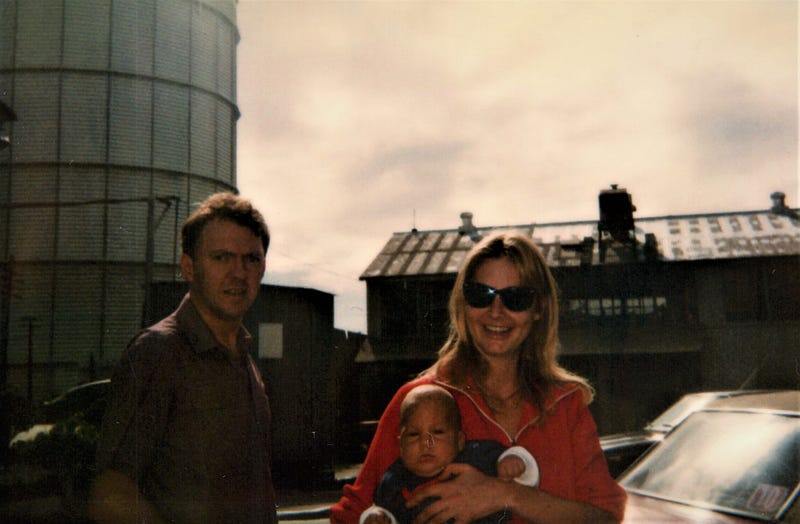
At a party at Ted’s warehouse in August 1987 and where I ran into ‘A’ again.
Will was born on June twenty-eight, five weeks premature but in good shape. He had to stay in an incubator for three days. Then he came home, a bit yellow from jaundice but a perfectly healthy baby within a few weeks. In July we had a stream of visitors. Bill and Muriel for three days, then Betty, Sanita’s mother bringing along her granddaughter, Cathy, aged nine, for a week, then my mother for an even longer stay, all eager to see the new arrival and help out.
A month later we were showing off our child to my friends in the East Bay. We went to an afternoon party at the warehouse where Ted Falcony, the guitarist for the band ‘Flipper’ lived. He was my friend now and invited us over. I’d met him through Jim H. a year earlier and we became good friends, over lines of speed and long conversations. Sanita, in sunglasses, was holding our one-month-old Willie in her arms.
There, by surprise, we ran into Allen, delighted to see us in that courtyard, but he told me he was totally broke, his earnings and then his seventy-thousand-dollar ranch house sold and all that money gone up in smoke, crack and methedrine smoke to be precise. He’d met an addict girlfriend and every day they indulged continually until it was all gone. I saw a picture of her and she looked skinny but cute. Allen was only five foot one. When I met him the year before he hadn't had a girlfriend in many years. When your that short, no matter how handsome, girlfriends are hard to come by, unless of course you meet one your height. But he had higher ambitions and this woman was eight inches taller than him. It was his money that did the trick, and drugs on a daily schedule. She stayed with him for eight months. Then she was gone, off to the next victim. I had two hundred dollars in my pocket, felt sorry, and gave it to him. He gave us a phone number.
Sanita and I moved up north at his invitation two months later, to Upper Lake, about 45 minutes from his rented house in town and we did a little business there, almost ending in disaster. Then we moved back to Piedmont and never heard or inquired after him again or wanted to.
I’d had my wealth of reading time the six months up to the birth and little else. Now I was happy to socialize full time. From July to October I have only twenty pages of journal, all about my studies. Then in November we made the move to Upper Lake, far away, using the same camper as our truck.
Before I explain this relocation from a city to the middle of nowhere, I need to address another subtle, but major shift in my mind and my habits and my journals. When we came back from Europe my first urge was to score speed and do some all-nighters, which I did twice in the first two weeks, and a dozen times again over the next three years, when the company and the place was conducive to it, almost as if for old times sake. But with that first binge over I knew I had to change. Sanita was pregnant and we needed a transition to a quiet life. My binge-buddies were now all an hour and a half away, at a distance not exactly safe, as anyone might chose to take a drive and drop by. My reading plan was also conducive to change. I wanted to read daily and that meant a good night’s sleep.
So I fell into a pattern of doing just a few lines a day, eating well and sleeping soundly. About every three weeks I’d travel to the East bay and visit Ted for a gram. Sanita would accompany me on half these trips just to get out of the house and see old company for a few hours. Also we found that spending too much time cooped up together, just the two of us, would provoke little, verbal spats at times, though we always reconciled within a few minutes with apologies. She didn’t like me doing much ‘S’ so I hid it from her and did the few lines secretly, an aid to reading the whole day long.
This new moderation in turn changed my journals from the maniacal late night rants they were the year before to tame catalogues of reading notes, thoughts on what I was reading, future plans of study, book notes of interest only to me, meaningless to anyone else. So you won’t see me quoting much from them over the next years. By 1988 they devolved into word lists and quotes from my readings.
But this is the exact counterbalance I needed from the madness of the previous years. Pure, simple addenda to my pages read, in beautiful handwriting once again like in my school days, a scholar’s ledger of interesting words, the very opposite to the scribbled details of a wild speed binge. It was a sedate life compatible with Sanita and raising a child. With our move to St. Croix in 1991, and my return to work the journals almost completely stop.
This peacefulness lasted five years and through five moves to five very different places and seven houses, all of them at Sanita’s suggestion, I passively agreeing to each one, because I wanted her to be happy, and I was happy with her, raising our child together. I can’t explain her wanderlust. I can see the reasons for three of the moves, but our beautiful house and life and numerous, nearby friends in Piedmont was simply perfect, and the second house in Seattle nearly as fine, but without the friends. I could have easily stayed in each much longer. In location and charm they had fairy tale perfection, in my mind at least, and I was supremely happy in them with the occupations and hobbies I had at the time, and the pleasant care of Willy as he grew up.
But in Sanita’s head far different thoughts and scenarios were forming, spawning one might say, which she never showed or talked over with me, only a sudden, strong desire to move again, usually declared in a few words over the breakfast table, without explanations. They always came as a surprise and shock to me, out of the blue. But I agreed to consider the proposition and after a few days of her sullen looks and a woebegone shuffling about the house, I would slavishly agree, often to an immediate hug and kiss with each assent. Since I had no job, nothing tying me down, and the money in the bank to make the transition easy, I suppose the kiss and making her happy for a while again was reward enough for all the troubles of packing up and moving.
But she took care of much of that herself. An excitement would electrify her whole being. From the dejection of a few days before she was a flurry of activity and smiles and chatter, planning routes, packing up, disposing all the items we couldn’t take through yard sales or gifts to friends. I hardly partook in these matters. It was her private, pleasure filled domain and I didn’t encroach. A week into this maelstrom of activity on her part, more often than not I was sitting in a single chair in a room full of boxes, book in hand, still reading away.
These frequent, and one could easily say, irrational moves back and forth, North and South, East and West, spanning the whole continent and more, at Sanita’s insistence, were the first sign of a troubled mind and a troubled relationship. But it was a secret in her mind only. Except for a three or four brief, ugly arguments in those five years, all of them over issues of child rearing or Will’s health, and over us being too much in each other’s presence many of those years, (all of which I immediately remedied), I never suspected our marriage wasn’t on the same happy level that I was.
But these moves should have signaled that something was wrong. I accepted each one, quickly adapted to the change, and except for the nine months in Dallas, (where I was fairly content, though a bit bored with only Jaime and Barbara as friends), I can say I was very happy with all the moves and the new friends and employments I found in each different place. And I always had my books as a back-up. In Dallas, for instance, besides the bottom flat of an old Victorian, I rented another private room and read page after page of Herodotus every day with delight. Sanita didn’t have this back-up, or any employment, so she secretly stewed in her own juices, bored and ever more unhappy as time went on.
The reason she urged us to move so often was that she thought she would discover something new and exciting for herself in a far off place. But as Harrison Ford so famously said in ‘Six Days and Seven Nights’: “Look, it’s an island. If you don’t bring it here, you won’t find it here.” That also applied (in her case), to the cities we moved to.
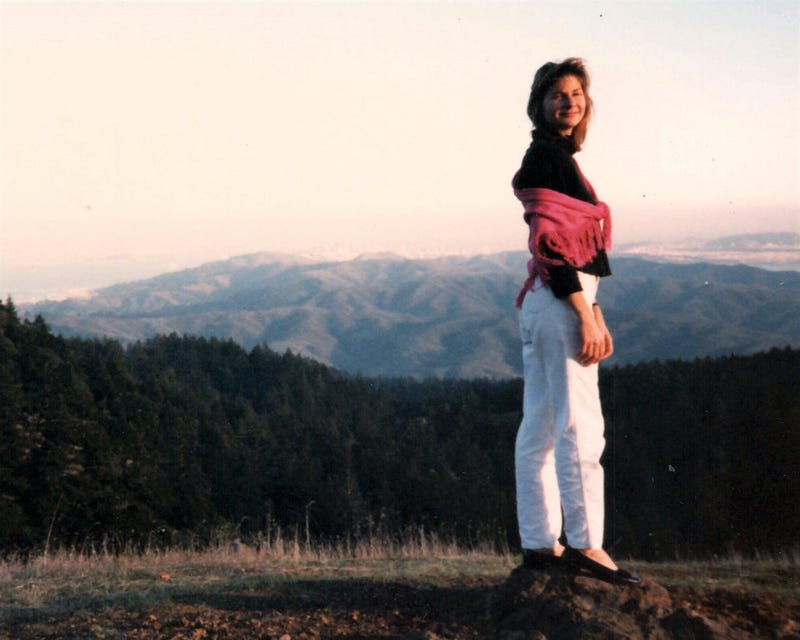
The hills near upper lake and Sanita, alone.
Your own internal resources are your well of happiness. I made friends everywhere. Sanita rarely did. And the few women she called friends were never that deep or intimate or satisfying, and never lasting. Even with me, she was only intimate during the first years. Over time she slowly grew distant, retired into her shell where I could never guess what she was thinking or feeling, which put her beyond the pale my helping her with any comforting talk or suggestions that might improve her well-being.






