
Mexico City
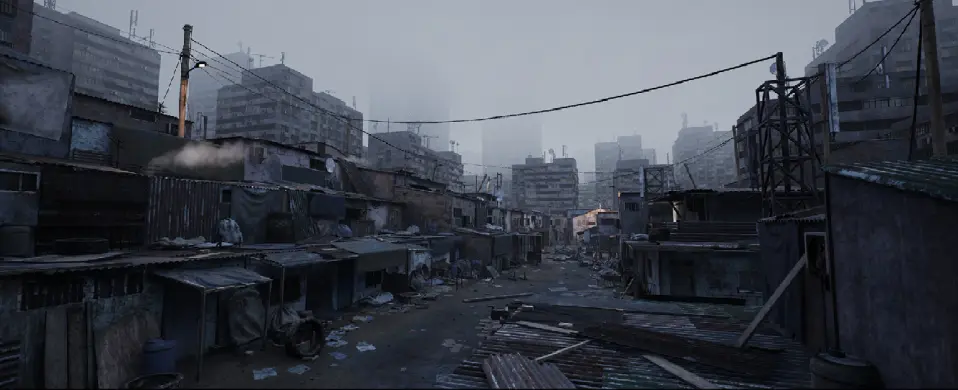
After Houston received us and our vaccine with open arms we sent an exploratory mission south, vehicles and gas tankers. They came back in three weeks unharmed. They met no resistance and found only a desert landscape, starving dogs in deserted towns, all the way to Mexico City. There they met an even more ghastly sight. In the city center they found a mob of sickly priests in white robes, arm in arm, chanting and protecting a crowd of cowering, scarecrow figures behind them, unwilling to even speak with our men or come to the boxes of vaccines we laid out. Our troops withdrew out of sight. After a day of watching through binoculars, as none approached the vaccines, our column turned around in disgust and came home. If people refused to be saved they were a waste of time. We had a world to rebuild. They wanted another.
It was the same with all of Central and South America. The cathedral was the center point of every town, of their lives. We sent several ships with the vaccine and the means to make it. But the Church still ruled, and they were far behind us by condemning any technology above the level of blacksmiths forging their plowshares. They didn’t ask for gas. They were agrarian communities back to Aztec or Mayan simplicity and decaying with the plague. Their populations dwindled to nothing. The Church was more focused on death than life. And death they found, one by one, with a sprinkle of holy water and a final benediction.
But in Russia matters took a different course. A ruthless general ascended from his bunker as the pandemic subsided. He declared himself ‘president’, assassinated the Church leaders with his thugs, moved into the Kremlin and built up an army for his totalitarian state. Many of the factories weren’t yet destroyed and the people were behind him. They had a two-year lead on us in reconstruction, but revealed none of that, meeting our ship on the Baltic coast. With the acquisition of the vaccine equipment (which Sheila deeply regretted now) all handshakes and smiles when they met him, a Stalin or Putin in disguise, Russia quickly restored its strength, its armies and weapons. They were rich in gas and resources, iron and steel, armories and factories, unlike the rest of Europe, and took quick advantage, annexing the Baltic states, Ukraine, Poland, half of Germany and Eastern Europe, with us unaware. Only a few garbled reports got through. With this assimilation a blitzkrieg began two months earlier and they overran Europe.
Sheila’s delegation was in the far East when this happened, receiving only vague reports. But those regions were no threat to anyone, almost in the stone age again. The few areas around coastal cities, once numbering millions in population were now reduced to a few thousand, with no communication between them. The rest was like our huge interior, a ‘no man’s land'.
So Russia’s conquest of Europe was easy and complete. They had jets and tanks, artillery and battleships in working order. Their power-mad dictator thought if he struck quickly, our continent would fall. We were the only block that might oppose him and after us world domination would easily follow. His one weakness was manpower. Half of his forces were spread thin throughout Europe. But he had a few submarines. We had none. Our ships were sitting ducks to that flotilla. But I hoped he made the same mistake Hitler did, a war on two fronts and spread too thin, ambition overreaching manpower. And I was sure he underestimated the resistance he’d meet on our shores, our wits and our resolve, our history, defending our homes, our liberties, the land of the free, fighting on our turf for our families, not some distant maniac.
We had one other strength unique to this land, America was boundlessly rich in guns. Like apples in an apple orchard, they were everywhere. And guns and bullets last a long time. They’re weatherproof.
I remember the words of a commercial my father repeated to me, from the NRA, a powerful lobby back then, from an actor of that ancient era, Charlton Heston, saying, with all-American pride and Ronald Reagan our president backing him up: “you can take this gun from my cold, dead hand.”
He was right in a way you’d never expect. There were skeletons everywhere holding guns, most in abandoned houses and buildings, millions of them, six or seven years dead now. But the guns and ammo around them were still intact and usable. A bullet has the half-life of uranium. Steel doesn’t rust and lasts much longer than we do. And many a weapon, when our troubles started, was taken from “cold, dead hands” and put to use again, making more skeletons. Strange irony.
As I sat in my study that night, pondering, I wondered what it was about our species that made brutes and bullies ascend to power in hard times, like Hitler during a depression, and our civilization so fragile. The Mongol empire, following the dark ages, was the largest ever. But most of its conquests were over deserts and wasteland. It didn’t have writing or build a single thing. It only destroyed by fire and sword and vanished as quickly as it came.
The Roman empire was the second in extent. But it civilized the world, built cities, roads, and aqueducts lasting to this day, bettered the world and every conquered people, assimilating and educating them. It made North Africa the breadbasket of the Mediterranean to a hundred miles inland through irrigation. It lasted a thousand years, not a hundred, and with its fall that farmland became a desert again. But its best books were rediscovered and created the renaissance, rich in wisdom.
So my final assessment was hopeful. Intelligence prevails over brute force in the long run. I went to bed at three a.m. to catch a nap for the long day ahead, ready for action.
The next morning we convened in the dining room. Sheila was finally rested up. I got word to general Steele that we’d make the appointment the following day. Our phone line to town was good again. From there a soldier would have to drive to deliver the message.
Our first question to Sheila was whether she thought we were safe. Sheila already knew a bit from the long ride home with officers. She said we were unprepared, spread out thin and that in an attack so unexpected the Russians were sure to make beachheads, acquire landing strips and gain control of our air.
That meant they could fly inland and bomb whomever they pleased. Our farm would be an easy target. But that might not happen for months, I thought. We were still the frontier, though blossoming with new farms and the small towns nearby slowly repopulating.
The enemy would be focused on the cities along the coast, Montreal, New York and Washington, or the bases in Burlington, Portsmouth and Charleston before they could safely venture inland, or else they’d have our armies behind them. I asked Sheila what we might camouflage. She said we might be able to screen the houses and barns under tarps, but hundreds of acres of fields were impossible to hide. And the solar panels wouldn’t work if covered.
All this while I was thinking of ‘assets’. It struck me, with few soldiers nearby and Bill gone, I should visit Tom. An hour later I was crossing the fields in the jeep, with Sheila and Jim beside me.
We’d all been close friends from the pregnancy days. But Myra often wondered how Sheila could leave her baby for so many years. That left a lingering doubt about her character. Tom explained that it was for ‘the greater good’, a concept not quite clear in her head. They’d had another child, now almost two, another boy. Tom helped Joe with farming while Myra was pure motherhood. Both were completely happy with this life.
So they were startled when I entered with Sheila and the news, surprised by her reappearance, but greeting her with smiles. We sat at their kitchen table, Myra holding the young one, the other, now five, Tom’s little likeness, running around the room waiving a spoon in his hand for some unknown reason. Tom was all ears about the crisis and insisted he come with us the next day. He said he was in tip-top shape and soldiers don’t forget their skills and training, not ever. Sheila knew of his mercenary past and while they talked about it and both agreed that’s what would be most needed, a thought struck me and I interrupted them.
“Myra” I said, “I think you might be able to help us out more than anyone, to win this war.”
Everyone looked puzzled, especially her, so timid and self-effacing. Her given name was Mirabel. But that doesn’t fly on a red-light marquee in a ghetto and was amputated down to 'Myra', just like parts of her life. She joined that rougher set a year before the pandemic began, and now, in this better life, I knew she didn’t want to recall the past. But she would have to if she wanted to preserve this one.
“This war is going to be ugly and guerilla in nature. Tom is just the right man for it, especially if he can collect a squad of his old mates. But I remember you said, the day you found us, that you were ‘passed around’ quite a bit among the biker gangs in the first years.”
That was the best euphemism I could think of on the spur. They both blushed as I spoke.
Myra slowly responded: “Yes I was in a way ‘bartered’ between the gang leaders, for food and cooperation.”
“I know you don’t like to think of that era and I’m sorry to have to bring it up. But do you know if any of them are still alive? Did you see any in our camps during the resettlement, in the busloads that passed through?”
“I remember quite a few” she went on meekly, “but I always looked away so they wouldn’t be shot or recognized.”
“But one I’ll never forget. He changed his leathers for jeans and rags and none from the other gang members dared say a word. Their throats would be slit if they did. He was always nice with me, as much as he could be.”
“Do you remember his name? Could you find him?”
“He probably changed his name. But I’ll never forget his face. He was put on a bus with some others I recognized, and I know the vicinity they were sent. I asked a soldier out of curiosity. If you took me there I think I could find him. He went by the nickname ‘Jack'. ‘Pirate Jack’ he was called back then. You can’t mistake him. He’s huge.”
“You’re coming with us tomorrow, with Tom’s assent. Miranda can babysit.”
They still didn’t quite catch my drift, none of them, till Tom spoke up.
“What’s the point?” He asked.
“These are just the type we need, gang fighters, killers, men practiced at night raids, slitting throats, hiding, robing, causing havoc. By the way, what did they do with their bikes when they ran out of gas?” I asked Myra.
“They stashed them in the woods.”
“Perfect” I said. “See, they were thinking ahead, never give up an asset. I really want to meet this ‘Jack’. If we find him, I’ll tell him that the past is forgiven. I’ll get a paper from the general saying so, full amnesty. Then he can spread the word and round up any former members they can find. They’ll wear their leathers again, be given Harley’s and Uzis and all the clips they can carry, form a troop for hit and run, maybe paid bounty for scalps. I know the Russians aren’t prepared for anything like that. It will scare the hell out of them. They’ll wish they never came. This is America, God damn it. So let’s use it.”
I was a little loud and heated in this speech, scaring the children. But the adults agreed. This war wasn’t going to be pretty and I’m sure the Russians would commit atrocious crimes and rapes as they always do. We had to show them some of our own ‘ugly’, or we’d be defeated for sure, pushovers. They’d never expect a pack of skilled riders on narrow lanes or in woods, where their vehicles couldn’t follow, shooting, dispersing and disappearing, the loud roar of the bikes left to strike fear again.
Our talk was over. I told them I’d send Miranda by that afternoon. She could spend the night and take over when they left. We’d leave at six a.m. The soldier would be waiting and drive us to Manchester and general Steele. He’d be deluged in preparations, and our interview would be brief. I asked Sheila if she had any proposals in mind.
“I’m still turning over a few options in my head” she replied. “Let’s see what he has to say. Then both of you can hear my suggestions. I don’t know what type of assault they’ll mount, and what we have in our arsenals to combat them. I’ll have to find out, so you’ll just have to wait and see.”
Here is a link to the beginning of the book.






