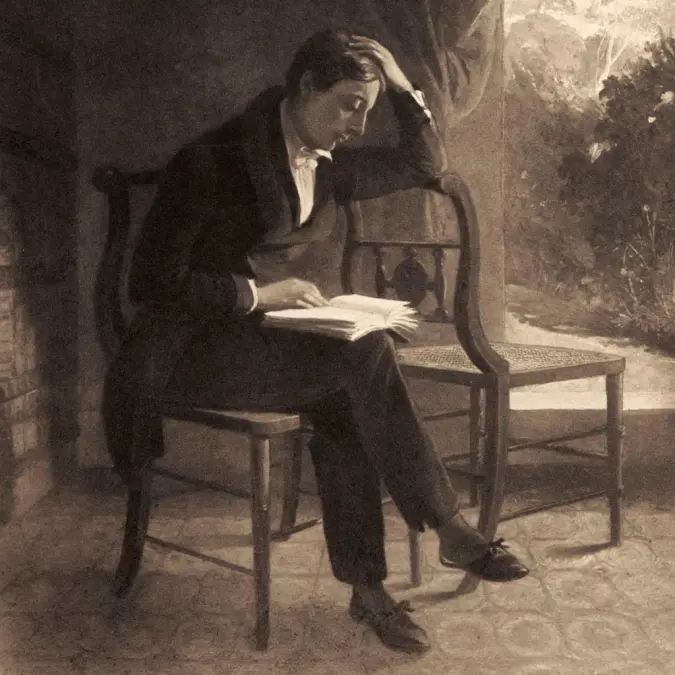
John Keats
My journals at this time began to fill and became a daily part of my life. I have four of them covering these two years, mostly lists of the great books I was reading and my thoughts on them. As I had no social life that was all I had to record, meaningless to others, but to me a slow, recuperative, reaffirmation of my worth and self-esteem, after the trauma of San Diego. There were no drugs or drinking, besides the glass of wine with dinner at my mother’s table. I certainly made up for this social lull in the following years, like a comet.
I have a friend, Bruno, who sometimes argued that the life of an Amazon Indian, living in the rain forest and foraging for food is just as rich in mental experience as that of a young man in a bustling metropolis. I’m sure he would argue the same for my very confined, quiet and retired life during these two years, sloppy in dress, sitting in the corner of a dim, tiny room, bent over reading some forgotten author and unknown to the world, and judge it to be just as rich and rewarding in its mental life as the dizzying stimuli of parties filled with music and talk and beautiful women, or the heady life of a young, up and coming Manhattanite rushing down crowded streets between business deals and dinner dates.
Surely if the mind were, as Milton said, ‘Its own place’, it would build equally magnificent castles of sand everywhere and anywhere.
I understand this good-will, this equality of all, but it’s wishful and wrong thinking.
There are barren, wretched places and luxuriant ones on this Earth. The same goes for people and the possibilities they have from the prosperity or the poverty of the places they are born into. Nature is hideously unequal and unfair in distributing its bounty. Some places have it all, others nothing. And it’s the same with people, some get all the advantages of wealth or beauty or talent. Others, (most people) none or some slim slice of a few, or maybe one of these. Some are born Eskimos, using their own piss as shampoo, chewing seal fat to survive, chewing hides all day to make crude clothes to stay half-warm. Toothless by thirty, dead by forty, no light all winter, only shivering in a dark igloo. Their only hope is to wake up to the next gray morning to eke out one more day, if they even have hopes or dreams at all, having no culture, no pastimes, barely a reason to go on. But they do.
That’s life. It was like that for every human being a hundred thousand years ago. Yet they persevered and here we are today, thanks to their amazing endurance through eons and countless generations of mostly grim, cold, miserable, starving lives. They deserve a thanks from us so great, it’s hard to fathom, it boggles the mind, and they can’t hear us or see what they created by their sacrifice. But they surely earned it, all that praise we can give. We owe them everything, civilization, our consciousness, our being. I melt to tears just thinking about such a debt we can never repay, as if some stranger saved your life from drowning a thousand times and always disappeared just as you woke up.
But where are we now for all that history of ancestors passed in agonizing, constant struggle? Inequality is the hallmark of this world, its one outstanding feature. It could be a far more just and equal place for all, but it isn’t. Consider wealth and its distribution, unimaginably imbalanced and insane. The very rich are surfeit in decadence and guilt and live apart. The ever-shrinking middle classes work hard and enjoy the benefits of civilization. The poor work harder and get only the crumbs. But the largest number, the poorest, till barren desserts for survival diets or just wait and beg for aid in their rags in these nightmare landscapes, little above animals.
These same vast inequalities also apply to minds. The most wretched have minds as malnourished as their bodies, their dismal surroundings and daily sufferings their only awareness, which they only wish to forget. The poor have some education and ability to reason, some good memories but a preponderance of bad and not enough mental strength to escape that gray existence, only enough to see and feel their plight in almost wordless anger and pain.
The middle classes and the rich make up a strange lot as far as their minds go. They have every opportunity to improve their faculties, in logic and clarity, expression and knowledge and most important, the ability to comprehend, reflect, digest and manipulate the life they live and improve it. But, as Samuel Johnson once said: “If it rained knowledge most people wouldn’t hold out their hand for it”. And so it is. Most people neglect their intellects, dislike or despise their school years, narrow all thought to their necessary jobs and dissipate the rest in idle entertainments or thoughtless passions, loves and hates in youth, devolving into petty peeves with age, and confused babble with senility.
I was fortunate to discover the world of great books and great thinkers and realize that the mind was everything. It spelled all our happiness and richness in life. To improve it meant control, over ourselves and others and that required select, rich reading, which Thomas De Quincey, a truly great mind coined “the literature of power”, which taught reasoning with skill, the ability to confront, dissect, accept, and either resolve or sidestep any problem encountered.
By ‘sidestep’ I mean escape, not in a bad way like ‘ignore’, or ‘refuse to acknowledge’, but in a way only the human mind can. Two quotes come to mind. The first from De Quincey himself. He was a very young boy being sent away to a boarding school for the very first time, a scary experience. His mother gave him a plum cake for the six hour long ride in a public carriage, full of five adult strangers. He looked around at them in silence and in complete fear such as children only know. But he wisely decided to make them friends. He unwrapped the cake and with the knife his mother had laid beside it he carefully cut it into six equal slices, passed one to each of these adults and one for himself. They were all soon talkative friends.
But here’s something he added, that not one in a million human minds would have thought of. As he cut the slices, with trembling hand, he noticed that they were all perfectly equal in size. He marvelled at this outcome, it consumed his thoughts for minutes and filled him with satisfaction and delight. Such is the mind at its best, turning fear to pleasure through one insignificant detail, but not insignificant in its results. It shows the power of imagination over reality, imagination winning the game hands down.
Another apropos quote is from John Keats. It was remarked by a woman admirer of his verses that he must have done well in school, for all the classical allusions they contained. He replied: “No, I didn’t pay attention. I had terrible grades. I was too busy counting the number of fairies dancing on the sunbeams that flooded through the window”. Now who would you rather have a conversation with, John Keats or the best ‘A’ student at Oxford?
I consumed shelves of books of such caliber with insatiable delight. A library was a feast to me. I carried one with me in my pockets and I survived this two year span, this desert of any social life, like every other span in my life, with great satisfaction.
There’s one perfect example of this ‘mental aristocracy’ in the 1937 movie “Grand Illusions”. A line of French soldier/prisoners are being marched up a hill by the castle where they are to be imprisoned, the German soldiers moving them along. All the prisoners are in a state of dejection, looking down to the ground, forlorn over their capture and imprisonment, except one. He’s the French aristocrat with a wide education. He’s looking up, admiring the turrets, noticing one has a fourteenth century design and the next a fifteenth century shape, obviously an addition, he thinks, as happy and occupied as a boy looking through an interesting picture book. And the German commander, also a well-educated aristocrat, notices this. They become kindred souls and he receives preferential treatment from then on. The best aspect of this mental wealth, this aristocracy of mind, is that it’s rich without taxing anyone else or lording it over others, a realm beyond and above this sad and dismal world that many of us live, like plodding soldiers.