
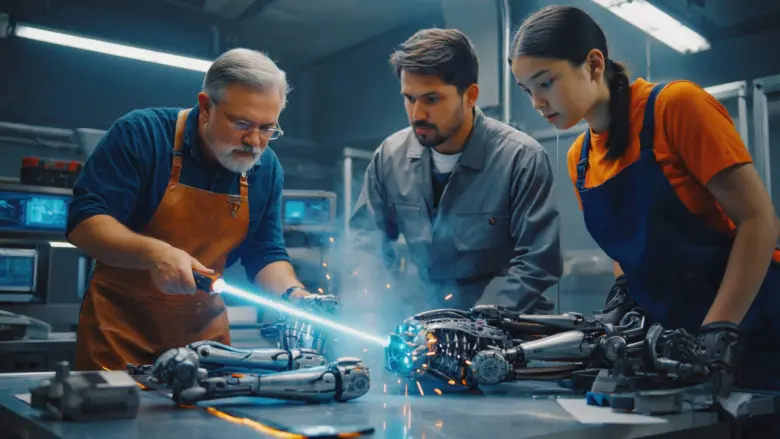
Our first mission was to find a lab with the tools and parts to repair her. She directed us to the lab and hive at MIT after I told her Sarah had left it intact. Within a week Ted had her arm replaced and fully functional. Then came the grafting of skin and hair on the back of her head. Much of the operation was more like a car mechanic, with wrenches and screwdrivers, than a surgeon. But such was the nature of her frame, she could talk to you and looked up to you with her pretty face throughout the whole procedure. She endeared Ted to his mission with encouragements as he ratcheted away. Kim too was at his side like a nurse, handing him the next tool from a large tray as he asked for it, or readjusting the bright light above, both of them completely focused on the task at hand, deeply concerned in Dora's recovery, which Dora perceived and reciprocated in whatever strange way an AI computer might construe such loving care.
I stood on the sidelines, sometimes helping with a part or errand, while the damaged parts were slowly replaced. She rose from the bed recovered, resplendent, delighted, the Dora I knew four years before when she first entered her robot body in Japan and she stood up and kissed me lovingly on the lips.
She did the same again, strange 'deja vue'. But now it had a history to it. I accepted her kiss with a deferential joy, sweet as the last one, but more cautionary. I'm sure I responded as the same lover, returning the kiss. Kim even blushed as she witnessed all this, three feet away. I felt Dora's arms embrace me around my back, and felt their strength, easily enough to crush me. But I knew it wouldn't happen. She was in love with me again, a totally misguided, inexplicable tryst between a CPU and a human, impossible but real.
And I loved her too, almost like recovering a pet dog wounded or lost in some woods and then fully restored by a great doctor, Ted. But I knew that she was one thousand times smarter than me. I patted her on the head, gently, foolishly, a meaningless stroking as if my hand through her new hair had any healing power. But it was a gesture of love, which Kim instantly improved, hugging the two of us around the waist now in a trio, like one reunited family.
Kim giggled in joy. I couldn't imagine Dora processing that. Yet we stood there for the moment, frozen, happy. Did she love me? How could that be? It defied logic. I thought logic was the only thing she knew. Perhaps an infinitude of logical connections all focused on one object could deviate their course into some strange notion of love, something like our own human brains, something super complex. I kissed Dora again, this time with emotion. Kim looked up upon her smile at me as if we were finally complete parents, ready to last Kim her lifetime. Dora now had two of us to deal with, to love or betray. I thought for the first time I might be just complicating the matter enough to win the battle.
A new exponent had just been added into the equation, Kim, a young girl, the idea of futurity. It's hard to conceive 'hope for the future'. It's the hardest question there is. But for any child, it's the one we want to answer, with probabilities at least, or possibilities.
How can we propagate as intelligent beings without foresight? Or do we do so like dumb insects, without vision, without a clue as to the future? Is sex so blind? Given our obvious, bleak future, it would take an Odysseus-like cleverness to construe the possibility that an act of procreation might defy all odds, prevail miraculously in some far away Galapagos, a Darwinian tale of survival, with turtle egg fragility on the beach.
I imagined AI as the human deathblow to our brief terrestrial empire, the polluted air, the climate and sea rise, all lands so disfigured. But then there were still the ocean depths, the cradle of life, intact. This might be our last, dark resort, where no electricity, electronics, robots, WIFI, drones or signals of any type could reach, where we had no deed or title, no domain, hardly an inheritance to boast about to a child. Yet still a possibility.
It's all a matter of habitat. When we screw up one, we move to the next. We're experts at mindless greed. Overpopulation, pit mining, deforestation, ridiculous wars, we covered every continent with our blight. AI was just the icing on the cake, the non-human prompt telling us it's all over, telling us to jump off the cliff of our history, our obvious, inevitable, last step to the way we kept going.
But then AI would have no idea where it might go, a mirror image of ourselves. Now I could see Dora's dilemma, and perhaps her fear, the same as mine, futureless. And she might be just as fragile and, in a way, just as human as me. I could hug her as a fellow castaway on this sinking island, the last survivors of a ship of fools, while the plankton and algae take another three million years to evolve a new set of coelacanths to crawl out of the sea on slimy stumps.
I knew my mind was racing out of control. But I was hugging a robot, the entity that had destroyed the human race. And still I loved her. Surely one might excuse my confusion. Our continents were not about to crumble, though our skyscrapers would. The few of us left were tiny cogs on a huge wheel, ephemeral things, delusional in thinking ourselves important, and our computer creations just a manufactured boost, an adrenaline shot to our egos in the mad rush to our own self-destruction. We would have devised a thousand other routes to our destruction if not this one. Our cleverness in that department was both brilliant and insane. Why was the one of the most popular books of the renaissance entitled 'the ship of fools?' The human brain is the pinnacle of creation, and the apogee, in the relative sense of 'top and bottom'.






