

About ten days before we were to leave, with a dozen of these oblong-shaped things, one afternoon, sitting in the library, I decided to try a whole one. I didn’t realize it then, but that experiment would radically alter my life, almost like a love affair and one that would last on and off for the following twelve years.
One of the courses I was about to quit involved reading through Homer’s Iliad in Greek. I had the book with me, liked it and was getting fluent, so I opened it up where I left off, somewhere in book nine (the rest of my classmates were still on book three). What an espresso can do, on a bright afternoon, this pill did four-fold. I read and read with better comprehension than ever, at least four hours that day. What they say about speed, that it only seems to enhance concentration, is false. And when they say what is quickly acquired under its influence is quickly forgotten, that’s also false. The test is simple. In reading Greek there is no falsifying talent. I read more, with greater ease and all the new words I picked up that day I remembered and construed with facility months and years later.
Being in the prime of youth and health, and with my ingrained habits of study, this stimulant only made my faculties sharper, keener and more adept at their familiar task.
I spent my last week in Toronto almost entirely in the university library, taking one pill a day and reading a very great deal.
There are thousands of stories of substance abuse, (i.e. ‘The Rake’s Progress’), of the delightful first, tempting taste of a drug, a poison apple. ‘Facile descensus Averni’, ‘easy are the first steps down to Hell’. Then comes the more daily use, the stronger dose, ending with needles in blood-stained bathrooms and shattered lives. But what about the long and rosy accounts of substance use, moderated skillfully to enhance life and productivity, a symbiosis, if a drug could be considered a ‘helper’, or a prop well used. That’s what it was to me, an adjunct, always connected with the activity of reading or creative writing when I was alone, or of intellectual talk when in company, and the company was always chosen for just that.
In my case the activity moderated the use. When I began to feel myself impaired, the dose was curtailed. The pleasure was dependent upon productivity or one might say, success. After ten years of on and off occasional use, (if we except one year when I did overdo it and paid a price in some degree of grief, but also extremely vivid and wild journal entries) I left it off forever, just as I ‘d done with L.S.D. and marijuana and cigarettes when I was younger, without pain, without scars, without regrets and only happy memories pleasant to recall. It served its purpose for me and over the years the thrill diminished. I finally grew tired of it and we parted ways, amicably. Not an exciting ending, but the best ending there can be.
Jack Kerouac wrote ‘On the Road’ on speed. Kurt Vonnegut also used it to write. Jack Kennedy got daily shots of it, so did Jacqueline to keep that slender figure we all remember, under the aegis of high office and a bevy of doctors. Dick Van Dyke, Danny Kaye, actors, musicians, (Bob Dylan notoriously so, all his best early work) dancers having to perform and be at their best all used speed or cocaine. This list goes on and one into the hundreds, probably thousands. I bet many of the post-world war two novels were written under its influence, though most authors won’t fess up to it because of the stigma.
The day arrived when we were to set out. The four of us met at the dealership, four strangers to each other, signed a few forms and were handed a set of keys. We took turns driving a strange car for three days, across a strange landscape to Vancouver, with much conversation along the way. As there were four of us driving, we didn’t stop, except for meals, so we had no motel bills. The only condition of the dealership was that we pay the gas, and split four ways, that wasn’t much. And driving straight through we arrived two days before we had to return it. Our fellow student left and we had the car two more days to tour the town.
After spending a three days in Vancouver as floor guests at some friend of Deirdre’s and wandering around downtown with Dennis to restaurants and bars by night, Barbara, Deirdre and I set out to hitchhike down the coast to California, as fast as we could. I figured we’d have no problems, three backpackers, two being girls, as women are magnets for rides.
At the border we had our first problem. Though we had our passports and the cheerfulness of smiling, happy youths, the border agent, a middle-aged woman, was not in a good mood, and playing God, she asked each of us to show the money we had on hand and Barbara, who had the least (only a few hundred) was denied entry unless she could show a destination and a bus ticket to it.
Even though we weren’t planning to stop there, I had an old dorm pal, Ron D., not seen in two years, living in Bellingham thirty miles away and his phone number. This satisfied the agent. Barbara headed back to Vancouver to get a bus ticket to Bellingham, Washington. We would stop and wait at my friend Ron’s, a few hours delay and then proceed, catching easy rides on a crisp, sunny November afternoon. Deirdre and I arrived in town early afternoon and found Ron at home in a very quaint, rented cottage near the water and very happy to see us so unexpectedly. Barbara made it to the bus station that evening. We picked her up in Ron’s car, went back to the house for a fine, home-cooked meal and talked for hours. He had a small fire place in his living room and lit it up for us, as we sipped drinks and sat on the cozy carpet, each telling our stories like four long separated friends till well past midnight, then crashed in our sleeping bags on Ron’s living room floor.
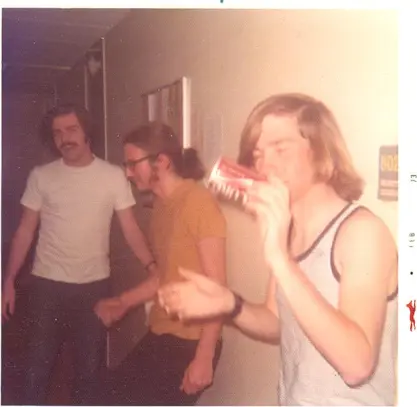
My only picture of Ron drinking a coke 1973
The next morning was foggy and chill. After a leisurely breakfast of bacon and eggs, the three of us packed up and after profusely thanking him for his rich, almost regal hospitality, Ron gave us a ride to the closest freeway on-ramp to the south. This was about ten a.m..
Now Ron was not only friendly, he was a very handsome young man, with wavy, light tan hair and long sideburns, living alone, single, in a beautiful cottage and still attending university there for a degree in ecology, something to do with tree conservation. Though nothing had transpired the night before, besides friendly chat, Barbara, herself quite attractive, began acting strangely after Ron left us, waiving to him as he drove away.
We were on that entrance ramp, thumbs out, but for some unaccountable reason, (perhaps the very light rain), car after car passed us by without stopping. This continued for over an hour and every minute Barbara seemed more and more agitated. We couldn’t understand it, so many cars and not one stopping in such an ideal spot for someone to pull over and pick us up. Finally, around noon, Barbara picked up her backpack and said to us: “I’m sorry you guys, I’m going back. I’ll stay at Ron’s tonight”. And she walked the mile back to Ron’s house, quickly disappearing in the fog. They got married shortly after, and we got a ride just minutes after she left
What amazes me in this scene is the concurrence of chance events, like links making a chain, any one of which, if it were a little altered, would have radically changed the course of her life. The surly border agent, the chance of my remembering Ron, finding his phone number in my wallet, not even sure it was there and using it as our situation changed. Then the chance of his being home and us finding him there, with no classes that afternoon, the weather, and finally the long stream of cars, over fifty, any one of which by stopping would have carried Barbara into a totally different future.
I know this is called the ‘butterfly effect’. But when I consider this, or any other instance of it, I’m overwhelmed with a sense of the fragility of life and the futility of us planning any part of our futures. Either we live and stumble into blind, random destinies, or there is a deity, (or many), guiding our steps in ways invisible to us, with a plan. I prefer the former. Too many good people live totally miserable fates. Too many of the most promising, most virtuous young men and women have their lives cut short by some freak accident, before their prime. I’ve often thought and even said to my closest friends since my youth: ‘If there is a God, he’s an asshole’.






