
Thinking is a miraculous thing, human thinking, that is. I don't know by what environmental challenges it was formed over the millennia, chasing various herds of meat with our spears, darting this way and that way across the Serengeti plains. But I guess this predisposed our minds to always anticipate the opposite of each heading the herd might choose; "No it's going to veer to the right. No, to the left". This gave us a broader and far more valuable intuition into every possibility of reality.
I can see this at play in one of the best Socratic dialogues, titled "The Gorgias", where Socrates decides to confront the most famous and rich Athenian orator of his time, to discover the secret of his success. If intelligence was the keystone to glory, Gorgias must have a superfund of it, which Socrates was always curious about.
But before Socrates even entered the arena of this friendly confrontation, he had in the back of his mind this doubt, "Perhaps this man is a charlatan at best, who knows how to persuade others with his honeyed words, like a politician, with no other view in mind than to gain popularity and riches with this expensive school of disciples he set up.
This is where the dialogue begins. He's stopped at the front door by a minor apprentice, whom Socrates quickly demolishes in reasoning with his right as a revered philosopher to speak to the master in person. Gorgias next sends his most accomplished pupil to deflect him. But Socrates again deflates all his objections to a simple and honest interview and Socrates is soon shown into the inner sanctum of the Gorgias school where he swiftly and conclusively defeats Gorgias himself, as holding any title to intelligence and not even knowing what he does, despite all his wealth and fame.
Shallowness is the hallmark, the greeting card of ninety-nine percent of the human race. It has broached from us a saying: "the rat race", a strange comparison because rats don't race against each other. It's a fabrication of our vivid imaginations. But if they did, I can guaranty you that a tight circle of excited humans would be pressing against the tiny racetrack and gambling on which rodent would win.
I don't know why I went on these long digressions. I suppose it was the long highway ahead of me and Dora's and Kim's silence, lost in their own new wonder worlds. We were in a land without people, or next to none. And it surprised me that I didn't try to talk to them more often. The word 'agenda' had become meaningless.
I remember walking into a stationary store in Paris on the Champs Ellyse. I still had a love of books in any form, and noticed a black, leather calendar-book, a briefcase ledger beautifully crafted with gold-tinted page ends, for the year 2025. Well, this was the last year of humanity I thought, as I picked it up, flipping its empty pages: "What is this to me now, with no appointments, no calls to return, no agenda of any sort. The endless, white pages seemed to mock me in my inability to fill them with anything relevant. Eight billion people were now dead, and eight billion blank pages now faced me, forever to remain so. This was the final slate of humankind, beautiful in its classic trim and design, empty of content. The fate of the world.
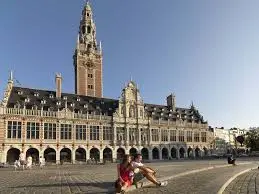
I snapped out of this dark meditation as we approached the ancient city of Louvain, where a hub was situated. Dora and Kim also shed their midday reveries as we drove up to the amazing spires, bombarded by the Germans on a whim as they marched through Belgium in the August of nineteen fourteen, but now partially restored. It was a sight too beautiful to ignore, the 'collegium trilinguam' the birthplace of the renaissance in northern Europe, a hub of intelligence, with Erasmus as its leader.
last post https://www.publish0x.com/robert-oreilly/posit-the-opposite-xoklnrx
next post: https://www.publish0x.com/robert-oreilly/riches-xdqnryp






