
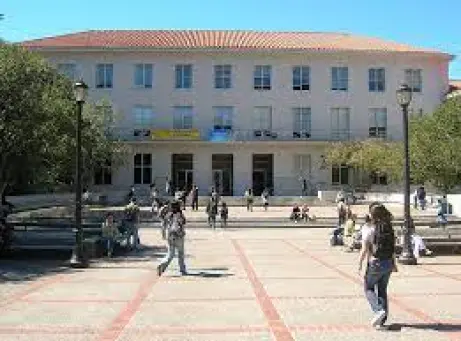
Dwinelle Hall, where the classics department was located.
But back to my Spring quarter of 1975. I signed up for the Greek workshop and searched for a new residence, as Hiram and Strange were going separate ways. And I found it, quite luckily, a room in a house on Channing street, just a few doors above College avenue, a stone’s throw from my first residence at Davidson hall. I lived there cheaply and happily till I finished school. It was a long, skinny room with a private entrance, being a staircase up the side of the house to the second story. It even had a little porch before the door where I could place a chair and smoke my pipe watching the sun set. I took up the habit that year but quit it before I left. Next to my room was a bathroom which I had to share with the three other tenants on the floor. But they lived inside the house, had to come in the front door, past all the other rooms and the landlady. They didn’t have the privacy I had. There was no kitchen, but I didn’t mind. I knew exactly where to eat out on the cheap, and the café Med. was as much my home as anywhere. I went to my lodgings to sleep and shower and change. The rest of the time I was in class or on the town and loved it.
My major was now Classics (called ‘Classical Philology’) and in the next four quarters after that summer I finished all the required courses, four each quarter, overstaying my quota of credits, but no one noticed. I even took the first Hebrew intensive course the next summer, not because I had any real interest in it, but because all the best classical scholars of three hundred years past said it was a necessary addition to understanding the ancient world, (thus the world-famous Collegium Trilingue at Louvain). I followed their advice. I didn’t like this course as much as the Latin and Greek ones. The teacher was less competent, and her and all my classmates were Jewish, wondering what the hell I was doing sitting amongst them, trying to learn how to read the Old Testament. I completed the course and had the pleasure to read a few dozen pages from the book of Genesis and Job in the original. It was quite poetic.
The best thing about this course was the T.A. (teaching assistant). She was the most beautiful woman I’d ever seen, to this day, a raven haired, Jewish miracle of beauty, then in her prime at twenty-three. She had an unforgettably perfect face. I never continued down that study of ancient Hebrew with more classes and forgot it almost completely over the next year. I can barely make out the alphabet now. But being in her presence daily, for ten weeks, made the study palatable, a good exercise for the mind, and the memory of her, unforgettable.
From a few brief notes I made and kept during these years it amazes me the amount of side-reading I was doing during the full course loads each quarter. It was due to my insatiable appetite for good lit. and the cafe Med. I’d be there by six or seven each evening, seven days a week and knock off all my homework first. By nine or ten it would be finished. Then after a half hour of chat with friends I’d turn to my latest treasures from Moe’s bookstore. I see that in the first week of July 1976, in the seven hour a day Hebrew workshop with loads of homework each night, I was also tearing through ‘De Quincey’ and Montesquieu’s ‘Rise and Decline of the Roman Empire’, in French. I also read two more plays of Euripides in Greek that summer at the ‘Café Renaissance’, the only other expresso place in Berkeley at the time, which I’d visit on weekends in the daytime for variety. I remember it vividly. I read the ‘Helen’ and the ‘Bacchae’ in editions with notes and my smaller ‘Liddell and Scott’ dictionary at hand. This was the apogee of my insatiable appetite for great literature and perhaps my intellectual vigor in devouring it, driven on by caffeine.
I realized by my third year that you didn’t choose a course for its subject but for its teacher. There was a list of courses I had to take for my degree and some of them were a pleasure, others a great pain because of the teachers, who differed so much in talent, that I wondered how some of them ever merited any degree at all and then found a post at such a reputable institution. They might have been experts in their fields. But their ability to communicate this knowledge, their teaching skills, were deplorable. I wondered if they went through yearly reviews, or if the evaluations of students, sometimes filled out, received any notice at all.
At least half of the teachers for the courses I took during those four and a half years I would rate somewhere between ‘mediocre’ and ‘horrible’. With a book you have no problems. That’s why I always enjoyed reading. There’s no other human involved. If you don’t like a book, an author, (in my choices usually long dead), you put it down, use it as a doorstop or throw it in the garbage or give it away to some Goodwill store where a far different type might pick it out and enjoy it, and there’s an end to it. If you really dislike it, know it’s so bad it ought to be destroyed, a true offence to human dignity, like some crazy conspiracy theory book, you can burn it, abuse it any way you want, use it for toilet paper in some cottage outhouse, ripping out each page with glee.
I’ve never had a problem with books, even assigned ones. I just didn’t read them, and with my pact with Hiram in mind, I didn’t care. But teachers were another story. Some classes I had to pass and stomach to get my degree.
This happened in a required Horace class, getting a ‘C’, and it would have been lower because I skipped most assignments and classes. But I had a knack for translation on tests. I considered Horace insipid, not worth reading, and the young female teacher uninspiring, unable to change my opinion of the poems. It was a bitter-sweet experience, those last two years at Berkeley. The sweet far outweighed the bitter. But I need to describe both. Here’s an invective I find in a journal written ten years later, in May of 1985. I was in a somber mood at the time so it’s a little overcharged. But it reviews all my teachers, good and bad.
Those who delve deep into mathematics for ten years, with their full minds, have some virtue to start with, and are ennobled by the journey. But those I’ve met on campus appear such clownish goofs and spoilt children, ugly, slovenly, unpresentable oddities, I think for all their efforts they’ve missed the boat. Their characters, like children left neglected in some nursery for many years have degenerated to sickening degrees. One finds them not so much actuated by a quest for great discoveries (though they dream of this) but actuated by more daily, petty concerns, clinging to their little tenure in a childish sanctuary, fearful of graduating into the harsher world where failure is of more horrible consequence and faults of person or character more roughly insulted.
All the younger Classics teachers I met were equally despicable. None possessed an admirable character. Only Andrew Millar seemed near a man. He was kind-hearted and reasonable but was shy and meek to a fault. Mayo was a jerk and child in every sickening way, and loudly proclaiming it with incessant old-maids chatter. Mastronardi was a human mouse, in looks and size and crouching posture and inaudible voice, a joke. Another, in his thirties, was a sadist, red-haired, bearded, not handsome or engaging, filled with seething hatreds and contempt, probably a sharp and wide intellect which preyed upon itself, making for a thoroughly unpleasant encounter. The Greek composition substitute had all the virtues of Bing Crosby, looked and talked as softly and trivially, a fair partner for a lifelong game of whist. The other, the Euripides prof. was the best of the lot, with no obvious failings, but also no apparent merits. He could have been a very average businessman, likeable but forgettable.
The young women almost equalled the male staff in number and surpassed them in mediocrity. Their characters, as with most women, tended to the weak and silly. Their mediocrity was in the intellectual department. Upon reading majestic scenes in Virgil the conversation slid to soap operas and harlequin romance comparisons under their auspices. Their minds were mush, yet they filled a third of the chairs in one of the best schools of higher education in the world. Tizzy Block was the exception, with more spirit and sanity than her associates, who could easily have replaced the dimpled, smiling housewives of laundry soap commercials. They treated us like kindergartners: ‘This class is going to be fun’, they’d proclaim on the first day.
And my fellow students, male and female appeared equally sorry, fit hopefuls for such a society and career, except for R. Glover and P. Andrini, who both wisely got out fast, who could talk with me in a coffee shop with true enthusiasm for literature, even straying from the reading on the ‘required’ lists.
What a difference Pritchert and McKay made to their successors! Though Pritchert stuttered a bit and had the demeanor of some British government functionary with 40 years’ service, habituated to the minute, never deviating much from business, cold to a fault with politeness, he was eminently respectable for what he was. He sometimes hinted vast experience and knowledge in a corollary remark to the daily text reading and stray for five minutes through other lore, jewels to us, but snap back to the text again, having whetted our appetites to distraction. He was faulted in this narrowness, this mechanical British humor that had no humor, and would show his love of literature by slips and momentary laxity. His voice and face softened, but in a minute a stern, clouded look returned, as if he deemed the chief virtue in life was regularity. Perhaps he was twisted in life by sadistic headmasters.
Mr. McKay seemed to me like an elegantly dressed, old Mark Twain, witty, engaging, full of stories and literature, always ready to drift into those stores and fascinate and bless us with them. I respectfully greeted him at a small informal party once and we talked of Froissart and Greek romances, both of us exuding adoration for certain books and an intimacy with long-ago authors as if they were our best friends, addressed by their first names out of fondness, and we talked long and intimately and others wondered at us glancing, till Murgia came up to see what was going on and sat down and joined in our fine conversation.
As for Pritchert, I took a course in Herodotus from him in the Fall of 75. There was a story still current that during the worst of the riots five years earlier, with helicopters twirling by and tear gas dropped into the screaming, shouting crowds right below his classroom in the court of Dwinelle hall, and all the other classes that day quickly disbanded by their teachers for safety, he simply walked to the windows and closed them, as if closing out the world, continuing his lecture as if nothing was happening, almost as if he lived in a dream.
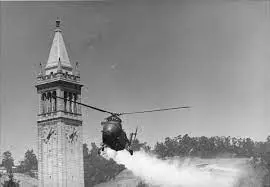
The campenile, not being fumigated for insects
He’d been an archeologist in Greece in the twenties, like McKay, and his slips were the tales of the famous people that he’d met and the wonders he’d seen.
More rioting outside Sather Gate 1969.
And I have two more which Hiram took and in which I participated. It was in the Spring of 1973 over Haviland hall, a small building where police were supposed to be trained. One so-called radical professor there was stripped of his tenure because he didn't just teach police tactics and how to best smash heads in. He gave lectures on whether police forces were good or bad for society or even necessary. When the student body heard of his dismissal we rioted and took over the building for two days and nights, about a hundred of us, with students on the ground bringing us baskets of food we'd raise up on ropes through the third floor windows. After two days we agreed to come out peacefully with no charges laid and his case would be reconsidered. I forget the outcome, but they did have to broaden their program to include humanity.
 This one has Doug in it. I'm in it too somewhere, because I was walking near him.






