
For all my 'doom and gloom' essays of what's to come, my philosophical comparisons of wealth and poverty or reflections upon different ages, the dangers of technology, its advantages and costs, or any other complex question I've endeavored to dissect, I'd like to take a step back and put one thing in perspective:
The real condition of daily, human existence is far different and far, far away from any 'thinking'.
We are emotional and sentient beings, mired in the present, like pigs in a sty, completely happy when an apple falls our way.
I think that any intellectual faculties we have which transgress beyond our daily lives more than a week make up less than one percent of our consciousness.
There's a remarkable line in a famous book where a common farmer happens to run into a great philosopher on a street in London after church. They had not seen each other in thirty years but went to Oxford together as youths. The farmer reminds the sage of this fact, mentions his name and a few occasions where they were together. It takes a few minutes for the other to remember him, but when he does, he shakes his hand, glad to see him again. They walk a while together and reminisce. At one point the farmer mentions how honored he is to be in the company of the world-famous philosopher and says, as if in excuse:
"I too in my time have tried to be a philosopher, but happiness was always breaking in".
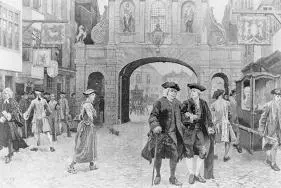
After they parted the philosopher and his biographer, who was there, both noted what a deep truth lay in that sentence.
I was looking through my journals and found the same feeling described, thirteen years ago, working outside with my fellow electricians in brutally cold, winter weather on a new, outdoor mall. But we were in the warm lunchroom for a half-hour break. All of them were younger than me.
Sat. Feb. 15th 2013. Yesterday in our little trailer at lunch my co-workers and I were talking about how cheaply made and how overpriced new houses were. Yet they sell like hotcakes to young couples starting families and to new immigrants who can afford them.
They look nice but scratch the surface and they are poorly built, made of the cheapest materials, often toxic, and assembled in the shoddiest manner, made to last maybe thirty years, whereas older brick homes like mine were made to last a hundred. Their lots are small, they stand row upon row without much variation, tract houses, with a bubble price tag, quadruple of what I paid for my comfortable old home on a quiet street, with a large yard, beside a whole group of other, unique and widely different houses, a neighborhood, not a tract.
Then we diverted to new cars. For one-fourth the price you can buy a fairly new, used one, just as serviceable. But when you buy the new one, you indenture yourself for years to mortgage payments at high interest, your hard-earned money going mostly to the banks.
I call it buying into the dream. It’s like walking through Virgil’s gate of horn. The dream is false and the future is a disappointment. But our society, in its greed, promotes such folly to make us slaves to debt.
New houses are like the institution of marriage, a brief thrill to move into, a short-lived bliss of decorating and showing off, like a Christmas tree with gifts underneath, like the pleasant aroma of a new car that lasts a few weeks. Then the credit card bills come in, and the reality of debt and responsibilities, and the thrill is gone. Financial penalties are the new hurdles to jump, and the bankers and lawyers, fat in their mansions and swimming pools, are smiling.
I write these gloomy truths because many of my hard-working partners in construction have fallen into this trap, the younger ones with young children, new houses and trucks and huge debts, the older ones, with lost homes and divorces, alimony, and little to show in the bank after decades of hard work.
Imagine a society that promoted individual autonomy, which allowed people to form and alter their unions as they pleased, without penalties, like some Hippie commune, children brought up communally, an emphasis on self-reliance and living off the land, making your own tools to supply your needs, build your own house and furniture, provide your own table, in short, life without money, like the Amish, only without the religion.
What a utopia that would be, like the pioneers of old. I was going to add to the last sentence, “an enviable race”. But then I thought of their huge hardships, short lives, and few luxuries. Yet with modern technology and medicine and crops, solar panels and internet, we could build our log cabins with all the comforts of a city house, off the grid.
I’ve been lucky enough to know the deep satisfaction of living in a house I built myself. That cottage is now sold and long gone, perhaps razed, but the pleasant memory persists. There is a huge pride and satisfaction in making something with one’s own hands.
Since I first heard it while still a boy, this line from a Who song struck me as profound: “But they couldn’t keep Jack from feeling happy”.
When we look back at our lives with a long view, we often see a string of disappointments, unhappy childhoods, broken marriages, stalled careers, and injured bodies. But when we look at minute to minute life, in the trailer of my work buddies that I described yesterday as a house of broken dreams, you’ll hear unbounded laughter and gossip and storytelling in a warm room, all the while enjoying a lunch, a plain, simple, familiar sandwich, delicious because of your hunger.
Our daily lives are for the most part a series of happy moments, like those of a child at play, unthinking, unclouded by debts and divorces, bad government and looming disasters. Even if your car breaks down while going home from work, telling it to your companions the next day is often hilarious. Except for the few with miserable dispositions or those in extreme plight, our default status is ‘happy’. Even prisoners enjoy their lunch. Company cheers us. The aches and pains of work vanish with a joke and more than vanish with a drink. The mind is truly “its own place”. It is deviously adept at turning rags into blankets, scraps into feasts of laughter, and creating its own sunlight in a cave. It embroiders life continually with imagination. A few go so far as to straight out lies and invent their life narrative. But all of us are decorators, embellishers, with a skill that outwits reality.
This is the dilemma of wise historians. It seems impossible to represent events without bias or coloring. They can barely scratch the surface of those times as they really were, in terms of the people who lived them.
The innuendos of combinations of words are infinite, like whispers tainting the facts. But reality can't blemish them.
They can be beautiful and convey succinct truths.
As La Rochefoucauld said:
“The sun and death are two things no one can stare at steadily”.
The moment the eye turns away from the scene, a transformation begins with our own personal bias at play, ‘La vie en rose’.






