
Addison, an odd receptacle.
 Construction prints.
Addison knew how to read prints better than anyone, from his New Jersey beginnings in the construction field, and his smarts, which no degree of crack abuse seemed to diminish. I remember one day a ridiculous scene occurred. A group of five men in expensive suits, a delegation one might say, so out of place it was striking, strolled up the hallway, everyone parting the way for them.
They stopped in front of the K.B. store and asked a worker in English to see Addison. He had no reply. I was at the front of the next store and overheard them, introduced myself and told them I could bring him to them presently. Luckily, the box he was sleeping in was in the back storeroom, out of sight. I went there and kicked it several times. It was only ten a.m. and he was in deep REM sleep. I pulled him out. He shook his head a few times and realized where he was.
His daily, unchanging attire for work these days was a white, tank top t-shirt and a green pair of jogging shorts, rarely washed, and sandals. On this occasion the tank top and sandals were left in the box, so he approached the delegation barefoot, in green shorts only. They didn’t seem to mind. They had an important question for him and somehow knew that he was the one person, out of the thirty contractors in the building, (half of them Americans with years of experience) that could best answer it. It was the mall owner and his architects and engineers, all men in their forties or fifties.
They unrolled their large set of prints on the hallway floor before him and everyone crouched down in a circle. I stood right behind them, transfixed by this interesting scene. One man pointed to three faint lines on the blueprint, in front of the K.B. store, with the tip of his gold pen. They were a millimeter or less apart, less than four inches if one applied the scale of the print to the mall. One seemed to mark the mall hallway, the tile line, and the other the storefront glass. They didn’t know what the third line meant and didn’t have available the architect who drew the prints, or it might even have been machine fabricated and even the architects didn’t know.
But Addison did and was quick to answer. The dashed middle line was the zone line, which the store contractor could transgress depending on the footing for the glass. The back line was the storefront glass, the outer edge of it. In some stores the glass went straight to the floor into a slim metal footing, in others there was a tiled, brick base a foot or two high. So for each store, at the base there was some play. The mall floor tiles could be cut to accommodate these inches.
The drop ceiling grid allowed no such play. This answer satisfied everyone. They all stood up and shook his hand, five men in expensive suits and ties, and one scraggly, disheveled, half-awake drug addict in a two dollar pair of shorts. But intelligence finds strange lodgings and one has to go where it is to get it. This was just such a case. Decorum be damned. He reminded me of Diogenes the Cynic meeting Alexander the Great, or rather Alexander going out of his way to meet him, the whole army following behind.
Alexander was appraised of his fame, but wondered how he attained it. He presented himself in his fine military armor and told Diogenes that he would be granted anything he asked. Alexander had just conquered Greece and was in a generous mood.
Diogenes was sitting on the ground, in the dirt, leaning against a wall, in rags. But he’d been enjoying the nice day, the warm sun. He listened to Alexander’s offer with due respect and after a moment of thought replied: “I do have one request to ask of you. Could you move a little to the side. I was sunning myself and you’re blocking it right now. Alexander smiled and not only stepped aside but promised him he would never be harmed. Then he walked away, ordering the city to be plundered, but this man left untouched.
Addison and I went out for beers early that day.
He reminded me of all the dog-eared, student editions of some ancient author I bought, full of priceless knowledge, priced at a dollar in an outside bin in front of the store, because it was now forgotten and out of style, or in Latin or Greek, which few studied. It was almost out in the rain and about to be thrown in the trash if it didn’t sell in this ‘last chance’ discount bin. Many of these ragged, rescued volumes still adorn my shelves. I don’t care what they look like. I know their golden contents.
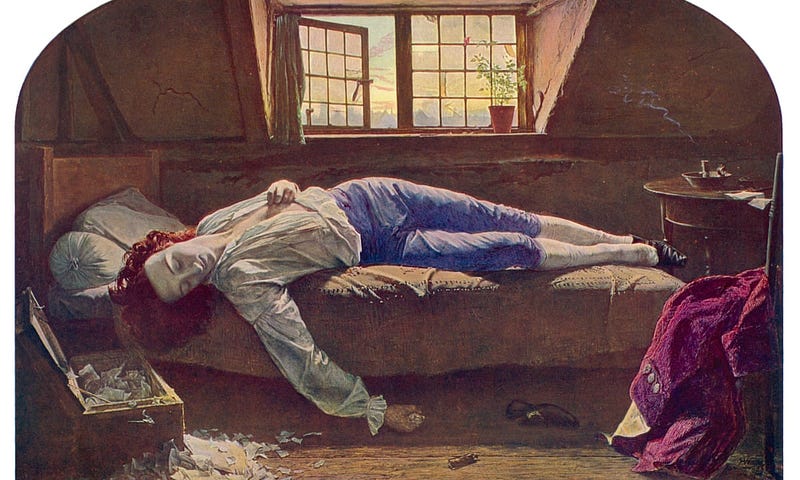 Chatterton’s death
I find the exact same parallel between artists and the works they’ve composed, beautiful works which high society admires and praises to the skies, played on a piano or recited to gatherings, by young women with fine voices and silk dresses, while the authors of those works were not presentable at any soirée.
Steven Foster died in a ditch at thirty eight, a vagabond. Thomas Otway, justifiably considered the second best playwright after Shakespeare, died at thirty three of starvation, lying naked under a sheet in a bed, having sold his clothes for his last scraps of food. Someone came to him and offered a stale piece of bread. He died choking on the first bite, not having eaten in four days. John Keats died at twenty five, Chatterton even younger. Then you have Ernest Dowson and Francis Thompson, minor yet excellent poets, both of them very close to being street tramps.
Some of the greatest intellects of England and France lived beggarly lives. Coleridge, De Quincey, Gerard de Nerval, Balzac, Murger, were often unpresentable to the discerning class of readers who esteemed their works. Samuel Johnson, in his early career had to sit behind a blind in a tavern once to hear his journalism praised. Edward Cave, his publisher, wanted him to hear it from a noble admirer but was too embarrassed to present him in person.
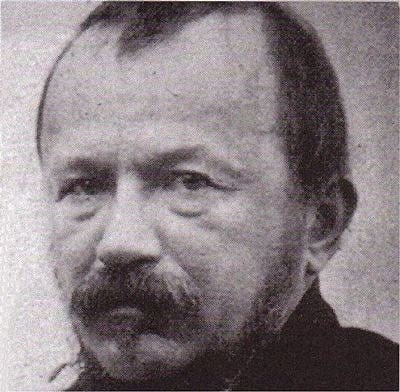 Gerard de Nerval
So, as I said, genius finds many strange vessels to inhabit, a far cry from what polite society expects, (someone in their own image), like a well-tailored Mendelssohn or a handsome Schumann, bowing to the ladies before they played, not the Chopin of 1849 coughing up blood, or a threadbare, unknown Schubert dying at thirty one, the greatest musical geniuses of all.
That’s what fascinated me about these bohemians from early on, attracted me to imitate them. Henri Murger, when finally famous for his book, after years of starvation living, was invited to an upper class Parisian dinner and half of his bottom lip fell off right into his soup in front of some twenty astonished socialites. He was rotting by then and died less than a year later at thirty eight. His body was spent. His mind was inspired. None of the company present had anything near his comprehension of human existence. I didn’t follow bohemians per se, down a road to self-harm, but I knew the highest peaks of human excellence, intellectual and artistic, at their shining best, are found in every strata of society, young and old, educated and tramps. The world slowly recognizes their merits, often too late for recognition and rewards they deserved. Yet in their own minds they enjoyed incredible richness all along.






