
Previous Chapter ...
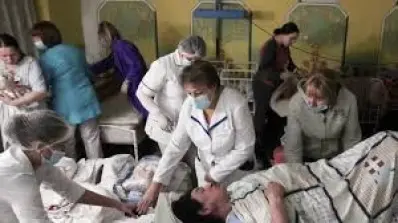
A War Zone Hospital nbc.com
The first thing I did was to thank him for carrying the Russian wounded to our hospital. He was sitting at his desk, alone, but I caught him deep in thought.
“I’ve followed your suggestions” he said, “but we need to have a long talk. Some of these troops we round up are not going to be amenable to total surrender and compliance. They might be die-hard Russians, their hate towards us insurmountable, over any offerings we make. And what about the commanding officers?”
Just as he said this Sheila entered the office. I jumped up and kissed her. We offered her a seat, and I continued the conversation.
“I’ve been dwelling on this very question since I left yesterday. I know the top command will refuse to surrender and they’ll have a number of junior officers and men of the same opinion, ready to die.”
Here Sheila interrupted us. “That might not be so. I spent yesterday interrogating some of the sailors we picked up along the coast. One was the captain of a larger vessel and I’ve brought him here, along with several others. I learned some interesting facts you need to know.”
“The ships we didn’t destroy barely made it to the rest of their fleet off Brooklyn. They have no fuel, none of them. Ship fuel is far heavier than diesel and we don’t produce it. The closest refinery for that is in Houston. That’s why they never sailed down the coast to chase and destroy our own smaller fleet. They’d never reach them. It’s hard to fathom but they were sent across the Atlantic with just enough fuel to reach our shores. They were meant to take Montreal and refit the refinery there to refuel and conquer the rest of the continent. Only the very top brass knew of this. Such a mad and desperate plan had to be kept a secret, or riots would have broken out.”
“This captain I’ve talked to told me even more. The commander of the fleet is named ‘Goudov’. He’s alive and in the harbor on the largest destroyer they have left, and he’s very unhappy, feeling betrayed in fact by his leader, and I think willing to negotiate. That’s the word I heard, as the secret leaked out after they lost Montreal and every sailor and soldier heard they had no fuel to return home. The swabs in the boiler rooms knew that and word spread up through the decks.”
“They’re demoralized and don’t know what to do. They can’t do anything. They can’t move. I think it’s up to us to make some offer.”
General Wilde was ecstatic hearing this news. He stood up.
“This is great” he began, “but let’s give it time so that the catastrophe sinks in. Like I was just explaining to Luke, I’m sure there are die-hards who will fight us to the last bullet or blow their own brains out rather than surrender. I’m sure if we just contain them with our forces, surround them at a distance, the disaster will sink in. They’ll consume their supplies, and we’ll send envoys to knock on their gates, Russians with generous terms, to a camp much like Luke so vividly described to me when he entered Hamden with Johnson six years ago.”
“I don’t think we have to wait that long. Hamden looked like Auschwitz. That’s out of the question. Give them a few weeks and let’s send every one of their recovered wounded back to them, anyone who can walk. They’ll be proof of our humanity. I was researching our geography for my book before this war. There’s a fine swath of farmland west of Trenton. It borders on the counties we were just resettling. Send them there. Tell them it’s theirs to rule and farm and start a new life, their own little kingdom. It’s far enough inland from the sea. We’ll have to deal with their ships separately, refuel them one by one and send them south with our men on board. I’d like to try out my Russian and volunteer for these negotiations if you’ll let me.”
“You’re my best man for any job” Wilde replied. “I just have to make sure you’re safe.”
“I’d like to go with him” Sheila added. “A woman will make it seem more civilian, not military, and from the survivors we picked up, there’s a large percentage of women we’ll be dealing with, and I know Russian too.”
“Settled” Wilde exclaimed.
Sheila and I retired to the hotel, promising Wilde to meet him in the afternoon. Nothing could be done before more reports came in. We lay in bed together and kissed, too tired to eat or think. Both of us had only a few hours of sleep the last two nights. Even the noise of the raucous party above us didn’t stop us from falling into the deepest slumber, waking up fresh and happy in each other’s arms.
In a meeting with the general and several of his colonels the next day, we heard that matters were proceeding to plan. The Russian detachments had been surrounded and surrendered, with few casualties. The same with most of the troops who had scattered to the east. The road to Boston was clear and the town deserted. The one immediate problem was the number of wounded and lack of hospitals. Some, who could be moved were being sent to Montreal, our largest facility, or to homes there, where the citizens volunteered to take in any they could take care of, while the doctors or nurses made their rounds and checked on them once a day.
The Russian force had moved due south and made it to New Haven, where the remnants of their fleet could protect them. From there they could join up with the rest of their army in a day. But I told Wilde this was great news. Not only would they learn of the naval defeat, and their predicament, but they gave us a clear road to join up with Johnson and combine our forces.
They made the best logical move, given the circumstances, to hole-up in New York, an impregnable fortress with their ships. But now we could surround them, and all the rest of the coast was ours.
We left Springfield that afternoon and met with Johnson in Morristown. There was a medical center there still standing, in what I called the sweet zone, just outside the Church’s destructive reaches in the early years, and too close for marauders to loot and pillage freely, just like Durham college. After a quick tour of the deserted buildings, we saw they could easily be restored, house soldiers and a hospital, in a good position to keep an eye on New York, with plenty of woods to the south.
Johnson agreed to relocate, but one of his majors, in charge of a regiment from the south, a fourth of his army, insisted on occupying Fort Dix, to guard against any Russian incursion in that direction. As we sat around a makeshift conference room with a dozen of his officers and ours, they didn’t quite fathom that there would be no more incursions, that the Russians were not only trapped, but totally defeated. So I whispered in the general’s ear to let him have his wish. Reduce Johnson’s numbers. We didn’t need his troops; we needed all our wits in diplomacy. Most of all, we needed to act in full accord and agreement.
After more heated debate, I finally convinced the hard-headed officers that the time had come not for offensives but bargaining. The Russians had no more bullets and nowhere to go, and a slaughter was out of the question. They slowly came around, like little boys being told their game of cowboys and Indians was over. You could see the disappointment in their faces, almost pouting. They were Johnson’s boys and had been sitting and waiting (or rather hiding) for over a month without firing a shot, polishing their guns each day, and their mentality was such that the bars on their uniforms were only deserved by scars on their faces and heaps of dead soldiers around.
It was wise of general Wilde to seat me at the head of this table because I had a clear solution for their disappointment, their lust for blood and danger, which no one had thought of yet. We wanted this war settled amicably, to our advantage, with a new and vibrant set of colonists, expanding our whole eastern seaboard inland another hundred miles, with the gain of a diverse gene pool, enriching our culture with theirs, assimilating, absorbing, growing, just like America did in the past, making it what it is.
I didn’t explain these ideas. They wouldn’t have satisfied these men. They were too abstract. Wilde’s officers had their fill of carnage and forced marches and sat quiet. It was Johnson and his men I had to appease. But just as I about to unfold my solution, during a temporary lull in the haggling that went on about who would be positioned where in this Russian stalemate, general Johnson rudely said:
“Who put you at the head of this table. You’re not in charge.”
Wilde quickly replied: “I did, so listen up, or it will be you and I coming to blows and the Russians can have what’s left of this damned, divided country.”
This caused an immediate silence.
“I began in a soft, conciliatory tone: “The Russians aren’t our concern. They’re defeated. They have no fuel for their ships so they can’t sail home. They have little food and ammunition of any kind left. Consider them immigrants on Ellis Island. We’re preparing envoys right now to negotiate, captured officers from their ranks who’ve agreed to our generous terms and wish to save their compatriots. We’re offering them land to settle and farm and everything they need. They’re switching sides, to our side, so treat them like brothers. It was an easy choice between that and death. Besides, their lives will be much richer here, with freedoms and choices they never had back home.
“We’ll also be taking over their fleet. We can refuel it. They can’t. I want you to query all your men for sailing experience. If we can’t fill that quota, we’ll be working alongside some of them. Get used to it. This war is over. But another much larger one is just beginning, and anyone of you with bloodlust and a love of soldiering in the wilds will get your fill. It will start in a few months once the Russians are disarmed, settled and happy. I think a number of them might be fighting alongside you.
“We’re going to retake the continent, expand west. It’s been called ‘no man’s land’, ‘badlands’ and might be filled with the savage remnants of those that disobeyed the Church. They’re likely to be diseased in mind and body, maybe even demented. But those that have survived this long have plenty of weapons. There may be groups and fortresses. The reason we haven’t attempted this yet is because we didn’t have the manpower. Now we do. Our only route to the west coast is through Canada. We need interstates ten, forty, seventy and ninety open again, and busy with commerce.
“You’re going to be opening up a treasure chest of wealth, factories, refineries, distilleries. The loot alone will make every one of you rich. You’ll be resettling your families in empty mansions once the land is safe, looking over thousands of acres of farmland, yours to own and till, once we rid it of the remnants of men who wouldn’t accept the vaccine. Now isn’t this better than waging a war against a small band of misdirected Russians, with no profit in it, only casualties?”
The table stood up and cheered. I thought to myself I was getting better at such speeches with practice. Both general Wilde and Johnson shook my hand. Their officers were eager to leave and tell their men. The room cleared, except for the three of us and Sheila, who’d been standing by the side. Johnson needed the most filling in. We all took turns at that. But everything was pretty much in place.
Over the next week we organized a tight circle of posts with good communications and reserves behind them, on the odd chance the Russians might make a sally. But they couldn’t, too weak in every department, living off the scraps they found in the city and more demoralized with each passing hour.
When we sent our Russian captain across the river in a cruiser with a white flag, he was well received. He was motored back across the Hudson in an hour with a high-ranking naval officer for us to hold as hostage, begging us to send our team to parley a truce, a settlement of the face-off, an end to the war.
Sheila and I and general Wilde himself, with a staff of ten, made up the delegation. We had no fears of treachery, and the Russian commanders respected our trust and show of good will. The discussions were formal at first but soon turned amicable, as I laid out our generous propositions in my nineteenth century Russian.
The commander of their force broke in at one point: “This is no surrender. You’re offering us full rights of citizens, not just amnesty but property and full freedom. I’ve never heard of such generosity. I couldn’t conceive of better terms. We lose nothing and gain everything. You can have our ships and our rifles. You don’t even ask for those, just our friendship. How can we refuse? But one thing, you make yourself perfectly clear, but your vocabulary is from a century past. Where did you learn your quaint Russian, from some ancient book?
“Dostoyevsky and his contemporaries” I said. “That’s all I know.”
“Well you’ve learnt their humanity also. I’ll immediately sign a formal agreement with you, and all our men will be more than delighted to hear these terms. Will all of you come to the bridge with me and announce them? They might not believe me. But they will believe you. Your face is known to them, and your Russian will honor them.”
I repeated our terms to a few hundred men and women on deck with general Wilde on one side of me and Sheila on the other with the admiral. I asked Sheila to say a few things, amplifying our desire to integrate them into any field their expertise or interests might lie. She said our greatest need right now was medics, to heal those wounded and that our few hospitals were full of their soldiers as well as ours. We would be grateful to have them work alongside our doctors right away. This drew a cheer. Their immediate needs were rations, to be delivered to their ships. Other than that, we held daily conferences to work out the details of such a complex merger. But with each article agreed upon, the farmlands and towns mapped out as theirs, they could relocate at their convenience, in whatever manner and numbers they chose, to ensure their security and our good faith.
These terms they conveyed to the soldiers in New York who were also running out of food. Within a few days landing crafts began unloading hundreds at a time on the New Jersey shore. We provided fleets of buses and with their rifles in hand we guided them through the empty expanse of farmland, dropped them off in a small town and carried a few of their lieutenants back later, to testify to the others that all was good, that they’d been given a territory so large it was a fortress in itself. After that the exodus took off and three or four hundred a day were transported to choose their new homes.
When the city was emptied it was time for the ships, a more delicate matter, as their big guns had munitions and could do a great deal of damage. But our negotiating team was busy bargaining with their naval commanders every day. Some were opposed to any surrender, and we agreed to refuel three of their ships to sail back to Europe, with whatever crew would go along. These hardline commanders had trouble finding the crew to go with them and in the end only two ships left. Both Sheila and I convinced Wilde this was a good move, because we didn’t want these die-hard communists in our country and two ships posed no threat. Besides that, they’d have a hell of a time explaining how they made it back. They wouldn’t be revealing our generosity.
The admiral and most of his staff agreed to stay if they kept some shreds of command and authority over there much diminished fleet. We offered them more than that. We proposed a merger with our fleet in Houston, to work as a whole, swapping half of our own officers with theirs on each ship, manned with both American and Russian seamen. Those were the terms and we felt comfortable with this as we had many more sailors than they did. But we assured them they’d have full respect and authority according to their ranks, and with all the fuel we had they could practice maneuvers for months and become one integrated team over time. We decided that six large vessels and dozens of smaller ones would fill all our needs, some patrolling the Atlantic, the others exploring the Caribbean and further south. Many of the sailors just wanted the feel of solid ground under their feet again and were decommissioned.
And here the question of women came up. I attended all these negotiations, Sheila too, because we saw it was a bargaining point full of rich possibilities. Their female contingent numbered over five hundred. The vast majority of them didn’t want to serve on the ships or in the army. They were conscripted at gunpoint, and most were young. Some were eager to go to the new territory and find a mate and start a family in some large farmhouse. But I insisted we make an exchange, with tempting enticements. Boston needed to be repopulated and had many fine, empty mansions with small fields beside them, self-supporting units.
We drove busloads of these wide-eyed girls through town and promised them such dwellings if they would consent to an American husband of their age and choosing. They’d never seen such luxury as we walked them through the satin curtained living rooms with plush furniture, pianos, the dining rooms, tiled kitchens and guest rooms, with oak wood flooring and Persian carpets, turrets and bay windows.
Most immediately agreed, almost swooned, forget the husband. Any man would only be a side accessory to such elegant accommodations. We told them they’d have to farm and raise children, learn English, hard work, but their eyes were bedazzled.
I suppose the Russian men drew the shorter straw, American women being more demanding than European ones. For each of theirs we promised an American bride for a Russian soldier, and I left that to Sheila’s ingenuity. She had notices posted in all our hospitals and town halls. For those who lost their husbands in battle, and those unmarried or unhappily married, there would be a triple allotment of land if they took a Russian husband in the new settlement. Dance parties, shindigs, barbecues were arranged where they could mingle and meet. The soldiers spruced up and did their best to learn a few words of English. They’d never seen such a line-up of well-dressed single women, the feasts and music, and danced their best, kissed hands and bowed. The American girls, unable to communicate, had the harder choice to make, but chose by politeness and looks and their own instincts, as they always do, and many joined hands.
Most of these ‘adult-exchanges’ worked out. The language barriers took a good year to overcome, so they could barely argue. Most men are intrigued by a foreign bride, as if they might smell different and bewitch them in bed. And foreign mannerisms are always an exotic allure. The women were soon mothers, with their minds on their children. But it was the affluence of our land that smoothed over most cultural differences. If a husband wanted to please his wife with a gift, there were jewelry stores a day’s drive away full of treasures. If she needed a crib, or any furniture, that too was free to collect in the back of his new truck, along with any tools or farm equipment he fancied. They felt like they were in the land of milk and honey, and they were.
Here is a link to the beginning of the book.
Chapter One ...






