
Previous Chapter ...
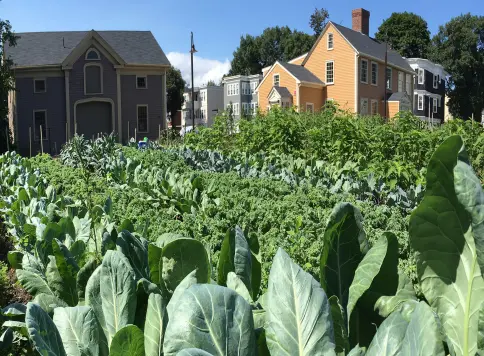
Farms downtown. FCE-Brassicas
I spent the evening with the doctors and scientists. They ate together. They wanted to hear about my house so hidden away and they were surprised I enjoyed more civilized amenities then they did. They rarely had meat, but plenty of fish again, almost every night, after a year’s interruption. They had the fresh produce which the people of Boston grew between their houses and in vacant lots. Empty houses were razed to the ground for just such a purpose. And almost everyone farmed. There was little else to do. And doing everything by hand, planting, watering, and harvesting, it took most of them to feed the city.
But they were happy with this new agrarian life, right in old downtown. The finest old houses were given to them, filled with four-poster beds, quilts, carpets and elegant furniture. This was a district the mobs didn’t reach before being called off by the Cardinal and his rows of police. Harvard commons was now a pumpkin patch. The old sports fields were now wheat fields.
These survivors lived clustered together now that the plague was cured, for safety and a sense of community. They had their plots right beside their homes. They had no transportation beyond bicycles, no electricity, but they were prospering. Some of those who had been torch bearing rioters were now your friendly next-door neighbor, settled with a wife, tilling the ground beside you, exchanging civilities. Their only fear was an invasion from New York and so they held weekly meetings and formed citizen militias, given guns, just like in colonial times.
In fact, the more I heard of their lifestyle, it mirrored our colonial times to a tee. The plague had thrown us back two centuries. It was Boston 1760 again, same population but living tighter together, and the same lifestyle. Only the port was different. There were no overseas ships full of immigrants, only small fishing boats with sails.
And it made me wonder, as I heard these descriptions, if people were generally happier back then and led more fulfilled lives. I decided on their side and that our modern progress had only screwed us up.
I said this aloud to the scientists. A few nodded. My young doctor friend, Jim, spoke up and said he missed a few modern comforts, like his book and music collection, most of the books on the campuses having been burned in the first riots. He also missed brandy and pipe tobacco and lights at night to read by and a hot shower in the morning.
When I told him I had every one of those comforts at my mansion with my solar array, my fine library of literature and downloads of the whole catalog of music, playable on the finest speakers, his jaw dropped, and the others stared at me in envy. I told him I’d take him there someday and he could stay a month, as we had a guest house and I loved conversing with him. We’d have coffee and a pipe together at the fireside after a long and leisurely dinner, pick out some old volumes and talk and read, while enjoying a symphony.
I truly meant it and he said he’d take me up on that offer. I thought it would be in a year or so, when our route there was under our control and perfectly safe again. But I was wrong. He was there in a week.
Before dinner I asked what we were having, and then riffled my Cherokee for any condiments. After the plates were set out, to prove my boasts, I produced from my pocket a full pepper shaker, a jar of tartar sauce and another of horseradish, setting them down in the middle, asking if anyone would enjoy some seasoning.
Their jaws dropped again and their mouths watered. It had been three years for most of them to enjoy anything like that. They especially lusted for the tartar sauce. It was passed around and almost empty when it finally got back to me. I was their best friend instantly. The whole table of fifteen perked up in conversations of all sorts, almost drowning out one another.
And I had one more gift, hidden in the lab coat they had me wear. I kept this one till we finished eating.
I never could live without coffee. It had been my staple since my student days. So when Nancy and I first supplied the house in the woods, I ordered an inordinate amount of many brands. This was the one item; besides wine, I spared no expense in buying. My publisher thought his secretary had copied it down wrong. But when he saw the page of thirty varieties, five grinders, three espresso machines and amounts adding up to over four hundred kilos, even naming the store in New York where she could purchase most of it, he had her call and she verified the ten-thousand-dollar expense. He took the phone from her and asked me if I was crazy.
“It’s cheaper in bulk” I told him, “and it keeps me writing late into the night”. That shut him up immediately. The delivery was done.
This morning, after giving two bags to the General I kept five others in the car for myself. Now I produced one for the table, holding it up and they were awestruck again and started clapping. There's a hundred things we use in daily life and never think about and never run out of. But if we do it’s a shock. And if we acquire that item again after a long absence, it’s a godsend.
Imagine things like coffee or liquor, cigarettes, sugar, gasoline, even razor blades. That’s where these people were now. That’s why they didn’t send out patrols anymore, they were nearly out of gas. As for razor blades, they simply reverted to the Roman practice of sharpening a good knife blade everyday. But some grew beards because it was too much trouble. As for soap and shampoo, or toothpaste, they still had plenty. Looters never took such items, even from stores. And with only cold water, everyone bathed less.
Our dinner lasted long, full of lively and diverse chatter. But one thing I noticed, these people were bored. They had nothing to do. Their only patient was Nancy, and they hadn’t had another serious one in a year, since the last skirmish and a few bullet wounds, now that the plague was gone.
I spent the rest of the evening with Jim at Nancy’s bedside. She was now able to talk and couldn’t thank him enough for helping in the operation, or me for finding him. The others checked on her so frequently, she said she felt like a superstar. She was, I told her. But I’d be going away on some missions and visit when I could. They told me she’d have to stay there, immobilized, her leg in some kind of traction, for at least six weeks, then another four of physical therapy, to repair her muscles before she could walk and run again.
But if all went well she would. I couldn’t stay put for that long, or under the thumb of the Church, paraded around. I told her I’d made a deal with the bishop and was heading West.
“I hope it’s not dangerous”, she said.
“It might be but it’s important. The bishop has agreed to it. I have a plan, to consolidate the people inland, have them join us and end these ridiculous wars and stalemates. It involves us in finding some of them to spread word of the vaccine, which we’ll give them freely, asking nothing in return and see what happens. It could save many lives. It might reunite the world”.
“Jim will stay here with you and keep you up to date. He can explain everything about the state of the Church, why it’s failing and falling apart and why I need to go right away”.
“I drove you here for your operation. But when I learned all these pieces of information, I saw that I could make a difference.
“Wouldn’t it be wonderful if I could drive you home in three months, all the way through a peaceful countryside with farms and a few towns rebuilding, everyone free from the plague, with people who would greet us just like it was four years ago”?
“The looters and rovers are so depleted now they can be wiped out. We have a new weapon, the pill. For that they’ll desert to us in droves. And the sick will be cured. But we have to get this message out now, to save all those left worth saving”.
Even Jim was surprised to hear my daring initiative.
“I’m on your side Luke. Just tell me what to do. And all my friends are right behind you and I’ll tell them what you said here.”
I needed to think about tactics and left them. I paid a quick visit to the general, saying I wanted to leave in the morning with one of his best combat men.
“What do you want, a sniper or a Navy Seal. We have both”?
“No, I want an intelligent partner who can handle an Uzi, who doesn’t hate inlanders and can keep a cool head in tense situations. We’re going out there as negotiators, civilians, not killers. We’ll take Nancy’s Wrangler. I know you guys are low on gas. And don’t have him dressed in white”.
“What’s this about an ‘Uzi’? I haven’t seen one of those in ages”.
“I have three in the car, with dozens of clips. I’ve found them to be the best weapon in negotiations with these brigands. They come well-armed, with guns pointing at you. You can hide one on your back and if things go south pull it out and fire away. A hidden handgun is also an asset. Just give me your best professional soldier. Someone who looks like a plain civilian but is deadly when he needs to be. The most important thing is that he can keep a cool head”.
“I know just the man you need. But you’ll have to pick him up at one of our bases. It’s about thirty miles from here, near Exeter. I’ll send someone now, so he'll be ready for you at sunup. He was able to infiltrate down the coast to the outskirts of New York by himself last year and talk to a few farmers and bring back information. One of the things he found out was that their Cardinal died a few months after the war was declared. Then they squabbled over power, which bought us time. But you’ll have to give my man some of your own clothes. We don’t have such things here anymore”.
The next morning, getting ready to head out, the general came with me to the garage and told me he was the man to depend on in a fight and one who would stay silent until then. His name was Tom.
I pulled out some clothes and the Uzi’s while others hitched up a low, open trailer with a table and wood strapped in it. As the general handed me the envelope of pills and the message, he asked to see one of the guns, gazing at it like a child.
“Here, keep it”, I said”. We only need two”.
He took it, admiring its streamlined deadliness. “Nice weight and feel” he said, as he cradled it in his arms. “I’m going to keep this in my office. One of these days I’m going to have to give you something big in return for all these presents you’ve given me”.
“This envelope of pills is a hundred times more valuable than anything I could ever ask for”.
He smiled and soon I set out. Jim came down to wish me good luck.
But as I started driving away, that envelope and what I’d said to Jim the night before put thoughts in my head. I had to get some of these life-saving pills to those I left behind at my farm, and maybe other supplies from the base, as soon as possible.
We used to be seven there and all of us were busy handling the daily chores to survive. Now there were only three, with me and Nancy gone, Bill was wounded, and I wondered how they fared. I worried about their safety.
Soldiers stood around in the garage in groups of three or four and they all looked bored. I guess when you run out of things, you run out of things to do.
What my mansion needed most, besides these pills, was people, manpower for protection, perhaps a few soldiers and one or two of the scientists for knowledge, maybe a few young women from this outpost to help in the farming, to give Jane and Miranda much needed company.
They might be surviving right now but I knew they weren't happy, or in any way feeling secure. A pang of guilt hit me for leaving them.
That was the favor I could ask of the General, and I know he’d grant it. But they were far away, a six-hour drive west and I didn’t know what dangers lurked outside the zone. In my rushed trip here with Nancy, I thought we were just lucky to make it, my blind luck once again, in full throttle.
I arrived at a much smaller base and met Tom. I found out he was special forces before the plague and had been in a few far-off wars, with eight years of service. He also knew this area well. He told me Manchester was quite a risk when they occupied it two years ago. There were people fleeing in and fleeing out when the Church formed and commandeered the army. Their first outpost was near Lowell. But the renegades wanted to distance themselves from our army and fled as far as Manchester.
Then a big battle took place and we won, losing a hundred soldiers but killing twice as many. They retreated inland and we built the large base there, right downtown.
“We wanted a base as far from the Church as possible, to be less under their daily scrutiny and daily rituals. So we convinced them the further out we cleared the territory, the safer they were from any sudden incursions. We set up watchtowers every five miles due south down to Providence and east to Portsmouth, both of which are well populated with our own. That’s our territory, and the whole coastline, now dotted with farms free and safe. The fisherman don’t go out far and keep in daily contact with them. They don’t have to go out like they used to. The sea is full of fish again, and besides, they use sailboats now. The trawlers took up too much gas.
“When New York declared war they made most of Connecticut a no man’s land. We fought a few skirmies but neither side had the manpower nor the willpower to fight, so we built our trenches and lookout posts around Providence and nothing’s happened since. I made it down the coastline by night, after all the power grid failed, but never inland. I think the whole state is pretty much deserted by humans. The rats and dogs are doin fine.
I couldn’t help notice his Irish brogue and asked if he grew up there. He did as a child, then his parents moved here, ten years before COVID. He joined the service as his best career choice, growing up in a poor part of Beantown. I was beginning to like the fellow.
We were now ten miles up the 85, no sign of life at all, outside the zone on the outskirts of Durham. We took an off-ramp and drove closer as the town appeared so peaceful and intact. We pulled over on a hill above it.
Looking through binoculars, there were no signs of life on the streets of a campus nearby. This didn’t surprise us. The other parts of the town, most of it, suffered fires but the campus area was spared, green in fact, just deserted.
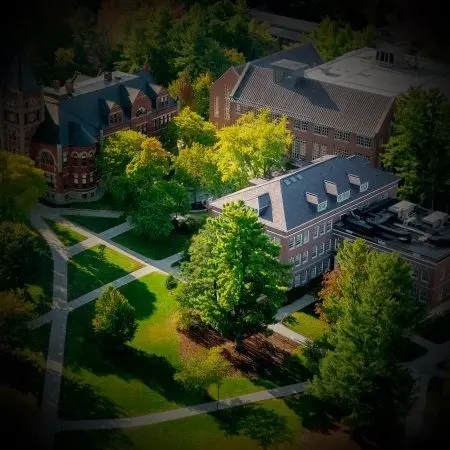
A Campus with no one in sight.
I spoke to Tom: “I don’t think anyone is here, and look, the campus is in perfect shape. Let’s drive down there and see if there are any books left. That building to the left looks like a library”.
“You must be quite a reader if you're willing to take such a chance to find some books. But I’ll go”.
“There’s nobody here. I bet this whole town’s been deserted for months. And now I think this plan with the bonfire is useless. If we are going to find anyone, we have to jump right in”.
We drove down the hill, took a few turns and stopped right in front of the structure. My hunch was right. Carved into the facade of the entrance was ‘Library’.
We entered this beautiful old structure and sure enough, found it undamaged inside and eerily silent. It had the beauty of an ancient church. We went up one floor and there it was, a library, all the walls covered with books, mostly new. As I walked over to examine them, it was the science section, with recent volumes on every subject imaginable, and journals too.
“Wow” I thought, “what the boys in the lab wouldn’t give to be sitting in this room”.
“I know who you mean” said Tom, “but they don't leave base and the church condemns reading”.
"Well, I've seen plenty of drinking and smoking going on in the one day I've been there. They may as well read too and be complete sinners."
‘I read,” said Tom. “I wonder if there’s a section on military stuff, magazines with the latest in gear and guns”.
I told him to gather up a few books and magazines for him and his chums. I went exploring the other way. I found the literature section and picked out a volume of Hemingway and a collection of Mark Twain, and a stack of novels Nancy would like for her bed indisposition. He came back with a stack of magazines, which he said his buddies would love.
“You see, we can break the rules, always do. The Church doesn’t bother us. They rarely visit and we see them coming. Besides, we have the guns. Their puny police force would run if they saw us coming. They’re only enough to keep the odd villager in line”.
We walked our prizes back to the car. I was hungry and told Tom I had a few cans of beans and bread and a propane hotplate. We could sit on the steps beside us and heat them up. He liked the idea. What we thought was going to be a dangerous mission turned out, so far, a pleasant picnic. We lounged and ate, leafing through our new finds. It was a bright, warm spring day.
Halfway through this leisurely meal we heard some bustle in the bushes near the side of the building, footsteps breaking twigs, then the voice of a woman as she peered around the corner.
“Can I have some”? She asked in a plaintive tone.
We turned, completely surprised, and then she stepped out.

A young woman appears. Annapurma Mellor
She didn’t seem scared of us, only hungry. She had nothing but a blue, skimpy dress, posing no threat. We invited her over, put another can on the stove and asked what she was doing out here, in blue?
One of her hands was bandaged up in a white ball of cloth. She sat down next to Tom and explained she’d had little to eat for days besides apples. I handed her three slices of bread which she instantly devoured.
“Thank you”, she said. “Please don’t rape me. I’m tired of that”.
We told her we were decent beings and would never do such a thing.
“I asked if her hand was hurt”. She said she broke it just a week before, trying to open some bar on a steel door, banging it with her hands to no effect. Then when a crowbar slipped, it pinched her hand. She said it hurt constantly.
“If you come with us, we can have that fixed at our hospital”. Tom offered.
“I never knew there was such a thing”, as she continued eating. Tom could see she was so famished he handed her his half-finished bowl of beans, which she also devoured. Soon the next can was warmed enough and he re-filled her bowl.
“How did you get here? Have you been living here for long’? I asked.
“Two months now” she said. “I’ve been alone, when the last of my group died of the plague. I’ve been sick with it too. Aren’t you scared to catch it from me”?
“No. We have a vaccine and can give you one right now. It will make you better. We’re immune”.
I stood up, turned to the car and took one out of the envelope and handed it to her. She looked at it for a second then ate it saying, “What have I to lose”.
“Please” I said, “trust us. We wouldn’t let you approach if we weren’t immune, and you’ll see how we take care of you. This will make you feel better in days, and you’ll be immune ever after”.
Her look of despair slowly vanished.
“I haven’t met nice people since it all began, and you seem nice. I didn’t know there was a vaccine. But I wouldn’t. I’ve been living with outlaws all these years, a motorcycle gang. One by one they died off, in gunfights or the plague. I came here with the last of them when he was very sick, all the way from Farmington by foot. It took us three days. He could barely walk. Our gas ran out almost a year ago”.
“But why did you come here”?
“We lived here a long time, in the tunnels under the buildings, and made raids from here. This is where we kept our stash. It’s a safe place from other raiders, too close to the Church lands for our enemies and the Church never comes here either. But there’s little left to eat and I’m slowly dying. So I came to you when I smelled food”.
Tom spoke up in the gentlest voice. He’d been staring at her the whole time. He seemed to be enamored.
“You don’t look that sick to me, just a little malnourished. You look beautiful. And we have plenty of food for you, and we’ll fix your hand, even prepare you a hot bath and some new clothes, and a bedroom all to yourself, which you can lock at night”.
“Sounds wonderful” she said, now smiling at him. “But wait till you see me when I’m sick again, like a ghost, unable to get out of bed for a week”.
“That won’t happen now that you’ve had the pill. I’ll take care of you. I promise”.
“But one thing” she continued, “I can’t go back to the Church. They’ll never take me in from what I’ve heard. That’s why I didn’t go already. I used to be a stripper. I heard they kill people with wicked sins. That’s why I joined the motorcycle gang when the city was cleared. One of my boyfriends was a biker and they took me in. There were five of us girls at first, and thirty gang members. We were invincible, riding into towns and looting and taking anything we wanted. The few left behind would hide in their basements. We’d bring our booty back here and feast and party for a few weeks, then ride out and do it again. We called ourselves ‘the pirates.'
“But even in the first year we lost four members to the plague. Everyone had it in some degree, and it kept coming back in waves and more black marks. See here”.
Sliding closer and closer to Tom I could see she was flirting with him already, or maybe she was just so happy to have found a protector, her survival instincts were taking over. She unbuttoned the top of her blouse and showed him a black spot on her white bosom, just above her bright red nipple, equally displayed.
Then she went on with her story. “The second-year things started getting worse. We made peace with the rival gangs. There was so much to take we just divvied up the map into territories, each gang with their own turf. But then things started running out and we made small raids into other people's back yards. Then there were fights. In one we lost five men and two of my girlfriends. Even the few townsfolk went ugly, trying to guard their last few things.
“They’d hide on rooftops and pick one or two of us off with rifles, while we turned around and sped away, which they never dared do the first year. By the end of that year, we were down to six and also out of gas. We’d emptied every abandoned car we came across and now they all were empty. So we hunkered down here and one or two would sneak out at night and pilfer what food they could. There are apple orchards nearby and some vegetables. But our diet was poor and one by one they died of disease and drinking themselves to death. Now I’m the last one, all alone”.
She started crying what is best known as ‘crocodile tears’.
Tom offered her his arm with its light jacket, as if some kind of handkerchief and said. “You're not alone, as long as I’m around”.
He moved his arm around her shoulder and she leaned into him.
I didn’t interfere in this melodramatic scene. I even hoped they would make a happy couple. But I also thought about some things she’d said, being rational still, unlike Tom.
I let them enjoy their cozy symbiosis for a few minutes, admiring such a rare scene these days, but I had a few questions.
“Excuse me, could I ask your name”?
“My name is Myra Peterson. What’s yours”?
Formal introductions were made as she wiped her tears on his jacket folding back his limp arm with a smile, setting it gently in his lap, as if it were jello. Then she sat up straight, out of her slouch of despond, revealing her fine figure.
“I don’t mean to pry” I began, “but you said these tunnels, your home for so long, are out of food. But you also said the last few of your gang drank themselves to death. How did they do that”?
“Oh, in the early days we looted whole supermarkets and used trucks to bring it all back here. We found one large warehouse, an alcohol distribution center of some kind and it was full. So we emptied that out too. There’s still a half-tunnel full of it. But you can’t live off whiskey. It will kill you if you try”.
Of course I had to ask her the next obvious question.
“Can you show it to us”?
Without hesitation, and seeming as if her spirits revived, she stood up and asked if we had a flashlight. We did. Then she walked us inside the building, down one staircase and a dark hall, then down another into the basement to a steel door which she opened with a key. Before us was a series of tunnels branching off everywhere with large, insulated pipes in the low ceilings. It was the heating system for the entire campus. We followed her around a dozen turns and she opened another door with the same key.
Inside were crates and crates of every sort of liquor imaginable, from beer to wine to fine cognacs. ‘Jackpot’ I thought. Even Tom’s eyes grew wide in speechless amazement.
But I kept my wits. I demurely asked: “Could we perhaps take some of these as a gift to our General. He’d greatly appreciate it, and some for the men on base. You’d be treated by everyone like a queen and given the finest quarters. Tom, don’t you agree?"
She said: “Fine, take it all. I never want to see this place again."
I drove the Jeep to the back of the building which had a closer door. There were even some carts taken from the warehouse, no doubt to load up their trucks.
The tunnel was packed so tight you had to unload one wall of boxes to see the next. We immediately dumped the contents of our trailer into a ditch and began loading up, the two of us, while Mira watched and smoked the cigarettes from a pack I gave Tom earlier, which he gave to her. She said she hadn’t had one in a year and loved them. When he offered her his whole pack she pecked him on the cheek. I could see where this was going from my wide experience with high-class escorts in my New York days. He might as well have tucked a twenty in her garter belt for that peck. But these were different times and she wasn't wearing one.
She took a seat in the front seat of the Cherokee puffing away, while we worked as fast as we could, for over three hours.
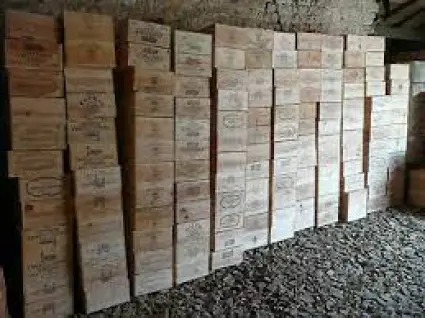
A tunnel packed full U.K.images
When the trailer was half full with about sixty crates, I stopped to catch a breather and asked her if she’d like anything more to eat. She told me she did. I searched the back and found one last salami, a full stick. As I handed it to her along with my knife. She stared in disbelief, saying she hadn’t had meat in eternities. Then I opened her a bottle of wine to help slide it down her throat. I had a plan in mind and needed for her to fall asleep before we got back.
When we’d taken out four full walls of cases we came to what you might call an ‘inner chamber’, like in some pyramid, where treasure was buried long ago. It was a space, not of liquor but piles of cartons of cigarettes stacked high and other boxes, one of cigars and another three full of purses stuffed with jewelry and gold coins, no doubt the treasures of many an empty house. On the trip back, now nightfall, we drove slowly and told her to recline the seat all the way back if she was tired, while Tom sat behind admiring her face from a few inches away.
Soon she was sound asleep. We stopped by an abandoned barn outside Manchester and hid the jewelry in a hole we dug and half the crates under a pile of stinking hay, turning our lights out and engine off as we glided in. The only sound was the tires on the dirt and there was no one around for miles. It was the Western approach and I’d remembered the rotting barn driving in.
I told Tom my plan, out of my respect for him. I didn’t want to see his heart broken in this new, blind, fool’s love, while she might make a pass at every officer, starting top down, then the six hundred horny men in camp, all for trinkets. But I underestimated her greatly. She just had the looks and mannerisms of a stripper from her past, but a heart of gold, and gave it all to Tom.
“Look Tom, I know you love her and I’ll tell you the sure way to have her keep on loving you, a thousand nights of pleasure in her arms. I know her type. When I was first rich in New York I hung out with many just like her. Once a stripper, always a stripper unless you slowly coax her out of it.”
He took objection to these words as if I was demeaning her. But he was listening closely to everything I said. He might be a Navy Seal in military matters but he was a child in matters of love. I wondered if he’d even been with a woman before.
“We’re going to stash most of our haul here. What we do bring home tonight we’re going to barter. First, we talk to the General for your immediate transfer to our base and some private quarters right outside camp for you and her. That’ll take a case of whiskey and a box of cigars.
"We’ll drive in through the garage gate and tomorrow watch the soldiers' gape as we tell them to line up and hand out cartons of cigarettes and the beer. All three of us will do this. It’ll gain you and her all the respect in the world. They won’t dare touch her when we tell them there’s plenty more to come. She’ll be your girl if you treat her royally. Every day you and I will go out on more missions and dole out more of our buried loot upon each return and stop by the barn to add to our reputation.
“And every night you come back, give her one or two pieces of jewelry, saying you found them on the mission and tell her how lovely she looks, constantly. We’ll find some nice clothes for her too, searching houses, not sexy things, just pretty and proper clothes. She seems meek, so find out what might occupy her in her apartment. If she likes magazines, we can satisfy that wish easily. Most of all, remember what she said. She's been raped frequently, so don't insist on sex until she asks for it. She's sick and malnourished and needs time to recover, so nurse her. That's your best opportunity to prove you love her."
"In fact, your best move is to stay with her. Tomorrow, I'll need you to help unload more of the tunnel and check out a few things. She'll be in the hospital having her hand looked after. Tomorrow night the celebration begins. I'll tell the General that she's a mine of information and that you're the best man to get it out of her. He'll instantly agree to that."
He was struck by this plan, thanked me and told me how lucky he was to have met me, a true friend. And finally, shyly, he admitted he was in love with her and had never been in love before.
Thinking over the events of the day, laying on the floor, while Tom and Myra shared the two cots Nancy and I had shared two nights before, I had another piercing realization of just how lucky I was. It seemed like I was charmed somehow, and I wasn’t even Irish.






