
Previous Chapter ...
Reconstruction Begins
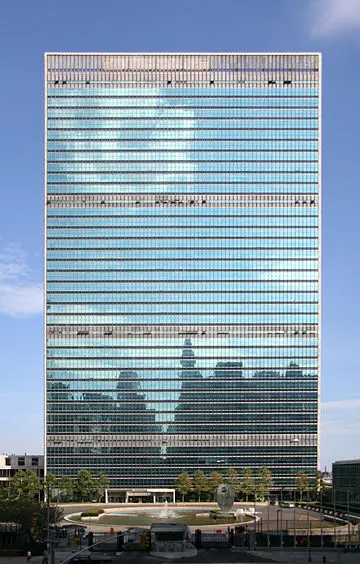
United Nations Building UNO-New-York
The next morning I donned the silly white frock and had Sheila do the same. I pinned my big silver star on it and had her run to the General’s office for the next biggest. He gladly lent it to her, keeping it in a drawer and only putting it on for Church occasions.
When I told her to pack a bag of civilian clothes, she said she had none so I told her to take Nancy’s suitcase. There were plenty in there. She ran to Nancy’s bedside for permission, then up the stairs to get it.
I’d done the same, along with a military jacket and my Uzi, in case of contingencies. I also had her put three thousand pills in her lab coat pockets. The last thing I did was take two loaded handguns, one for each of us, and extra clips. I handed her one and she shuddered.
“I’ve never used one of these and don’t want to”. “Just tuck it in your pants. You might need it."
We set off in a white jeep, fully fuelled towards Boston. Soon we were ushered straight to the bishop's office in the back of the cathedral by attendants bowing to us, without a single question, as if they knew we were coming.
He sat smiling at us from behind his desk and pointed to chairs against the back wall. We pulled two up and I got straight to business.
“I’m sure you’ve heard we’ve been busy lately?"
“Yes I have. You’ve been looking for the fuel we are desperately in need of. I commend your celerity and determination in this matter”.
He must have had a few spies in our camp, I realized. But this was only natural.
“This is Sheila. I think you’ve met her." He nodded politely.
“First time I’ve seen you in a frock though, with the General’s star."
“Well, we’re going to New York today. I wanted her to dress the best."
“On what business, might I ask?"
“To end the war right now and save what few people are left there."
“Commendable again. But where will I sit at the end of the day?"
“In the same seat as now, watching over your flock, with the same authority as their spiritual leader, which you well deserve in reverence and honor. I want to talk to their military commander first. Do you know his name and where I might find him?"
“Yes, His name is Victor Dugall. He’s in the same shiny tower they occupy, on a higher floor I hear. They keep him there on a tight leash, not like it is here. I don’t know how much authority he has. But he has a subaltern named Johnson who resides in a much smaller building right behind theirs. He’s the one who visits the ranks daily and reports back. You might want to talk to him first."
I had no idea the bishop had spies there too, but his advice was critical to our mission, and I thanked him for it.
“Will do” I said, “thanks for the information. We’re leaving now."
He kept the same complacent smile the whole time, relaxed, as if he knew exactly what we were doing, just not the outcome.
“I hope you brought a lot of pills” he said, as we stood up.
“Three thousand”, I said. “That should do the trick” he added. “But make sure you take off those stars before you meet the lieutenant and put them on again before you enter the tower."
I nodded in thanks, tipping my white helmet to him as we left.
We drove fast down the coast on the 95, seeing no one. Sheila mentioned how smoothly that went with the bishop.
“He’s a smart man” I told her. “He’s on our side, one hundred percent. I just didn’t know he had so many spies."
“Perhaps that’s how all churches operate” she said. “He saved my life once before. Maybe he saved it again, today.”
We drove all the way to Stamford before we met their first outpost. But they had no jeep. It was just a cheap wooden roadblock with three men with machine guns, sitting against a tollbooth. They looked tired and starving. One of them reluctantly got up.
I didn’t want to waste time. I handed him an envelope of twenty pills and told him to pass them out to his mates. He looked disinterested.
“One each” I said, “and you’ll be cured. I’m going to see Johnson. And here’s a lunch for you three."
That did the trick. When he looked in the bag and smiled his two companions got up. They quickly opened the roadblock for us and even saluted as we drove by. I could see them devouring the food in our rear-view mirror.
“They’re spent”. I told Sheila, “And they all know it. We’ll visit this Johnson and take him with us and make our own terms before the Cardinal, if they have one alive."
Now we spotted a few small farms past Greenwich, just fenced in vegetables, no livestock, and some fishing boats, sailboats offshore.
What was once the capitol of the World was now in ruins, most buildings empty, every window broken at street level, all deserted darkness above. On side streets we could see some houses burned down, most abandoned, others occupied with little plots of gardens beside them, and abandoned cars and trash everywhere. There were a few people outside lamely working their plots, but all turning to stare at a moving vehicle cruising by. Some even waved. This was the Bronx, so different four years earlier. A sense of deep sadness penetrated me to the core. I glanced at Sheila and she had the same dismal expression on her face.
In upper Manhattan the streets were cleared and painted white but deserted, as if to mock all that effort. As we approached the U.N. building, glimmering in the sun, more people appeared on the sidewalks, mostly priests in the same white frocks we were wearing, all of them staring as we passed, some carrying small satchels towards the building, others coming out with empty ones. But none said a word as we passed. There wasn’t another car on the streets.
We were just one block away from the building and turned to go behind it and slowed to ask one of these men where we could find lieutenant Johnson.
“You're in luck” he said, “he just pulled in. He’s in that office across the street”. He pointed right at a door. “Say do you have any food you could spare”? I reached in the bag beside me and threw him a sandwich, saying “thanks for the information." Then remembering I was in a priest’s frock, I added “God bless you”. He walked away quickly, unwrapping it and taking huge bites.
“This town is gone” I told Sheila, as we pulled right up to the door, a single other jeep parked in front of us. “Take your star off” as I did mine. I threw my satchel strapped over my shoulder and told her to do the same. The barrel of my Uzi was sticking prominently out of it. But I wanted it so. It would prove we weren’t priests.
There was a soldier inside the door, with a rifle slung on his shoulder. He looked at us, confused. I said “Johnson’s office” curtly and he pointed to a door across the small lobby. Everything was white, the carpet, the walls, the doors. But they looked like they hadn’t been cleaned in a long time. There were smudges of mud on the floor and stains on his office door. We knocked, then after a faint “come in” we entered.
He was sitting behind a large desk but looking tired, defeated almost. He recognized us instantly, not who we were but where we were from. He stood up instantly and shook my hand, nodding to Sheila, gesturing us to sit in the two chairs across from him.
Then he spoke first, nothing to the point, but maybe to break the ice, and it did.
“What kind of gun is that. The barrel’s too short to be a rifle."
I pulled out my Uzi, fully loaded and handed it to him.
“Nice” he said, “I haven’t seen one of these in ages." He held it, bounced it in his hands like he was guessing its weight, he even clicked the safety off, then on again and handed it back to me.
I asked Sheila for a bag of pills. We had them all wrapped up in sandwich bags, some with fifty, some a hundred. We had thousands of zip-lock bags, just not the sandwiches to fill them. But we did have some food and I wanted to talk.
First I set a bag of a hundred pills on his desk. He opened it and swallowed one immediately, thanking Sheila, as if he knew she’d been a part of their origin.
“Look” I said, “We’ve had a long drive. Do you mind sharing some lunch with us?"
I’d visited my bunker before leaving and brought more food, from old times. I laid out a can of sardines and oysters, another sausage, bread and a bottle of wine. While we talked and drank, he gave me the information I needed. Not only that, a plan. Once again, food and wine did wonders in loosening tongues. He opened up and revealed the state of his troops, the Church and the people.
Where almost everything is used up or gone, bribery greases every transaction, especially food in the land of the starving.
“We’ve been in a steady decline for over a year, even more than that. The Church is the whole problem. They’ve ruined everything. I wouldn’t even go in that building. There’s no one to negotiate with and you’ll probably be arrested and killed by one faction or another. There are different sets on different floors more violent and adverse to each other every day as they run out of food, all their own doing, and doing nothing to fix the matter but squabbling."
“Don’t they have a Cardinal in charge?"
“No, they’ve gone through four. Two died and two were assassinated. No one will take the job now. They argue over the most minor points of order, where there is no order of any kind. They send out the lower priests like tax collectors who go around and demand half of everyone’s crops for the Church. Then those who get to the scraps first horde it. They even have physical fights, like in some sleazy bar. That’s how bad it is. I was in there a week ago to report. But my superior’s door was smashed in and the office ransacked. I’m not going back. They were never meant to rule. They had no experience.
I mulled over these revelations a long minute. Maybe that was why our bishop had that strange smirk on his face as we told him we were coming here to negotiate. Then again, he would never let me walk into such a death trap.
Or maybe he would. That smile on his face was as undecipherable as the ‘Mona Lisa’. I thought he liked me and I knew he had a conscience. He probably didn’t know how low this place had degenerated. He also knew I was the only man who could go, the only neutral party with some prestige and a will to settle matters sanely. So he sat back waiting to see what I might be able to negotiate. That’s why he directed me to see Johnson first. And once again it seemed I fell into the right hands, the person to deal with.
“How many active soldiers do you have?"
“Five hundred or so and another three hundred ill."
“Where are they?"
“On the front lines. We have a base in Hamden, where most of the sick are. There are farms East of there where we get our food and the New Haven fishermen supply us with fish. We provide them protection against your imminent attack, which the Church keeps warning them is about to start any day now. They’ve been saying that for over a year. We also have a dozen marksmen who hunt deer and fowl.
But the Church caused this mess. They used to ask only a tithe from the farmers and fishermen, something they could spare. When they upped it to twenty percent then thirty, people started leaving. They were producing barely enough for themselves to survive. Then the Church declared it a sin to leave, a death penalty, the only one they had, and enforced it with their militia for a short while, killing over fifty good farmers. Then they couldn’t feed their militia and they deserted to us, out of reach, along with more farmers now that they could escape. Most of the people who cultivated land in New York have left and started up again in the areas near us, many of them North of here, to escape the priest tax collectors who now demand half their produce. The priests don’t go that far, not even to New Haven. They can’t. It’s too long a walk. They did have a few carts and horses. But they ate those too, a few months ago. This spread that you’ve put on my table, well, the so-called leaders of the world have seen nothing like it in over a year."
“So you’ve run out of gas” I surmised “and can’t do anything?"
“That sums up the whole matter. You hit the nail on the head."
“Then come join us” I said, “right now, today. We’ll cure your sick with these pills and we’ve found our own fuel supply. We now have millions of gallons."
He stood up from his seat as he heard this, he was so astonished.
“How could you do that?" He exclaimed. “We have spies up there and to re-build a refinery would take months and we’d know about it."
I didn’t want to tell him our secret. He might try to find it for his own purposes. So I said: “A little, skinny waif we found starving in the woods told me and my friend Tom, just wandering in those parts, all about it, in exchange for a warmed up can of beans”.
“I was hoping you’d come to us with the offer to join you. But now you have everything. You hold all the cards. I accept, unconditionally. We fold”.
“I know who you are and that you were in Boston. Rumors fly fast. The fishermen told us. I and all my men will gladly accept your offer, right away, just for the taste of one more decent meal, a pill, and the chance to escape the madmen in that building”.
“And beer for everyone and a case of Rye for you” I added. “Let’s go before these priests interfere. They probably know I’m here now and I don’t want to get caught up in their sinking ship."
“You’re right” he said. “We need to leave now. They’d be here already but they’re probably arguing over who’s to be their spokesman and what to say. That jeep you drove in stood out like a sore thumb. You may as well have blared the horn all the way."
We grabbed our bags and left, the lieutenant sweeping all the unfinished lunch on his desk into his bag. He snapped at his man outside to come along. I went with him in his jeep and Sheila followed in ours with the soldier.
We were lucky to pick that moment as a delegation of priests were coming towards us, half a block away. But we sped off and they had no vehicles to pursue, leaving them at a dead stop and bewildered. All fools are bewildered just before they meet their doom, when they see it coming and can’t figure out why.
We left the city the same way we came, speeding along the same route, to New Haven then towards Hamden. When we were near, he pulled over, to take off his white frock for some army fatigues. I did the same with some clothes from our jeep. Sheila walked to a nearby tree and opened up Nancy’s suitcase for the first time.
She gazed at all the multi-colored clothes as if they were sparkling diamonds, and began leafing through all of them, picking out a red, then a blue blouse, holding up the colored pants, pairing them. She might have spent an hour in her forest boudoir mesmerized by all the fashionable possibilities, oblivious to us and time. I’d never seen her so intrigued, so womanly before, not even in her first minutes exploring the library stacks. It made me wonder if three years in the same white lab coat killed all femininity. I made it a point to walk over and tell her how pretty she looked in the outfit she finally chose.
But Johnson cut it short with a whistle and yell saying we had to be off. We couldn’t drive into camp looking like priests, being strangers. Some angry guard might shoot us, even with him, so sick of their miserable situation and their fury against the Church. A colored shirt was a sure pass.
The camp was a dismal sight with so many sick, leaning against walls or lying in the dirt. We walked around and gave everyone a pill, all four of us. A few were corpses already and stinking, their neighbors too weak to drag them away.
We left the food we had with the camp commander, more pills for those who’d return from foraging and some to trade with the fishermen. There were no more post duties. Everyone was in survival mode.
We told them we'd be back with buses tomorrow, to take them to Manchester. It was a two-hundred-mile trip. The buses would leave at dawn. In fact, the healthy, a few hundred, could stay at the base in Providence, half that distance. They had food and shelter there for that many.
We took eight with us, those who had stripes and knew the area well and could guide the buses back. We crammed them in the back of our two jeeps. But they were happy to be chosen for the ride. It might take a number of trips to evacuate everyone. But this was great news to those we left. Food for everyone would be here next morning, the vaccine was already in their hands and the war was over, all their problems solved. We were all Americans, and brothers.
We made it to Manchester by evening and drove our two packed jeeps through the gates into the yard. The soldiers there came out to see their would-be enemies up close but only recognized themselves. They all shook hands and exchanged greetings with a mutual joy that the war that never happened was never going to, a relief to all, and all the hidden fears in everyone, unable to be expressed in words. Many just hugged each other, in lieu of words.
The General came down to the yard, hearing the loud cheers, to meet his match, the Lieutenant. They too exchanged handshakes in front of everyone. I asked if I could hitch the trailer to the jeep and make a quick trip, back in thirty minutes with enough liquor for another celebration. But I left plenty in the barn for the next nights, for larger ones, when many others would arrive.
We decided, before all the men got drunk, to send out five jeeps full of men and gas cans and round up a convoy of twelve buses, so that all the soldiers down South in Hamden could be brought here in one shot. We had the hospital for the sick and Manchester was a big city, with plenty of empty buildings to house men, until plans could be made and the newcomers acclimatized and merged with our ranks.
The two commanders went up to the General’s office to appraise each other of all the news, of the disintegration of the Church, and make plans on how to best integrate their armies, but mostly to sip whiskey and smoke cigars late into the night, and become friends and allies in one shot, or several shots, but not the kind they would have traded two years ago.
I spent long hours with both of them and Sheila and other scientists in the General’s conference room the next few days, discussing a plethora of plans. But I spent that night and the next beside Nancy, talking away about all the developments happening so fast it almost made one’s head spin. Our situation was finally looking up.






