
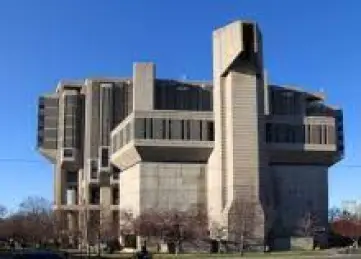
Robarts library U. of Toronto
I packed up my few belongings and headed home to Niagara Falls the week before Christmas. I turned my room over to my good friend Tim, sweet talking the landlady. She liked me and I’d been a good tenant there for sixteen months, the quietest lodger she ever had, she said, so she agreed. He’d seen the little room and liked it, especially the low price and its private entrance. Years later he became a high school teacher of history in Santa Cruz, where I visited with him several times. He always mentioned the room, how much he enjoyed it for a year, and the furniture I left him. It did have a quaint character and a great location.
I’d applied to four graduate schools at the last minute, Yale, Harvard, Cornell and Toronto, too late to start until the following Fall. Thanks to the high praises of several of my professors, Renoir in particular, (my grades and ever shifting majors being highly irregular), I was accepted with partial scholarships at the last two, free board in their residences with a small monthly stipend, and tuition waived. I chose Toronto, a big mistake.
I did manage to talk them into letting me attend Summer school, but I still had six months to wait.
My parents were just divorced and in the process of moving into separate places. I spent the month of January living at my sister’s, Sylvia, with her husband, Robin, and three children. Having no spare room, I slept on a cot in the living room, and having nothing to do I decided to try and teach their twelve-year-old boy, David and his eleven-year-old sister Kristin, Latin. I had Wheelock’s grammar. For an hour each evening we read over the first chapters. But the experiment fizzled after two weeks from a lack of interest on all sides.
I had the same smoldering ambition some fifteen years later with my son. But that too never got off the ground. The age of computers had taken over the age of books and dead languages. The successful experiments of Michael de Montaigne’s father were never to be repeated. And I was proved a silly dreamer once again, not of this time, yet a ‘beautiful dreamer’, just like the title to the lyrics of Steven Foster’s last unfinished song, found in his pocket on a scrap of paper, beautiful lyrics, but the tune not written down, lost in his head to the world, as he lay dead in a ditch along some solitary road in Ohio, dead of starvation, a true, far-wandering bohemian like me, pure of heart. Maybe I’ll end up dead in a ditch someday. Who knows? I won’t be as young as that pure dreamer. But I’ll probably have a book in my pocket, an ancient one in a dead language, like Shelley, washed up on some untrodden shore in the bay of Naples with a volume of Euripides in his coat. That’s how they identified him, his body and face a few weeks rotted away, after the storm that drowned him.
In February, my mother rented half of a duplex house. It had a large, unfinished basement, where I moved in, set up a large desk for study, an easel to practice oil painting and a dartboard to burn off nervous energy as it was wintertime and I had nowhere to go.
I started on a medium-sized canvass to copy from a book print, a portrait of Pico del Mirandola, one of my literary heroes. I made slow progress, even with a manual on painting at hand and gave up before it was half-finished, deciding my time was better spent reading him, which I did, along with many other Renaissance authors, getting the books from the Brock university library. My brother-in-law had a card as he’d taught there and lent it to me.
I did read some Greek in this idle time, one of the romances, “Daphnis and Chloe” by Longus, in a ‘Bude’ edition with a French translation on the opposing page. I also read parts of the Iliad and some Euripides, half of the ‘Helen’ and parts of ‘Andromache’ and ‘Medea’. I know this because I kept a bit of a diary at the time, recording my readings but little else. It does have this one gem though:
One should always start a book of spirit, (as most Classical authors do, like Sallust Cicero, Quintilian, Herodotus and Thucydides) stating why the work was undertaken, and giving it a universal reference, asking the big questions: what is the worth of this subject to others. If the reasonings are petty, we are forewarned. But if the author was moved by some lofty ideal to record valuable matter (which he explains and specifies), our hopes are properly kindled and the stage is set.
The book that really caught my attention at this time was the correspondence of Erasmus, his letters in Latin, in a huge, fat, ten volume set. I only made it halfway through volume one (some two hundred pages). But I consider that quite an accomplishment.
In the middle of June I set out for Toronto by bus. I had one large suitcase stuffed with clothes and far too many books. There was a room waiting for me at the Graduate residence hall on Harbord street and Bloor. But the fifteen block trek there, with no wheels on my suitcase, on a sweltering summer day, dragging the heavy load, having to stop ten times along the busy streets in crowds of pedestrians huffing and puffing to recoup my breath, and barely making it there after an hour of exhaustion should have been a forewarning, a presage, of bad things to come. And they did.
The rooms were doubled up. I was paired, (I forget his name) with a tall, skinny science major, a nerd, (as if I might not be construed as one at the time). Once again, just like five years earlier with Scott, I had a roommate with nothing in common. So we had only the briefest, insignificant exchanges of words. Unlike the previous dorm experience, I made no friends with the other tenants, none at all, not even a word exchanged in a hallway, a rather unwelcoming sensation. It was a graduate residence hall, with no partying going on, no common room, no cafeteria, just students rushing between classes and libraries.
I spent very little time in that room and so did he for the simple reason that the room was uninhabitable. It was the peak of summer and the heat was unbearable. The building had no air conditioning, so we had to leave the windows wide open at all times, to catch the slightest breeze. But there was hardly any. The tall buildings all around cut that off and the black asphalt and raised the temperature five or ten degrees above the forecast. Added to that the constant vehicle exhaust polluted the air. The buses and trucks, with their elevated exhaust pipes were at a perfect level to blow their black smoke right into our windows sometimes for minutes, stopped in back-up traffic.
The room faced Bloor street, or rather abutted Bloor street. The sidewalk was right below our window, eight feet below. I could have talked to any passer-by just by leaning out the window and exchanged a handshake, leaning down. The buses and cars that rolled by in an unending stream were just as close. The street itself was a main thoroughfare, one of the busiest in downtown Toronto, day and night, a sleepless street, and so were we, as we quickly discovered, living in what could only be described as ‘Hell’.
Being eight feet above street level gives you the most perfect sound chamber for street noise. I tossed and turned in my sweaty bed, unable to sleep even four hours a night, and never consecutive, as any siren or horn blast would shock me awake again, though severely tired from all the previous nights. It was broken, thirty minute snatches of sleep and maybe a lucky hour or two just before dawn. It was disorienting and the smog unhealthy, far more than all the near-sleepless nights soon to follow, later that Fall, when I first discovered and began using methedrine. Strange irony that I became practiced in sleep deprivation just before discovering that drug.
Luckily, I found in the main library, a block away, a place where I could nap in the afternoons, the small reading room on the eighth floor, next to the Classics section. This room contained a few chairs, a desk and a short couch. There was one on every upper floor, but this one was always empty and the windows sealed, so it was quiet and I could cuddle up and sleep undisturbed, my knapsack my pillow. The fact that it was always empty was just as disconcerting to me as everything else about the place. That whole area of the eighth floor was always deserted, the one area of books that interested me.
I've been reading of some interesting developments by several companies like Synchron and Neuralink working on computer to brain interfaces and soon to begin human trials. I wrote a sci-fi novel four years ago on just this achievement, its initial, rosy blessings and then its hidden monumentally disastrous costs to human beings. If you're interested in checking out my near-future predictions on this subject read my novel 'Roland House' posted in its entirety on this site. Here is the link.
Roland House ...






