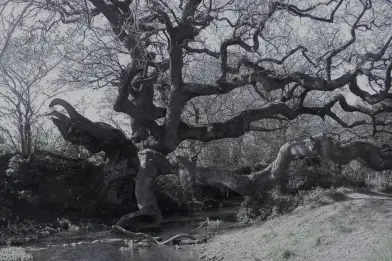
The oak tree
The day was still cool as Jonathan Winslow set out over the hills in a north-easterly direction. He decided not to follow the coast the way he had come. He worried that the townspeople might follow him a little ways and he had told them that he would be heading east. He could lose them in the hills without difficulty and would even save time by cutting this diagonal course, provided he could find the place. But he didn't doubt of that. He’d noted the landscape carefully and after a decade of wandering remote regions, had considerably sharpened his skill in getting places.
No one followed him and by midday he was peacefully alone. He hadn’t travelled with a pack animal before but found this a pleasant change. He could talk to the animal as he went along, and with comfortable sandals on his feet, no load to carry and the meandering pace of the burro, he relished the comparative luxury of the journey. It put his mind in a pleasant mode. Between the one-sided banter he shared with the beast he recalled various scenes from past years, with a greater fondness than usually accompanied such thoughts.
"So now I'm growing senile, talking to animals and doting on the past. I guess I've reached old age despite all my efforts to avoid it. How strange to want to die one day and live the next. 'Vita dum superest, bene est.' 'Life, while it remains, is good' and this at the end of a poem detailing life's miseries."
It was at this moment that the thought first occurred to Jonathan to write a memorial of his strange life. "Why not" he thought, "I've already broken the ice. They can steal and chew up a note well enough. Let's see them try to swallow a whole, fat book of my writings, or deny that it's there. I'll knock the fools on their heads with it and scatter the leaves to the winds and sink the whole town in sin."
The idea engrossed him and grew in scope the more he thought upon it. "Here I am by training and inclination an historian, cut off in early career by plagues, revolutions and religious fanaticism, condemned to silence, a witness to the burning of my books, other's books, all history. Yet I am a witness to it, and if I'm to be true to myself, a recorder of it. It's up to me to keep the tradition alive. They should have killed me, those fools. Now they'll have to read me. Even if they don't I'll still write it and make copies and place them so that someone in saner times will come across them, if there's enough ink."
This was the only hitch to the scheme that he could see. He would have to settle for whatever writing implements the cellar afforded. Maybe there were more pens or pencils there that he hadn't seen. Now he regretted his haste in leaving the cellar and not making a thorough search of such a rare a find. "But no matter" he thought, "I'll be back there a day from now."
The paper, he thought, would not be a problem. He remembered that he had torn his sheet out of a whole notebook of it, and besides, if that ran out there was plenty more in the world. Blank sheets were everywhere, framed and hung up as the perfect symbol of the new faith, the most immaculate message, the single yet sufficient icon of the Church, holy miniatures of the one great canvass that started it all.
Not a single sheet had been manufactured in the last twenty years, but this was one of the few items that escaped the destruction of the revolution. Reams and reams of white paper were treasured up in every town and city. It was sacrilege to harm them. When any old sheet became soiled through handling or brown with age it had to be ceremoniously destroyed and replaced. And so great stores of paper were still extant.
Dusk descended upon Jonathan and his burro as they slowly trudged over desolate hills and along deserted valleys. He had been following a meager stream the last hour in hopes of finding a spot of white grass for his companion to graze upon while he rested. There were no predators in these parts, only a few wild dogs that dared not approach humans.
When Jonathan finally did come to some grass he made camp and built a small fire, more for company than any practical use. After dinner he sat by the embers, reclining and feasting his eyes on the unholy spectacle of the black night. It was one of those rare moments of thin cloud cover. A few stars sparkled dimly through the haze.
It struck him that such glimpses of the real sky were becoming more frequent lately, that the thick, white overcast that had enshrouded the earth the last three decades was now waning. He took this as a good omen and hoped that the strange shroud that had blighted people’s minds all these years might also be wearing thin, that nature and sanity might again burst forth like the sun and resume their former glory.
With morning came a thick overcast, but Jonathan got his bearings as usual from the dimly perceptible sun. He set out straight to the north this day, hoping to recognize a group of three large hills in a row, for halfway down the western slope of the furthest one, beside a huge oak tree that raised its old head above a dense expanse of briers, lay the ruins of the cottage.
He’d discovered these ruins by pure chance. For months he had been slowly making his way along the southern coast, skirting the great inland desert. When he learned from some fishermen that he was approaching the western edge of the continent, tired of beaches, he decided to head inland and vary the scenery, travelling in a north-westerly direction across the barren hills until he again hit the coast. He provisioned himself for a month at a coastal town, gathered all he could of the geography of the region still current, and set out into the wilderness not with any enthusiasm, but with the dry determination of a hardened wanderer. He was a friend to solitudes but it was a friendship of convenience and habit, born of the disgust he felt for human commerce.
On the afternoon of the seventh day of this trek he reached the last of the three, taller hills and noticed a flock of birds pass overhead and settle on an oak tree a quarter mile away up the hillside. He needed water and thought there might be a spring nearby, so he pushed his way up through the dense brake of thorns until he reached the canopy of the tree. He found his spring right there. Its waters came out of a rock wall behind the tree, filled a small basin and then overflowed and trickled away down the hill. It was like the wall of a room, smooth, defeating the encroachments of undergrowth, and the basin, at table height, was filled from a fissure right above it, so curious a sight that he wondered if man had had a hand in it.
He decided to camp here overnight, taken by the beauty of this sanctuary in an arid wilderness. He followed the little brook down the hillside and found in its valley a whole grove of trees and cool, fresh grass underfoot. Then, winding back up the hill on what appeared to be a trail, he discovered the ruins of a house, with some flooring and remnants of walls on a small plot of level ground cut into the hillside. Most of this was covered with brush except for the central floor. As he examined it more closely in the failing light he noticed that none of the structure had been burned, as was usual with ruins. It was decayed with age. He laid out his bedroll on the old floor and took a few bites of dried fish before he fell asleep.






