
Jonathan was not slow in gleaning that his plans were now dashed into nothing. He realized that his stature in this dusty town was too elevated to be impeached. "If only I hadn’t brought my staff," he thought. But then he tried again: "Your man here who has just run off has taken something from my necklace, and your official, who can attest to it, has run off with him."
The old priest looked concerned. "I'm very sorry Sir. We will look into the matter right away. If you stay with us the night I'm sure we can set it right by morning. Please, do not perturb yourself. Come join us for service."
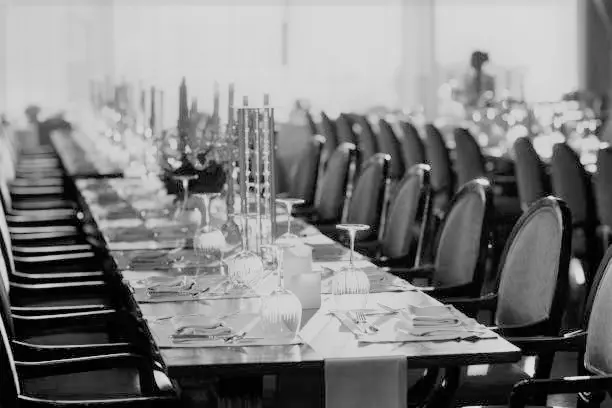
To this Jonathan relented, offering his hand to the old man and his staff to be carried in by an attendant. He was led into the main hall where a table for twenty was being set out with all the pomp that the town afforded.
After a brief tour of the temple, Jonathan, the old priest and his whole staff of priests sat down to a long and leisurely repast. Many delicacies were brought out, as it was a rare occasion when they received a high-ranking guest. There were platters of lamb and fowl finely garnished, and even plentiful servings of white wine, for which the priests were as beholden to their guest as he should have been towards them. The head priest, sitting next to Jonathan, told him of the town's history and economy, and its place within the church hierarchy of this region. After several promptings and soothed by the wine, Jonathan condescended to tell the table a little of his own travels, of the capitols and great temples he’d seen, of their populations and dimensions, the city matters that forever awe provincials.
Towards dusk they rose to take their parts in the evening service. This was a simple event which the whole town attended. Long rows of benches were set up in the town square. From a raised and covered platform a sermon was delivered and prayers conducted to a sea of echoing faces illuminated in the twilight by a thousand candles. This was the new, world religion, all-encompassing and all-demanding and without a name. It needed none because there was nothing else.
Afterwards Jonathan was shown to a bare, narrow cell in the back of the temple. It was a guestroom containing only a simple cot, a mat, a chair and a small table with two candles on it, already lit. That it had a small window cut into the stone wall, overlooking the hills behind the town and letting in the night breeze was remarkable, for most of the priests' quarters were windowless. The night was always something to be shut out of sight and mind, as a thing that could not be illuminated, and therefore evil.
In every other way the room was typical. The austerity wasn't even noticed. You might say that austerity was the keynote of this era, for the simple reason that the mass destruction of all ornament and science had been the anthem of earlier years.
After gazing into the darkness a while and ruminating over the events of the day, Jonathan laid down on the narrow bed with a heavy sigh. He realized again that he had been a fool to overlook the matter of his staff, that he should have abandoned it and played the pauper if he’d wanted to be treated like a criminal. But he always seemed to overlook such things.
This world was too strange for him, beyond his power and manner of reasoning. His thoughts drifted back to the cellar he’d discovered by pure chance, the strangeness of it, an untouched relic of the past, and the odd circumstance of him, another relic, finding it. He’d left it too hastily, he reflected, and would like to go back there. He thought about how he should provision himself for such a trip, and in the midst of these deliberations he fell asleep.
In the morning, after a private breakfast and then public prayers, he announced to his host his intention to set out that very day on a long pilgrimage across the desert. He said that if they would provision him, he would report their kindness in the Capitol, and use his influence to aid in any business they might have. This was bribe enough and a burro was quickly brought out and saddled with food for a month, along with a tent and cooking implements. New sandals and a heavy cloak were also procured.
Jonathan waited in the temple courtyard while the supplies were collected, blessing the priests one by one by rank, when the old priest came up to him with the glad tidings that after an investigation the two culprits had been found and had confessed their guilt. If he could stay another hour he would witness their public execution.
Jonathan was a little shocked at this news. He begged humbly to be excused from such a sight, saying that the journey ahead was the only thing on his mind and that the events of the day gone by were best forgotten, as their religion dictated.
This fine sounding detachment duly impressed all those present. But to honor their guest they hurried all the more to build a pyre in the square and convene the town. When he set out from the front gate of the temple there was already a thick crowd of people to pass through. He was just leaving town when they kindled the fires. Everyone there thought it great holiness on his part that he didn’t look back on the blaze, while they all gaped and shuddered at the spectacle.
The truth was that the fat bureaucrat, after a long night of questioning, had denied ever seeing anything on the neck of the visitor, even after being branded with hot irons. This contradicted Jonathan's assertion, and lying was a capital offence. The secretary on the other hand, being questioned in an adjoining room of the temple basement, freely admitted to having taken and swallowed the pollution. For this he was scorched many times, especially about the mouth and throat, for the contagion of the thing, and uttered nothing of any comprehensible nature thereafter, only declaring a fervent wish to be purified, by his crazed looks and cries and his wish was granted.






