
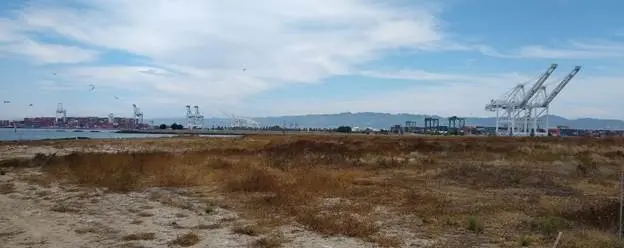
North end of Alameda, decades ago.
Zack kept his word. One of the first rules of being a successful entrepreneur is to always keep all your pawns and assets in play. Otherwise they drift off and disappear. He was also somewhat of a scavenger and would check out the abandoned docks and waterfronts in his truck, looking for free wood or anything else he might salvage.
On one such derelict lot at the northern end of the island of Alameda, right after you cross the bridge from Oakland, a large, strange-looking boat was being built. It was on a barren square mile of land just a few feet above the foul-smelling bay water. At the far end was a small marina house, a few short docks with a few sailboats. The end nearer the bridge was all rubble and rotting wharves. It had been a ship factory in W.W.II but abandoned since then. In the middle of this plot stood the boat, like an arc, one hundred and forty feet long and seventy wide, on many hulls, seven in all of diminishing size as they fanned out from the central one.
The boat was four-fifths complete. It was all wood and fiberglass, propped up on supports a few feet off the ground, rising two stories in the middle above the hulls and on one side a platform, cantilevered out, a helicopter pad. The outer hulls and one large central part of the interior were still unfinished, the boat’s workshop. But most of the side rooms, including the captain’s quarters, were completely done, trimmed out and furnished, beautiful accommodations. There were some hoses for running water, temporary power throughout, an outhouse and a long, black, steel four-inch pipe along the side of the first level always filled, which heated up in the sunlight and fed a finished shower inside, warm each evening.
The single, unique and solitary builder and owner of this boat was Henri Sudermann, and he certainly merits a digression. He was in his sixties but very fit and active and spoke with a slight German accent. His grandfather, Hermann Sudermann, had been a famous German, nationalist playwright and novelist. His father was one of the early Nazi’s, large and fanatic, bound to rise high in the ranks except that he had his head blown off in the very first week of engagement with the Russians.
Henri was the opposite of his father. He studied French and Spanish in school but because of his name was made an officer in the German navy with a very promising career as the war began, except, as he told me, he blew it all one night at a fancy restaurant in the Netherlands, seated among officers of much higher rank, when he conversed at length with a waiter he knew in French, though the waiter spoke perfect German. It was probably an impropriety that saved his life.
From this peccadillo his sympathies became suspect and he was assigned to a mine sweeping ship in the North Sea, not the Bismarck. The function of this ship was to run right over mines and explode them. The hull of the ship was filled with something akin to ping pong balls which the heat of each explosion would instantly melt and seal the breach so the ship could sail on. He told me that the shock of these explosions was such that it would throw everyone a few feet in the air and over time seriously damage everyone’s knee joints, (not your choice assignment).
Towards the end of the war his language skills proved useful. He told me he put black shoe polish in his hair and made his way through France to Spain and from there to Cuba, where he met Aristotle Onassis and became his employee, helping in the building of his luxury yacht, the ‘Christina’. Afterwards he came to the States where he built two yachts for himself, both of which caught fire and were lost. Now he was spending the last of his money and energy on this craft. He’d been at it for four years, the indefatigable German, but now he was low on funds and this is when he met Zack and his Hungarian friend, newly flush from their pot crop.
Zack had been there several times negotiating. He promised Henri money for materials and some manpower to finish off the craft and in return asked only to help provide part of the crew when she sailed. Henri did have a plan for his boat. It was to sail to the south Pacific. Because it was wide it could carry a good deal of cargo, and because it had so many hulls it had a very shallow draft, able to approach the smaller islands without piers and deliver supplies where other ships couldn’t. To be a part of such a romantic and commercial expedition attracted Zack powerfully, and today was presentation day.
So he packed me up and another fit young lad in his employ, Huey, in his truck. Following behind in their car was his Hungarian friend and his girlfriend, some twenty years younger than him, plump and silent and personality wise, little more than a servant and sex doll. We all accosted Henri in a group, shook hands and he gave us a tour of his amazing creation. He was a master carpenter and the few finished areas we saw indisputably proved this. The door to the captain’s quarters was peanut shaped, nine inches thick and had a thirty-degree outward angle in the middle of it, matching the wall it was set in. But the heavy door opened easily, lightly and its inner edges were also angled at a forty-five-degree angle, with a hundred little wedges on the door and on the frame, making a perfect seal. I’d never seen anything like it, a marvel of carpentry, and never will, if I were to visit the finest houses of the richest people on Earth.
Part of the bargain was that some of us could live on the boat if we worked on it full time. Henri never stayed there at night. He had a wife and a house in Hayward to which he faithfully returned each dusk. The strange thing was, the three months I lived there, he never once brought her by, yet he would mention her quite often. So he was eager to have people stay on his boat at night, so near completion, to guard his almost finished prize.
The Hungarian and his girl were to occupy the captain’s quarters. I had a smaller, finished room on the other side and Huey had the only other finished room on the boat, a round crow’s nest at the top, with a cushioned seat around it wide enough to serve as a bed.
We were all very happy with the deal. Zack and the Hungarian rolled a big spliff to celebrate the agreement and even talked Henri into taking a toke, for the first and only time in his life.
Our preliminary arrangement lasted about a week. I remember the first few days went well. Henry would show up and we would get up and eat, the Hungarian’s girlfriend serving us eggs and toast from a two burner propane kit, after which we set to work under his directions. He had me preparing long planks of wood, two by tens twelve feet long, staggered and laminated together on a long table, five thick, with bolts and fiberglass to make beams twenty feet long for the outriggers, to hold them together. He couldn’t afford new wood. He didn’t want it. Old wood was cured and much stronger. So he salvaged old planks from decrepit docks paying hardly anything for them. They were gray and weathered and looked worthless, but when I took an electric plane to them and spent hours planning away each face down a half an inch deep, you ended up with a beautiful, fresh piece of timber money couldn’t buy, aged, stronger than ever. It even smelled great. This taught me the lesson that old things, refurbished, are far better than new.
So this is what I did, prepping of the wood, while Huey mixed fiberglass and drilled holes for bolts and helped Henri laminate the beams together and clamp them tight till they cured. The Hungarian and the girl had less to do. He would roll joints all day and smoke them. She would make breakfast and sandwiches for lunch and clean up. She was short and pudgy and would wake me up each night with her screams as they made love. Zack would stop by several times a day and talk, but he always had some other pressing engagement to get to so he never stayed long. He wasn’t a worker either.
So after a week there was a big falling out. I remember Henri on one side and Zack and his friend on the other, screaming at each other. They were all alpha males and would never fit on the same boat. They stormed off but Henri came over to Huey and me, whom he genuinely liked, and proposed that if we gave him half a day’s work we could live there. He even had an old car there we could borrow. We instantly accepted. I never saw Zack again.






