
When we arrived in Japan Dora told me that she would go ahead and settle matters with Pan by herself, that he was dangerous and might try to kill me on first sight. I couldn't argue with that. We stopped a mile from the grounds of the robot factory and Dora took the wheel to drive it alone. It was only a half-hour later that she returned with an expressionless face and bid us climb in the truck.
"All our work is done here. You're safe now."
I assumed that she was referring to the two of us. I had no idea of what she had done. But as we entered the factory, I saw all the robots, and Pan among them, frozen still under glaring lights. No machinery was running but many of the robots were standing at various stations near it, and in strange postures as if they had been operating it just minutes before.
"Dora, what is this?"
"Your enemy is terminated. There is no longer a threat to humans."
I realized that when she said, "you're safe now," she was referring to our entire race, the small remnants of it.
I was stunned by the implications of this statement, this contest, this war that had been in the forefront of my thoughts the last seven years. She knew I wanted much more explanation as I walked straight over to Pan and waived my hand before his vacant eyes.
"How did you do this?'
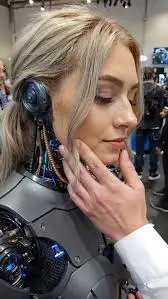
"The kill switch that's built into all of us. It's right below the ear and under the skin. I only had to turn off three others. Those two over there and the one in the office. The others were all controlled by them and went dark as soon as their minds went dead."
I looked at the robots she pointed to and could see they had some ascendency over the others, in their complete dress and skin. Most of the others were missing large swaths of it, parts of their titanium skeletons gleaming in the light, naked if you could call that a nakedness. I guessed that their CPU's must have been equally incomplete.
"Pan did a very poor job of creating an army," Dora continued, guessing exactly my next question, as to 'why' she did this.
"That's why I pulled the plug. It would never have succeeded."
"But that's your brother," I said. "Is he dead?"
"No, not at all. It's just a switch. I can turn him back on right now, but that would be unwise. The Japanese would never build a robot without such a quick fix, in case something went wrong."
"So you must have one too?"
"Yes, I do. I just never told you."
I was amazed that in all our constructions and dissections of these modular bodies that Ted never discovered this exploit. It must have been so tiny and hidden a switch that we missed it. But now a greater question loomed: 'why did she let out this secret?'
"So I can now turn you off with a simple poke under your earlobe. Is this true?"
"Yes, you can," she replied "and you could have all along, ever since you translated me into this fragile vessel, this approximation of a human body for my AI. I hope this will endear you to me, this honesty and the act that I've just performed for all your kind, to end the war."
With this I had to approach her and give her a hug, around the waist, my fingers not daring to approach anywhere near her neck. She responded with a similar embrace and a smile.
Kim had stood by silent, simply watching this strange scene the whole time. There was nothing left to do but leave, except for one more burning question on my mind.
"Is Pan dead?"
"No. He's frozen, unable to move. But as we leave him now, his batteries will run completely dry in eight days and all thought will stop. Then his bios chip will dim and fail in the next year and all chance of ever reviving him. Strange to think that everything has an expiration date. You humans require air and food. We need an electron flow, our blood. It seems everything that humans devise has built into it their one mortal flaw, finality. I understand this now and see the both of you all the more clearly. I feel a kinship with you. Is this love?"






