
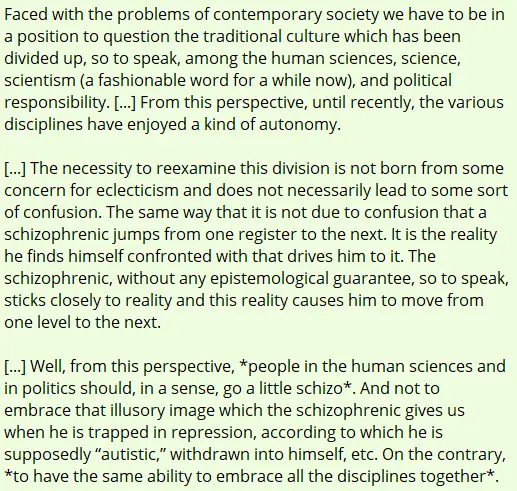
Stumbled upon this in Twitter and couldn't help share it and then got carried away expanding on it all a bit.....
Wow! Nicely put! The schizo state of psychotic free-flowing semiosis and loosened associations is precisely the one where static word labels and stable articulations of ordered meaning disintegrate into the much more intensely overwhelming sense of dynamic reality itself, of things in perpetual flux and change that no concrete contextual framework can hold anything meaningful together for long. As William S. Burroughs used to say, "A Paranoid is somebody who has just gotten a clue of what's going on, a psychotic is somebody who's just realized what's going on." Schizophrenia also seems particularly endemic among mathematicians (which tend to be born, not made - mathematicians, I mean, not sure if there is an actual correlation between these things on any other level). Examples are countless.
The poetics of schizophrenic speech and language also suggest that it is probably the state from which the first epistemology or science emerged, namely what we today refer to as "mythologies" or "ancient cosmologies and pantheons". While I argue on the side of Feyerabend (the subject thoroughly explored in his "Philosophy of Nature")here that monotheistic moralizing religions and polytheistic pagan traditions are different in kind in that while one's function is to scale society after reaching a threshold of complexity so that more people can have common ground on the basis of which to recognize each other as part of their people (following the same rules, laws, codes of conduct, organization, beliefs and recommended practices, etc.) whom they can trust, rather than live in a state of perpetual tribal wars and conflicts. (In that sense, Mohammed was a genius in many of the mechanisms he came up with, perfectly understanding he was dealing with humans, namely beasts, while the crazy weirdo from Jerusalem, I don't know what his trip was when actually thinking about it... "gather around for some anecdotes!" - yeah, that'll work...)
But mythologies, on the other hand, were nothing of the sort - they served more like sciences and philosophies (if we accept Deleuze's definition of philosophy as the art of creating concepts, and by concepts meaning something that is both concrete and slippery in its multiplicity at the same time, just like mythic meta-personas and gods and primeval deities of Lovecraftian horror, or even conceptual personae, natural forces and human inclinations combined in the barbarism of poetic constructions and even ritualistic human sacrifices which too were quite poetic in their symbolism - in other words, according to Deleuze, philosophers are or should be these modern day shamans in a sense.)
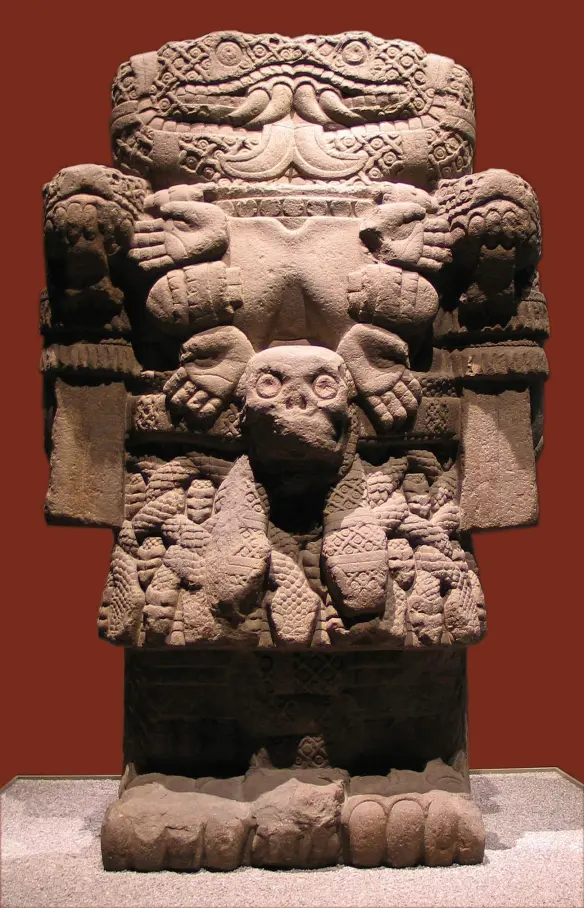
Coatlicue, Aztec primeval goddess of stars, moon, heaven, etc. - who also gives birth to life and death simultaneously. Obviously non-anthropomorphic in character, as characteristic for Mesoamerican cultures who took shrooms and mescaline quite a bit - and the vision of the above is definitely one produced by the symbiosis between humans and psilocybin mushrooms in heroic quantities in the jungles of South America. Aztecs had also institutionalized human sacrifice and were known as the "men without a face" by others because of also sacrificing their own. Sometimes early in the morning before the sun comes up, to help it make sure that it does. Or during dry season and lack of rain, they'd pick the most handsome young teenager, tie him up and kill him shooting arrows at him, the blood dripping from his body symbolizing the rain drops.
So, in a sense, and aligned with the citation from the first image above, a certain degree of schizo necessitates as a condition for being able to think trans-disciplinary in making connections and associations between things otherwise analytically and by institutional doctrines of royal science that deals with the sorting things out in categories illicit and forbidden, sometimes even scandalous, ridiculous, heretical, fringe lunatic and after all academic and professional guild reputations depend on the fundamental axioms and assumptions within their respective departmental niches of hyper-specialization that some proposals may violate as such.
Henri Bergson's method of intuition that he spent much of his life's work refining and formulating to as much precision as it was possible at the time (before many later on having arrived theories and models, which helped much better illustrate the general concept). By "intuition" Bergson did not mean, of course, gut feeling, or suspicion, or any such thing, but a mode or regime of going from analytically utilitarian and static modus operandi of being (necessary for survival and orientation, after all) to a state of becoming, an immediate, total and absolute sudden knowledge - and his going at much length to articulate it in a coherent and systematic matter. This absolute knowledge and the access to it cannot be fully captured in words of language and rather Bergson describes it as a lived experience, rather than passive observation - all of which likewise wholly analogous and reminiscent to a state of psychosis and/or mescaline/LSD (psychotomimetic agents, as the psychiatric term goes, psychedelics more popularly to the point of making the term annoying).
"Now the image has at least this advantage, that it keeps us in the concrete. No image can replace the intuition of duration,but many diverse images, borrowed from very different orders of things, may, by the convergence of their action, direct, consciousness to the precise point where there is a certain intuition to be seized. By choosing images as dissimilar as possible, we shall prevent any one of them from usurping the place of the intuition it is intended to call up, since it would then be driven away at once by its rivals. By providing that, in spite of their differences of aspect, they all require from the mind the same kind of attention, and in some sort the same degree of tension, we shall gradually accustom consciousness to a particular and clearly-defined disposition - that precisely which it must adopt in order to appear to itself as it really is, without any veil. But, then, consciousness must at least consent to make the effort. For it will have been shown nothing: it will simply have been placed in the attitude it must take up in order to make the desired effort, and so come by itself to the intuition."
- Henri Bergson, "Introduction to Metaphysics"
I've long had this sense that we are collectively entering into a phase of global psychosis of a bad trip where sense-making and meaning disintegrate rapidly along with institutions and reference points of orientation within consensus reality. Now, as some years have past, that sense has only magnified and strengthened - even the nihilism of pretending to believe and buy into what you know, deep down, full well to be false and a lie, if a symptom of it. Giambatistta Vico (in his 17th century Scienza Nuova, "the new science" - Marshall McLuhan follows in the steps of that very same tradition, as even one of his major works is called "Laws of Media: The New Science"), whom I've mentioned already before, suggests that the escape from this state, as it becomes worse and worse and more and more unbearable of a nightmare, is in the process of re-constituting reality anew in a way that we intuitively feel makes sense and resonates with the facts of the matter. In other words, a new beginning with another Age of Gods (the first of the three, second being Age of Heroes, last - Age of Men, rationalism, equality, forgetfulness of what he referred to as the early "poetic wisdom" in favor of vulgar rationalism, individualism, self-interested egoism, degeneracy, corruption, sloth, etc.) or exiting the schizophrenia of capitalist production by re-inventing and re-coupling back together the fragmented domains of sciences and arts, philosophy and literature, wisdom and practical knowledge, laws and codes of ethic, etc. - integrating them back into a more broadly conceptual and intuitive kind of knowledge by the creation of the necessary required concepts and terms necessary and needed for the articulation of problems in the terms in which they can be raised as such, so that the question itself already reveals the range of possible answers and solutions.

Joyce's magnum opus, FW, written in an amalgam of languages, puns and plays on words, where each sentence can be read in a number of different ways, revealing different layers of meaning (one way to read it is out loud with an Irisih accent) - saying how if the world ended tomorrow, it could be recreated back again on the basis of just this book, it is also considered the closest thing one can get to LSD in written word.
And while mentioning Vico, it is also worth noting that James Joyces' mostly incomprehensible Finnegans Wake is structured around the Viconian cycles of Universal History. Vico himself, as the ultimate anti-Enlightenment guy, didn't really get noticed until as late as the 20th century, by the way. And one huge fan/influence of his - or at least according to some sources - is Israeli Prime Minister Benjamin Netanyahu (whose father was a gloomy history professor, also keenly aware that all nations rise and fall and that all things eventually come to an end due to the fact of their developing from one stage or phase into another, following the inevitable logic of eventual conclusive end - just how the "new science" of Vico was based on carefully tracking and following the evolution of language through the ages and how language defined the nature of the knowledge in each respective era).






