![E-Prime and the Structural Differential (General Semantics) [Useful conceptual heuristics and critical thinking devices series]](https://www.publish0x.com/img/97633.webp?action=resize&ar=1&enc=webp&inv=0&ori=1&st=1&up=1&w=1140&signature=860639c3ac43e55c3436de01dbedeee9b621557029b9a023d3414e2af7562c9f)
This is from my series/collection of useful conceptual heuristics and tools for thinking (previously was a post giving a quick description of the Cynefin framework). This one concerns the perception and approaching of meaning (semantics), something that to me seems to be becoming increasingly important the more often I see meaningless statements and claims which seem to nonetheless exert actual effects (as well as cases where metaphor gets mistaken for the real thing, though general semantics is more about the fundamental reality of how the word is not the thing and the map is not the territory). General semantics begins in the late 1940's with the work of Alfred Korzybski who basically observed that while the scientific paradigm has shifted (quantum physics, etc.), we haven't adapted our language, grammar, habitual ways of thinking about things and the logic and structures in which we articulate our thoughts, reasoning and conclusions to the actual reality of how things really do work. Which consequently leads to a lot of misconception, psychological distress, distorted perception, etc., etc.
Structural Differential
Korzybski proposed the Structural Differential as a three dimensional model that illustrates the abstracting process of the human nervous system and which he suggested it should be used as a training device in General Semantics.

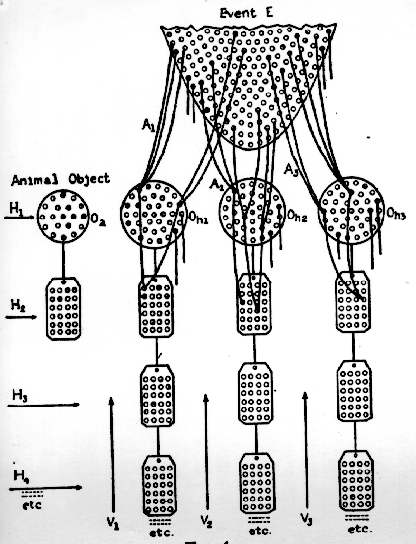
These are two representations of the structural differential. The device is intended to show/remind that human "knowledge" of or familiarity/acquaintance with anything is only partial and circumstantial (and perhaps also usually utilitarian, limited to the context of its use to us in any given situation) - and not total, absolute and/or static and unchanging. It illustrates how we extract what we know (in the form of how we can know it) from what we see in an imperfect representation of the underlying dynamics of [reality in] perpetual motion and constant change. Furthermore, we only see only some of what we already know and we cannot see or register what we do not know.
The structural differential consists of three basic objects:
-
Parabola: At the top. Represents a domain beyond our direct observation, the sub-microscopic, dynamic world of molecules, atoms, electrons, protons, quarks, and so on; a world known to us only inferentially from science. Korzybski described it as an 'event' in the sense of "an instantaneous cross-section of a process." Thus the 'event' or parabola represents the sub-microscopic 'stuff' that, at any given moment, constitutes an apple. In other words, the parabola represents the "external" cause of what we experience.
-
Disc: The circle(s) below. Represents the non-verbal result of our nervous systems reacting to submicroscopic "stuff", e.g., the apple that we see, hold, bite into, all on the non-verbal levels of experience. The disc represents what we experience of our surroundings versus what our surroundings actually are.
-
Labels: Tags representing the static world of words, e.g., "apple", giving imperfect accounts of dynamic reality. An object called an "apple" left in a jar for months becomes a putrid liquid (because of its underlying, dynamic, sub-microscopic structure), but the label "apple" does not change. The word "steak", at a lower verbal order, may imply "something to eat" at a higher verbal order, but in the sub-microscopic domain, a particular steak may be contaminated with poisons created by harmful bacteria that we could see only on microscopic levels.
The holes in the figures represent the characteristics that exist at each level. The characteristics that are abstracted to the next level are indicated by the attached strings. The strings that don't make it to the next level represent characteristics left out of our abstractions, as do the holes without strings at all. More is left out of our abstractions at each level than was there at the previous level.
Thus the differential sets up a hierarchy of order, with the sub-microscopic domain of dynamic change coming first, the relatively stable universe conveyed non-verbally by our senses coming next, and then the verbal levels. A label is what we attach to a non-verbal experience in order to identify this experience in verbal terms; when we identify an "apple", we attribute to this identification various non-verbal experiences.
It is useful to remind ourselves of all that, as it is visually captured in the s.d., as it helps us address and articulate our thoughts and order our perceptions more in alignment with the validity of reality and not in conflict with it (as there may be a range of possible "rights", but not all "opinion" or belief is valid as such just because it's subjective and somebody so chooses it). Our language, Korzybski spends a lot of time explaining, the alphabetic subject-predicate written and spoken language(s) we adopt, employ in our everybody, express ourselves in and order our perceptions of reality around, is really riddled with inaccuracies, fallacies, paradoxes and delusions. He especially pays attention to the harm of the verb "to be" in all its forms.
David Bourland later on proposed e-Prime,a version of English that excludes forms of the verb "to be" as means to clarify thinking, avoid fallacies and misconceptions and strengthen writing.
Particularly the verb's function in cases of assigning identities and essences ("is of Identity" and "is of Predication") gets emphasized as forming pernicious thinking habits (and thus epistemological consequences as well as psychological ones) in how things are habitually articulated within the syntax of language.
Avoiding usage of the verb whenever possible is suggested, substituting instead with other linking verbs and constructions.
To Be or Not to Be: e-Prime as a Tool for Critical Thinking
The 10 page paper is available here.
As we become conscious of our misunderstandings we improve the quality of our thinking, and most particularly, of thinking about thinking, which Richard Paul defines as "critical thinking."
[...]
The verb "to be" carries with it a huge intellectual momentum of completeness, finality, and time independence.
The Impact of E-Prime on Writing and Talking
Bourland presents in the paper four of the major consequences of using E-Prime in written and spoken utterances:
-
Vanishing Questions. One simply cannot ask a number of questionssome would say pseudo-questions-that have preoccupied many people . What is man? What is woman? Is it art? What is my destiny? Who am I? Such questions, by virtue of their semantic structure, set the stage for identifications and confusions in orders of abstraction. They tend to lead to discourse in which the likelihood of useful information generation or exchange declines precipitously. One might better ask questions on a lower order of abstraction such as these: What characterizes man or woman uniquely? In what way can I relate to this art form, if any? What can I do now to improve my future possibilities? May I have another drink?
-
Vanishing Internal Instructions. Various schools of psychotherapy have recognized the importance of the silent assumptions which we hold about the world and ourselves . Other schools, especially the "rational therapy" developed and practiced by Dr . Albert Ellis, also recognize the importance of what we tell ourselves, vocally and sub-vocally. "Self-suggested nonsense ;" Dr. Ellis calls this in its undesirable forms . Most of us have encountered people whose life patterns have decayed as they keep repeating to themselves such comments as these: "I am a failure, consequently . . ." "I am a success, therefore . . :" "She is a Catholic, so . . :" "He is a Jew, hence . . :" "I am a teacher, so what I am doing must be teaching" "Since I am the head of this household . . ."
-
Abbreviations. Forms of "to be" encourage and indeed facilitate the making of abbreviated statements that may turn out to convey little or no information, although we often behave as if they do . For example, we often see such empty comments as : "It is clear that . . ." "Well, business is business." "The problem is just a matter of semantics :" Let us discuss that last assertion. While of course most human problems involve important (and usually unexplored because unperceived) semantic issues, these issues do not evaporate just because someone has labelled them thusly . Some people use "It's just semantics" as an analysis stopper. One might productively respond to such a comment by pointing out, "Certainly ; at least in part . Now let's try to clarify some of those semantic problems."
"Science and Sanity: An Introduction to Non-Aristotelian Systems and General Semantics", Korzybski's main work on general semantics, first published in 1933.
If one adopts the above in his daily life and thought processes, the benefits become quickly noticeable (not to mention it may significantly improve your online trolling skills and make you build your arguments better, if you want them to appeal to scientific reality that is, otherwise here's a good set of tactics by Schopenhauer for appealing to human stupidity and emotion that generally seem to work better in most circumstances). I am firmly opposed to and do not trust/believe psychoanalysis and most of psychotherapy as I believe it to be self-indulgent charlatany or worse, but if one wants to actually address the nature of his problems, this is certainly one way to go about it - one must first make sure they calibrate and align their perceptions with what is actually out there and when we do that, a lot of our concerns and problems tend to evaporate (as the possible solutions to any problem are contained within the terms in which the problem is raised as such, as a valid, real problem).
Far as crypto, well, yes, I've noticed that when people say Bitcoin is "digital gold" they tend to misconceive that as if Bitcoin is literally gold, like gold or has gold-like properties when this is obviously false and "digital gold" is a metaphor at best. Or, just a few days ago, "Bitcoin is energy with money-like properties" - but how? Can I charge my phone with Bitcoin? No. So, what does that mean? It means we're calling waste energy now, which is utterly ridiculous (where things are headed with the Bitcoin crowd, I expect soon 1984-ish slogans like "ignorance is strength"). Or the reserve currency narrative - never ever anybody stopping to question and ask, what is a reserve currency, what makes one that, what properties ought a reserve currency have and how do we envision Bitcoin becoming one and how and maybe what possible or potential implications might that have in such a world? No, narratives, buzzwords (and even world salads of what Korzybski calls "semantic noise", i.e. having no meaning whatsoever), outrageous claims and very confused ideological worldviews (of economy, society, individual freedoms, etc.) reign over popular opinion and then we wonder why things fuck up...
Maybe, for starters, begin paying more attention to what we're saying and how we're saying it and then ask ourselves what exactly was it that we meant? What WE meant, not what whomever I picked it up has indicated they mean and I just blindly trusted them cos they're whatever, an authority, or experts in this or that, or way more knowledgeable in this area to know while I myself cannot penetrate and understand the matter so much so I just choose to trust his judgement... no, no! We should never do that! We should make it clear to ourselves what things mean for us - ask and pose questions (there's no stupid ones and even if there are, it's much smarter to ask than uncritically accept; plus, stupidity is what makes us human, fundamentally, intellect is just a special case of stupidity), deconstruct meanings, make sure that when in dialogue/discussion we clarify our semantics so as to be sure that we're on the same page and talking about the same things. And so on.
So, yeah.
Cheers. :)






