
This is related to my previous post "Re-inventing Democracy: Quadratic Voting, Futarchies and Liquid (Delegative) Democracies". Concepts such as quadratic voting are given explanation there. The below is one of the crypto-political initiatives out there which focus their efforts and attention on the institutional function and role of distributed peer-to-peer shared ledger technologies (of which there aren't that many yet, but at the very least this shows how diversely wide the possible applications of these technologies can be, not necessarily limited to monetary and financial use cases.)
Democracy Earth is an YCombinator funded initiative that provides governance as a service and focuses on crypto-politics and the institutional aspects and applications of the technology. It's described in the official site so:
“In a world that has succeeded in the globalization of financial assets while keeping political rights enclosed to territories, we need to build new models of democratic governance that enable humanity to collaborate and address pressing global issues. Democracy Earth Foundation is building free, open source software for incorruptible decision making within institutions of all sizes, from the most local involving two people to the most global involving all of us.”
The Democracy Earth Foundation provides Sovereign, software for creating and participating in democratically run and censorship-resistant DAOs (decentralized autonomous organizations). It introduces tamper-proof voting schemes and procedures such that shift the focus from the original Bitcoin "one-CPU-one-vote" principle or the plutocratic coinholder/stakeholder voting practices and centers governance around the people themselves in the real world beyond the technical disputes and issues of blockchains themselves (i.e., governance on or via the blockchain, not governance of the blockchain). A central problem to implementing such a thing then is, of course, identity.
Highly recommend the above talk by Santiago Siri from the Democracy Earth Foundation.
The proposed mechanism by Democracy Earth is one that is time-based and inferring of probabilities - the probabilities of a particular address belonging to a unique human as based on its activity and interactions with different and/or overlapping/related DAOs, capturing decisions requiring of governance input and choices which cannot be automated away. Replica, as the mechanism/algorithm is called, assumes all on-chain addresses to be non-human replicas as a starting point and computes various metrics from there on which point towards increased uniqueness, drawing from the intersection of DAOs that an address may be a member of and their relative presence in the social graph of on-chain transactions.
As for who verifies the verifier, Replica creates an intersubjective space which feeds from two functions - a subjective one where validated participants vote on the legitimacy of indexed DAOs by means of quadratic voting/governance procedures and an objective one applying a Gini Coefficient as measurement of how egalitarian the allocation and distribution of economic and political/decision-making rights is within a given DAO on the chain. Replica is specifically designed for the implementation of a social layer on top of distributed/shared ledgers (as they are, in essence, decentralized record-keeping bureaucracies) that makes it possible to deploy interoperable borderless democracies.
Replica: Solving Digital Identity on the Blockchain
Replica is designed in similar way to how algorithms like Google's PageRank had been conceived for making sense of the world wide web, but outputting instead probabilistic scores for Proof of Humanity to addresses interacting on the chain. The concept draws upon John Searle's social ontology in approaching the problem of identity from the angle of intersubjectivity. According to Searle contemporary society is traversed and permeated by invisible, but pervasive "status functions" or intersubjective entities emerging from the interdependence of a two ontological categories of facts - the objective brute facts, independent of human subjectivity on one hand and the institutional facts of some 'collective intentionality' of some kind or other (or what Deleuze and Guattari more broadly refer to as "collective assemblages of enunciation") on the other. For example, money, governments, contractual agreements, professional guilds, civil marriages, academic titles, etc.
Approaching the problem of identity from elsewhere outside the scope of centralized state/government ID issuance and verification requires the construction of other functions, such that would be embedded in said collective intentionality in a way that can substitute for the legitimacy of former sources of validation. And Replica does that by creating an intersubjective layer which accounts for both collective intentionalities in producing a score based on quadratic voting and the raw, objective facts as measured by the Gini Coefficient applied to any existing on-chain DAO. This generates a Democratic Index assigning a score to every Ethereum address based on its DAO intersections as a member or its position in the social graph of recorded on-chain transactions.
Democratic Index
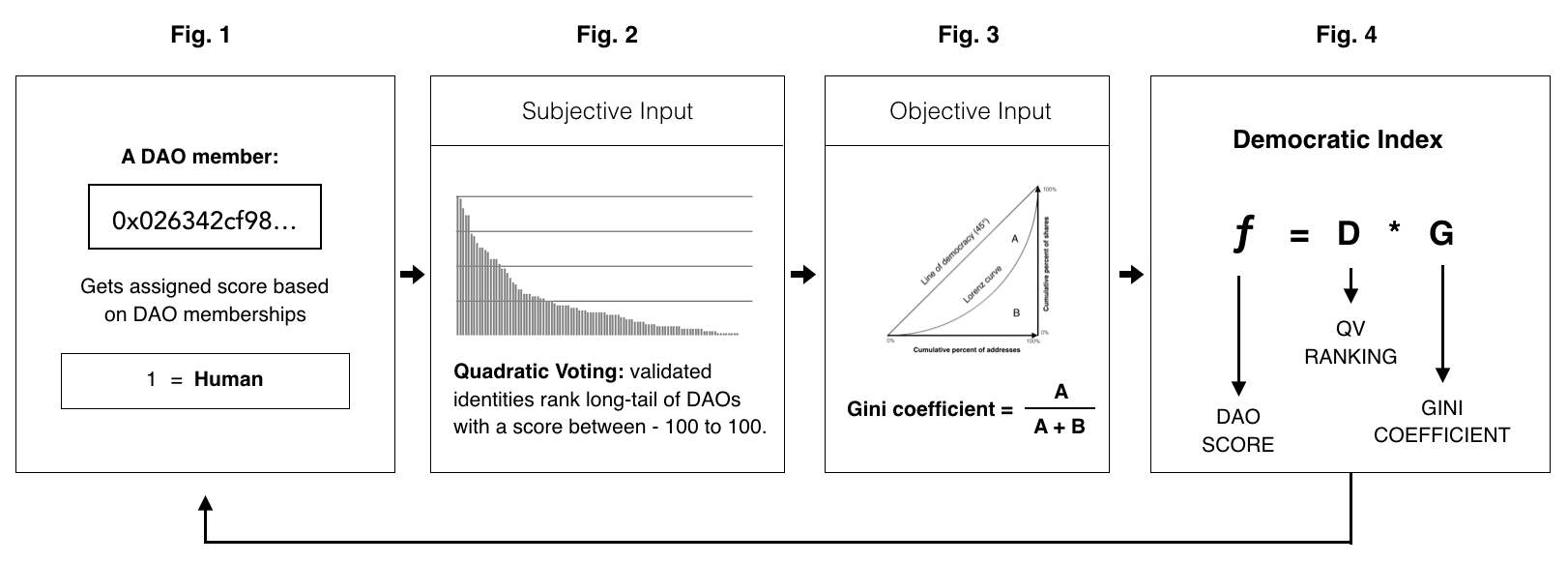
Fig. 1 Every address that belongs to a DAO will be weighted by Replica with a percentage of the Democratic Index obtained from the intersection of DAOs that constitute the identity of such address.
Fig. 2 In order to counter weight false positives on the Gini Coefficient, addresses that achieve a high score will be granted the right to rank the different DAOs analyzed by the Replica oracle, according the their corresponding ability to ensure that no single Human controls more than one identifier within its domain.
Fig. 3 The Gini coefficient for democracy ranges from 0 to 1, with 0 representing perfect totalitarianism and 1 representing perfect democracy. It computes a score that measures the share distribution by each segment of addresses belonging to a DAO.
Fig. 4 A Democratic Index is calculated for each DAO, as a function of their position in the Quadratic Voting rank and their Gini Coefficient.
Source: the Replica/Democracy Earth paper.
The paper also mentions, interestingly:
"In April 2019, Democracy Earth Foundation partnered with RadicalxChange Foundation to implement the first Quadratic Vote in the history of the US Government, for the Legislature of the State of Colorado (globally only a precedent in Taiwan can be found). Results show how Quadratic Voting is particularly useful in ranking a long tail of items. Instead of resulting in a few items at the top, with no clear signal over the rest of the proposals, Quadratic Voting succeeded in capturing nuanced preferences over the entire list of proposals."
Objective Input
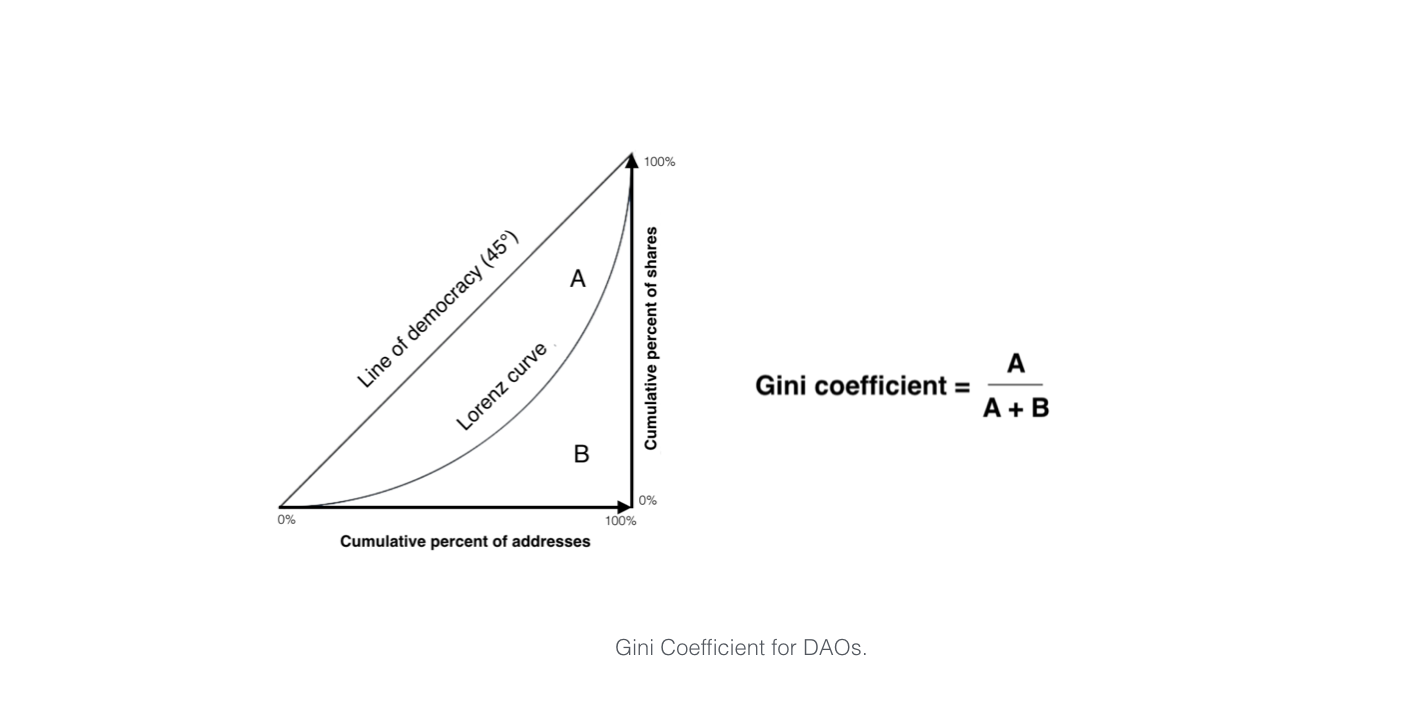
The Gini Coefficient measures the distribution of income across percentages of a population, with values ranging from zero to one, where 0 is perfect equality and 1, conversely, perfect inequality. Centralization and inequality are in many ways similar if not the same. Highly non-uniform and asymmetric distributions of wealth and/or power reveal highly undemocratic and centralized structures. Taking a DAO's two basic primitives, shares and addresses, a Gini Coefficient for measuring how egalitarian a distribution of decision-making power is in a given DAO. A similar calculation can be made to measure how democratic is a DAO by computing the score measuring the share distribution by each segment of addresses that belong to a DAO. Zero representing perfectly totalitarian and 1 perfectly democratic.
Incentives
From an economic perspective, governance and identity are tied together in a symbiotic relationship since a vote or political transaction only has value if it is cast by a legitimate voter. So for that reason the legitimization of digital identities is crucial and fundamental to the building of a working political economy. A protocol that is able to formalize humans can be made to mint and issue tokens for participants based on time elapsed since their verification, making it possible to create a humans-only crypto-economy by using time as a reference in such a manner.
Conclusion
Replica, instead of going for the binary output of either human or sybil which defines other previous protocols, takes the approach of defining entities within a continuum in which identity is probabilistically approached in an intersubjective space which gathers metrics from the embedded trust and sociality present within DAOs in parallel with the objective measurements of their democratic virtues. The approach is further described in more depth and detail in “Verifying Identity as a Social Intersection” (2019) by Jackson & Weyl. Glenn Weyl is the founder and chair of Radicalxchange (mentioned above) who first came up with the concept of quadratic voting some time in 2012 and who is actively involved in the fields of (economic) mechanism design and political economy (in the sense which, for example, Karl Marx used the term and as opposed to classical economics as such).
I don't know about anybody else, but these applications of the technology are the ones of most interest to myself and perhaps even overall objectively the most valuable and even critically necessary ones in a few years time. Since if our legacy institutions are quick eroding in the process of their inevitable collapse as they've stopped being useful in their problem-solving capacities and have instead become corrupt, burdensome and inefficient and/or instrumentalized in the hands of interests other than those they're supposed to serve, we will need to set up other such institutions ourselves, parallel to the existing ones and capable of adequately making sense of things in order to meaningfully produce solutions, and we need such structures (called "basins of attraction" or "attraction" in complexity and systems theory) in place to be able to fall back on, otherwise we should have some idea of what the term "failed state" means when chaos ensues (the emergence of ISIS was also to do with them providing some working institutional structures, whatever they may have been).
In any case, here's just a few examples of recent real world applications of Sovereign:
Yellow Jackets on the Sovereign platform
In the past two weeks, our Sovereign platform — a censorship resistant social network currently in beta test on the Ethereum rinkby test network — has been the host of a debate on the Yellow Jackets movement. Started by French participant anonymous0x4d0c3 on November 11, the conversation was kicked off with a manifesto posted in form of a thread: one post, one proposition.
The manifesto calls to defend the principles and structural changes that the #GiletsJaunes demand in the face of the government’s incapacity to understand the need for structural reform beyond the suspension of the current taxes. This message, obviously a subjective take on what this polyform movement is about, proposes to sum up what the movement is really putting forward in the form of 7 proposals. The authors shared in the thread the open source document they are working on as it is meant to be freely modified to bring out the points of consensus in the movement.
A Digital Referendum for Colombia's Diaspora






