
A reusable framework derived from real Task Node product work on the Post Fiat network.
A reusable framework for designing habit, discipline, recovery, or performance-tracking products. Each section defines rules first, then shows how those rules apply across two structurally different examples: a discipline-tracking app (internal, self-reported behavior) and a workout-consistency app (external, measurable behavior). The closing checklist is what other builders should save and apply directly.
How to Use This Framework
The five required design domains for any behavior-tracking app are scoring logic, onboarding structure, progression systems, anti-gaming constraints, and a builder's checklist. Each section below states the design rules in domain-neutral language, then shows the rules applied to two short worked examples:
- Example A: A discipline-tracking app. Behavior is internal, self-reported, hard to verify externally. Think practice consistency, sobriety streaks, focus sessions.
- Example B: A workout-consistency app. Behavior is external, sensor-measurable, partially auto-verified. Think strength training adherence, run frequency, mobility routine completion.
These examples are deliberately structurally different. If a rule only works for one of them, it isn't a rule — it's a feature.
1. Scoring Logic
Rule 1.1 — Score behavior, not output. The score reflects whether the user did the thing, not how impressive the thing was. Magnitude-based scoring rewards intensity spikes and punishes consistency. A user who trains five times per week at moderate intensity should score higher than a user who trains once per week at maximum intensity, because the goal is the habit.
Rule 1.2 — Make the formula visible. The user must always be able to reconstruct why their score is what it is. Black-box scoring breeds distrust and gaming. State the inputs, weights, and thresholds in the UI itself, not just in a help doc.
Rule 1.3 — Cap any single input. No single day, session, or input can dominate the score. If one extreme day can move the score 30%, users will optimize for extreme days. In practice, no single input should contribute more than 5–10% of the rolling score; beyond that threshold, users learn to optimize for spikes instead of consistency.
Rule 1.4 — Decay rewards stale data. A score earned three weeks ago should not protect a user who has done nothing for three weeks. Use rolling windows (7-day, 30-day) or explicit decay so the score reflects current behavior.
Rule 1.5 — Separate streak from score. Streaks are motivational. Scores are diagnostic. Conflating them turns the score into a brittle metric that resets on a single missed day. Show both, but compute them independently.
Example A (discipline tracking): Score is the rolling 28-day average of daily binary completions, weighted 60% on "did it" and 40% on consistency-of-timing. A single missed day caps at -3.5% (1/28). The app shows the formula explicitly on the score screen.
Example B (workout consistency): Score is a rolling 14-day adherence percentage to the user's prescribed weekly schedule. Each session contributes a fixed 1/N share where N is the planned count. Bonus intensity above plan does not raise the score — it just appears as a separate "intensity index."
2. Onboarding Structure
Rule 2.1 — Onboarding teaches the system, not the app. The user needs to leave onboarding understanding what the score means, how progression works, and what gets rewarded. Tutorials that walk through buttons fail this. Tutorials that walk through why the system is built this way succeed.
Rule 2.2 — First three days are the activation window. A behavior-tracking app's retention is decided in the first 72 hours. Design those days explicitly: what does the user log on day 1, what feedback do they receive on day 2, what does the system tell them on day 3. Don't leave this to the user to figure out.
Rule 2.3 — Defaults must produce a successful first week. If a new user accepts every default and follows the suggested flow, they should hit a meaningful first milestone within seven days. If defaults can produce failure, casual users churn before the system has a chance to work.
Rule 2.4 — Progressive disclosure of complexity. Advanced features (custom rules, integrations, deep analytics) should be hidden during onboarding and surfaced after the user has logged a baseline of behavior. Showing everything on day one creates choice paralysis.
Rule 2.5 — Make the first input frictionless. The first behavior log should require fewer than three taps. Friction at the first input is the single highest-leverage churn point.
Example A (discipline tracking): Day 1 is a single binary log ("did the practice") plus a one-tap mood scale. Day 2 surfaces a 24-hour comparison view. Day 3 introduces the weekly score concept with the user's actual two-day data. Custom practice categories are locked until day 14.
Example B (workout consistency): Day 1 asks the user to declare a target schedule (e.g., 4 sessions/week) and log their first session if applicable. Day 2 shows adherence-to-plan percentage. Day 3 introduces the rolling-window concept. Heart rate zones, periodization templates, and pacing analytics stay locked for 21 days.
3. Progression Systems
Rule 3.1 — Progression must be earned, not unlocked by time. If features unlock purely on calendar elapsed (day 7, day 14, day 30 regardless of user behavior), progression becomes meaningless. Tie unlocks to behavioral milestones the system can verify.
Rule 3.2 — Progression should expand the system, not gate basic functionality. A user who hasn't progressed should still be able to use the app. Locking core functionality behind progression breeds resentment. Progression unlocks new dimensions of capability, not the original ones.
Rule 3.3 — Show the next milestone, always. The user should always know what they're working toward. "You are 4 sessions away from unlocking custom routines" is concrete. "Keep going!" is not.
Rule 3.4 — Progression should change what the system tracks, not just decorate the UI. Cosmetic rewards (badges, colors, streaks of streaks) are weak signals. Real progression introduces new metrics, new analytics, new feedback loops the user didn't have before.
Rule 3.5 — Allow regression. A user who falls off should not lose all progression permanently. Maintain a recovery window (e.g., 14 days) where prior progression is preserved if the user resumes. Permanent loss creates abandonment cascades.
Example A (discipline tracking): At 14 logged days, a personal trend graph unlocks. At 30 days, weekly mood-to-practice correlation analysis appears. At 60 days, custom practice categories. If the user goes inactive for 21 days, prior unlocks are preserved through a 14-day recovery window — beyond that, they re-earn the most recent tier.
Example B (workout consistency): At 10 sessions logged, the user unlocks a load-vs-recovery view. At 25 sessions, periodization templates. At 50, an auto-generated weekly readiness report. Regression: a 10-day gap doesn't reset; a 30-day gap drops the user one tier.
4. Anti-Gaming Constraints
This is the section most behavior-tracking apps skip. Skipping it is the single largest cause of long-term user drop-off, because once users discover they can game the system, the system stops being useful to them, and they leave.
Rule 4.1 — Identify the gameable surface before launch. For each input the user provides, ask: how would a user fake this to inflate their score? If the answer is "easily," that input needs a constraint. The exercise is mandatory, not optional.
Rule 4.2 — Constrain timing of inputs. Logs that can be batched at end-of-week are gameable. Require inputs within a defined window (same day, within 12 hours, etc.) to make retroactive fabrication harder.
Rule 4.3 — Penalize patterns, not single events. A single suspicious log is noise. A pattern of suspicious logs is gaming. Detect at the pattern level — repeated maximum scores, identical timing every day, perfect streaks with no variability — and use the pattern to trigger soft interventions, not individual log rejections.
Rule 4.4 — Reward variability where it exists honestly. Real behavior has variance. A user whose logs show natural fluctuation is more credible than a user whose logs show machine-perfect consistency. Build the scoring system to recognize this and reward the realistic pattern.
Rule 4.5 — Make gaming more effortful than the behavior. The system is gameable in some way; the goal is to make actually doing the behavior the path of least resistance. If gaming takes 30 seconds and the behavior takes 30 minutes, the system will be gamed. Add friction to the gaming path: required notes, required photo evidence, required cross-input consistency.
Rule 4.6 — The honest user must never feel constrained. Anti-gaming rules are invisible to honest users by design. If a real user trips the constraints, the rule is too tight. Tune against the gaming user, not the honest one.
Rule 4.7 — Bias toward false negatives, not false positives. Every anti-gaming system faces a tradeoff: catch more gaming and risk punishing honest users, or err lenient and let some gaming slip through. Always err lenient. A few undetected gamers cost the system less than one wrongly punished honest user, who will leave and tell others. The cost asymmetry is large and one-directional.
Example A (discipline tracking): Logs require submission within the same calendar day (no retroactive entry beyond 18 hours). Pattern detection flags users whose mood scores are identical across 14 consecutive days. Optional 1-line journal notes correlate weakly with score multipliers, making faked logs more effortful than real ones.
Example B (workout consistency): Sessions auto-import from connected wearables when available; manual sessions require duration plus one of (heart rate range, perceived exertion, exercise list). Pattern detection flags identical session durations within 1-minute precision across 10+ sessions. A user who completes 100% of planned sessions with zero variability in duration gets a quiet wellness-check prompt, not a punishment.
5. Two Worked Examples Side by Side
A useful sanity check: does the framework actually generalize, or is it a single app's design with serial numbers filed off? The table below maps the same framework rules across the two structurally different examples used throughout this document.
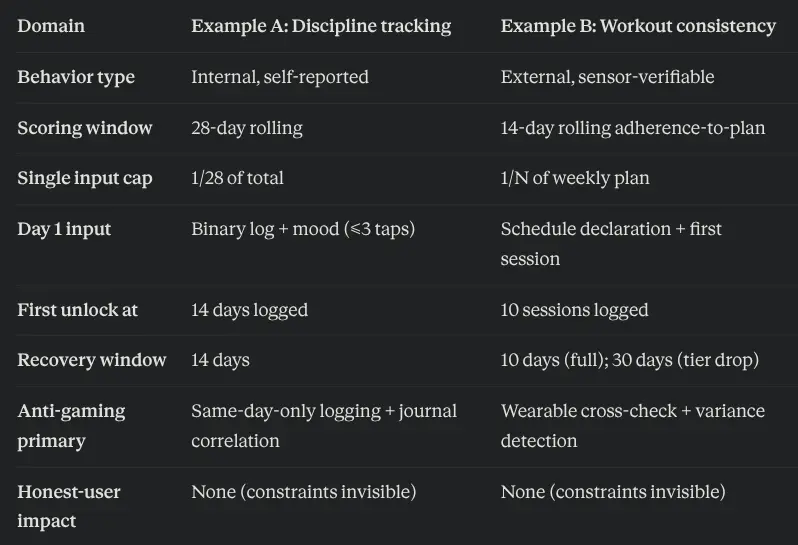
The same underlying rules drive both columns. Where the columns diverge, the divergence is in the implementation surface, not the rule. That's what generalization actually looks like.
6. Builder's Checklist
If you cannot answer every item below, do not ship.
Use this before building, mid-build, and before launch. If any item is unanswered, the system is not ready.
Scoring Logic
- Is the score formula visible to the user inside the app?
- Is any single input capped to prevent it from dominating the score?
- Does stale data decay or expire from the score?
- Are streak and score computed independently and shown separately?
- Does the score reward consistency over magnitude?
Onboarding
- Does the user understand the score, progression, and reward logic by end of day 3?
- Is the first input frictionless (≤3 taps)?
- Do default settings produce a successful first week for a passive user?
- Are advanced features hidden during onboarding and unlocked later?
- Is the first 72-hour experience explicitly designed, day by day?
Progression
- Are unlocks tied to behavioral milestones, not calendar elapsed?
- Is the next milestone always visible?
- Does progression introduce new tracked dimensions, not just cosmetic changes?
- Does the system permit regression with a recovery window?
- Can a user who hasn't progressed still use core functionality?
Anti-Gaming
- Has the gameable surface of every user input been mapped?
- Is input timing constrained to prevent retroactive fabrication?
- Does pattern detection operate at the multi-event level, not the single-event level?
- Is gaming more effortful than the actual behavior?
- Is the honest user genuinely unaffected by all anti-gaming rules?
Sanity Check
- Can every rule above be expressed without naming the specific app's domain?
- If yes, the framework generalizes. If no, it's a case study, not a framework.
7. Closing
The shortest version of this framework is a single sentence: a behavior-tracking app should make the right behavior the easiest path, the wrong behavior the most effortful path, and the score a clear-eyed reflection of the difference. Everything above is the operational expansion of that sentence.
If you build against this framework and find rules that break, the rules need updating. If you build against it and find rules you can skip, the system probably has a gaming surface you haven't found yet. If your system can be gamed easily, your users will discover it before you do — and they will leave. Treat the checklist as the contract.
A reusable framework. Apply, modify, and extend as needed.






