What are voluntary carbon markets?
First things first. Carbon credit (or carbon offset) is a tradable certificate that allows its owner to emit a predefined amount of greenhouse gases. One carbon credit represents one ton of carbon dioxide (CO2) or CO2 equivalent greenhouse gas emissions. Once an entity buys a carbon credit and claims that it has been used to reduce emissions, the carbon credit is retired, i.e., it is taken out of turnover and cannot be traded anymore.
Voluntary Carbon Market (VCM) is a type of market where entities buy and sell carbon credits voluntarily. The underlying for these credits is greenhouse gases that are removed or reduced from the atmosphere. By purchasing carbon credits on VCM corporations or individuals support the projects which otherwise would be non-viable financially.
Why are legacy carbon markets broken?
Legacy, or off-chain carbon markets are inefficient and flawed in many ways:
- Lack of price discovery. That most voluntary carbon transactions happen over the counter (OTC) leads to poor transparency of the market. The value of carbon credits depends on multiple factors, such as project type, vintage, or country. This makes it even harder to know the real market price of a voluntary carbon credit.
- As mentioned above, the voluntary carbon market is done mostly not on exchanges but OTC which results in the highly fragmented and illiquid markets. The heterogeneity of carbon credits implies that different carbon offset types trade in low volumes.
- Poor market transparency. Since the market is voluntary and not regulated by a single entity, it’s hard if not impossible to obtain information on the owners of active carbon credits, on the project details, or on how much each owner spent.
How blockchain can fix it?
Bringing carbon markets onto the blockchain could solve most, if not all these problems. Blockchain is a decentralized and public ledger that cannot be modified any single entity. This would make on-chain carbon markets more transparent than legacy markets. Furthermore, tokenization of carbon credits will add more liquidity to the markets by bringing many users to which the markets would otherwise be inaccessible. Transporting carbon offsets to the blockchain will also result in improved price discovery because similar carbon credits will be combined in a single pool which facilitates their comparison.
Protocols
The most notable protocols building in the space are mentioned below.
Toucan
Toucan’s Carbon Stack contains three modules:
- Carbon Bridge.
- Carbon Pools.
- Toucan Meta-Registry
Anyone can bring their carbon credits from off-chain sources to on-chain through Carbon Bridge. To bring carbon credit from a legacy registry to Toucan registry one should retire their credits in the original source to prevent double counting. Once the bridging is complete, carbon credits can be fractionalized into tokens calls TCO2 where T can mean “Toucan”, “Tonne”, or “Tokenized, and CO2 represents carbon dioxide.
If Toucan protocol did stop here, it would have been no different from legacy carbon markets. Since there are too many carbon projects, and carbon credits are typically project-specific, the carbon markets tend to be illiquid. To aggregate carbon credit with the similar features would be a natural solution to the problem. This is what the protocol did by launching Carbon Pools.
Carbon trading is mostly done over-the-counter, not on centralized exchanges. This means that these markets are not fully transparent and lack the discovery of price. Toucan’s Carbon Pools group alike carbon offsets into pools creating more liquid markets and a more transparent price signal for various carbon categories. Once a carbon credit is tokenized, a standardized token called carbon reference token is created. These tokens can be traded on decentralized exchanges where liquidity is much deeper. Thus, Carbon Pools make carbon markets much more liquid, less fragmented, and more transparent.
Toucan Meta-registry is where all the fractionalized carbon credits are stored. Other details, such as project-specific information, retirement of carbon credits are also recorded here.
Klima
One of the biggest visions of Toucan was that other projects or protocols would use their infrastructure to build things on. This is what KlimaDAO did. That is a project with the goal to create a carbon-based currency. Users can buy its coin, KLIMA using BCT, Toucan’s token. KLIMA token is backed by one BCT 1:1 which, in its turn, is linked to carbon offsets from real projects.
When a BCT token is deposited into KlimaDAO treasury, more KLIMA is minted to the market. You can think of KlimaDAO as a blackhole for BCT – they lock away BCT and thus carbon offsets from the market pushing the price of carbon credits higher.
Reward mechanisms for investors are bonding and staking.
Bonding
Bonding is getting KLIMA by adding reserve assets, such as MCO2 (see below) or BCT to the KlimaDAO treasury. You can get KLIMA at discount
Staking is another value accrual mechanism of the protocol. By staking your KLIMA tokens, you’ll get sKLIMA tokens which have a 1:1 ratio to KLIMA. How does the protocol reward the stakers? Recall that KLIMA is backed by real carbon credits. When the treasury has more credits than it needs to back KLIMA, it will mint new tokens and distribute them to stakers. Staking is win-win both for the protocol and users. For KlimaDAO it’s beneficial because staking tokens for some period locks up supply thus decreasing the selling the pressure. Users benefit from staking through receiving staking rewards. At the time of this writing, APY is 21%.
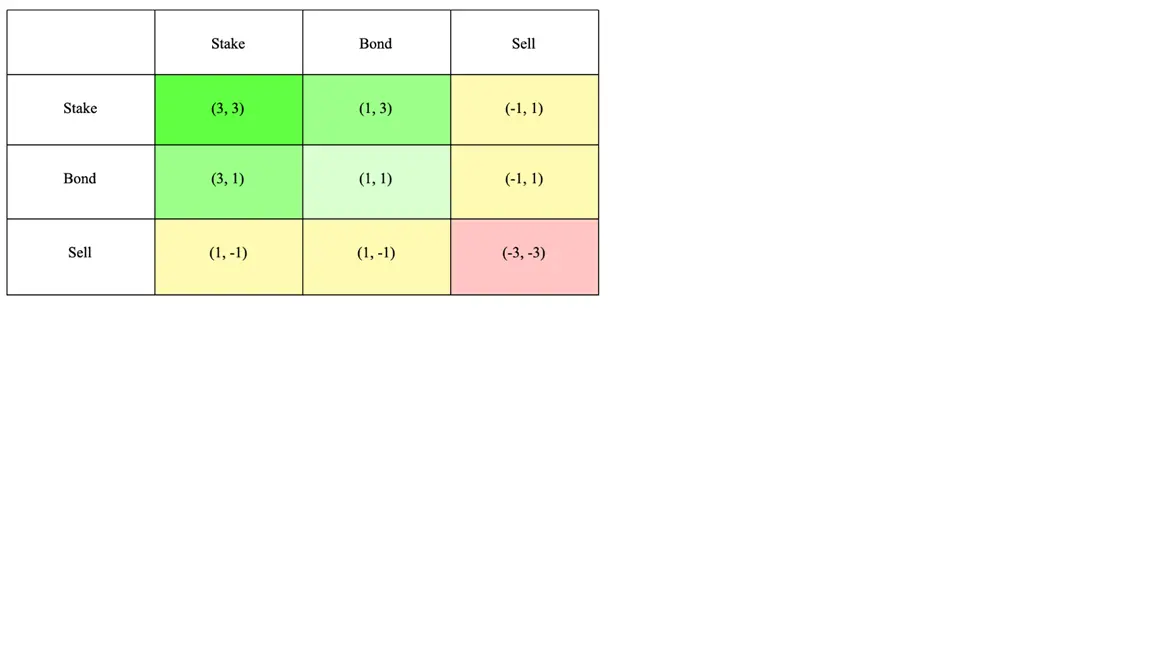
These all can be summarized in the game-theoretic view of KlimaDAO actions. Staking is the most beneficial action for the protocol for the reasons mentioned above. Next is bonders. They increase liquidity by adding reserve assets to the treasury. But their action result in selling pressure when they sell their bonds. Finally, sellers are the least desired actors for the protocol. Their selling pressure can decrease confidence in the project; thus, they get least rewards of the three groups.