
If you’ve spent any time in crypto, you’ve probably heard the phrase:
“Just stake it and earn passive income.”
Sounds simple. And in many ways, it is.
But the real question isn’t if you can earn from staking — it’s how much you can realistically expect in 2026, and whether it’s actually meaningful.
Let’s break it down properly.
The short answer: It depends (but not in a vague way)
Most major cryptocurrencies today offer staking rewards somewhere between:
- 3% and 10% annually
That range hasn’t changed much over the past few years, and it’s likely to stay relatively stable into 2026.
But here’s what people often miss:
- The return itself is only half the story
- The size of your position matters much more
Small portfolios vs large portfolios
Let’s take a simple example.
If you stake $1,000 at 6% annually, you earn:
- $60 per year
- $5 per month
That’s fine, but it’s not life-changing.
Now compare that to:
- $10,000 → $600/year
- $50,000 → $3,000/year
Same percentage. Completely different outcome.
That’s why staking feels “slow” in the beginning — and why many people underestimate how long it takes before it actually matters.
Where staking starts to get interesting
From what I’ve seen, staking becomes noticeably more meaningful when:
- You have a mid-sized position ($5K–$20K)
- You compound rewards over time
- You combine staking with price appreciation
That last point is key.
Because if the token itself increases in value, your staking rewards scale with it.
A practical way to estimate your earnings
Instead of guessing, it’s much better to run the numbers.
You can do that using a simple crypto staking rewards calculator:
What I like about using a calculator is that it forces you to think in terms of:
- realistic returns
- time horizon
- compounding
Not hype
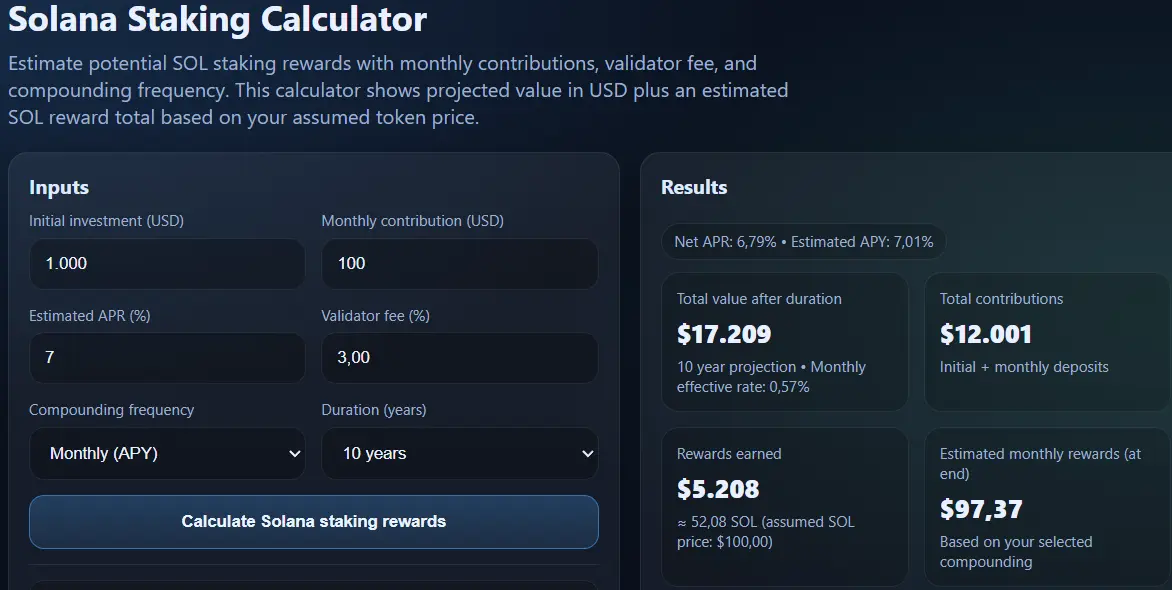
Example: Solana staking
Let’s look at a concrete case.
Solana has been one of the more popular staking assets, with relatively stable rewards.
If you want to estimate your potential returns specifically, you can check your Solana staking yield
Again, the takeaway isn’t the exact number — it’s understanding how:
- rewards accumulate
- compounding works over time
- small differences add up
The part nobody talks about
Here’s the honest truth:
Staking is not a shortcut to fast money.
It’s closer to:
- a slow accumulation strategy
- a way to increase your exposure over time
- a “background engine” for your portfolio
If you go into it expecting quick results, you’ll probably be disappointed.
If you treat it as a long-term layer in your strategy, it starts to make a lot more sense.
So… is staking worth it in 2026?
Yes — but not for the reasons most people think.
It’s not about getting rich from rewards alone.
It’s about:
- gradually increasing your holdings
- staying invested
- letting time do the work
And if adoption continues to grow, even relatively small positions today might end up being more significant than they look right now.
Most people focus too much on the percentage.
The real game is:
- consistency
- position size
- time
Get those three right, and staking becomes a lot more powerful than it first appears.






