
Most people think they need 1 Bitcoin.
They don’t.
Not even close.
Because the real question isn’t how much Bitcoin you want…
It’s how much Bitcoin is even available — if the world adopts it.
And once you start looking at it that way, something becomes clear:
Those round numbers don’t actually mean anything.
Because Bitcoin isn’t about targets.
It’s about scarcity — on a global scale.
Start with the only number that matters
Bitcoin has a fixed supply:
21 million BTC
The world has roughly:
8 billion people
If you divide that evenly, you get:
0.0026 BTC per person
That’s it.
No opinions. No hype. Just math.
But that’s not the real number
Not all Bitcoin is actually available.
A meaningful portion is permanently lost:
- Forgotten wallets
- Lost private keys
- Early coins never moved
A reasonable estimate:
~2.5–3 million BTC lost
That brings the effective supply down to roughly:
~18 million BTC
Now divide that globally:
~0.00225 BTC per person
Now think in terms of a family
Let’s say a family of four.
Their “fair share” becomes:
0.00225 × 4 = 0.009 BTC
That’s less than most people would consider “serious exposure”.
That’s the baseline.
Not wealth.
Not a goal.
Just what would exist per family if Bitcoin were evenly distributed.
And here’s where it breaks down completely
Because Bitcoin is not evenly distributed.
A large and growing share is already concentrated.
Major holders include:
- MicroStrategy
- BlackRock (via ETFs)
- Exchanges and custodians
- Early adopters (“whales”)
These aren’t small holders.
They control millions of Bitcoin — and continue to accumulate.
And much of it is:
- Long-term held
- Strategically accumulated
- Not actively circulating
Estimating the “real” available supply
Let’s build a simple, grounded estimate:
- ~20 million BTC mined
- – ~2.5 million lost
- – ~3.5–4 million held in large, concentrated pools
Leaves roughly:
~13.5–14 million BTC
That’s the part of supply that is realistically circulating or accessible over time.
Now divide that across the world
14 million BTC / 8 billion people = ~0.00175 BTC per person
And for a family of four?
~0.007 BTC
That’s it.
That’s the number most people never think about.
Now everything changes
Look at common “small” holdings through this lens:
BTC (family) vs global realistic share
0.01 BTC ~1.4×
0.05 BTC ~7×
0.1 BTC ~14×
0.2 BTC ~28×
0.1 BTC is not small
If your family owns:
0.1 BTC
You are not “behind”.
You are holding ~14× more than what is realistically available per family globally.
And 0.2 BTC?
~28× the global share
At that level, you are no longer just participating.
You are positioned far ahead of what most people on earth could ever reach.
Why this matters going forward
Bitcoin is becoming more accessible every year:
- Mobile wallets
- Easier on-ramps
- Global internet penetration
- Institutional adoption
Over time, more people will want exposure.
Not 1 BTC.
Just some Bitcoin.
Even small amounts.
And that’s where scarcity becomes visible
If billions of people start accumulating:
- The average stays extremely low
- Supply gets tighter
- Small differences in ownership become meaningful
This is how I think about it now
I don’t think in:
- round numbers
- perfect targets
- “whole coins”
I think in:
How far above the global baseline can I realistically get over time?
Because that’s what creates asymmetry.
Turning this into a real plan
Once you understand this, the strategy becomes simple:
- Accumulate steadily
- Think long-term
- Ignore noise
- Focus on position, not perfection
If you want to see what this looks like for you
I’ve been running different scenarios myself — how small, consistent amounts build up over time.
So I built a simple tool to model this in practice:
You can test your own timeline and see how close you can realistically get to different levels.
The asymmetry most people overlook
At today’s prices, Bitcoin is around $70,000.
So let’s keep this grounded.
If you aim for something like:
- 0.1 BTC → ~$7,000
- 0.2 BTC → ~$14,000
That’s your maximum exposure.
In the worst-case scenario, that capital could lose most or all of its value.
That risk is real.
But it’s also defined.
You know exactly what you’re putting at stake.
Now compare that to the potential upside over time.
If Bitcoin continues to grow as adoption increases, even relatively small holdings could become meaningful in ways that are hard to predict today.
That’s what makes this different from most investments.
You’re risking a defined amount of capital…
for exposure to something that has no predefined ceiling.
What does this actually mean in practice?
Instead of guessing what “enough Bitcoin” is, it helps to look at simple scenarios.
Not predictions.
Just possibilities.
If Bitcoin grows, small amounts scale fast
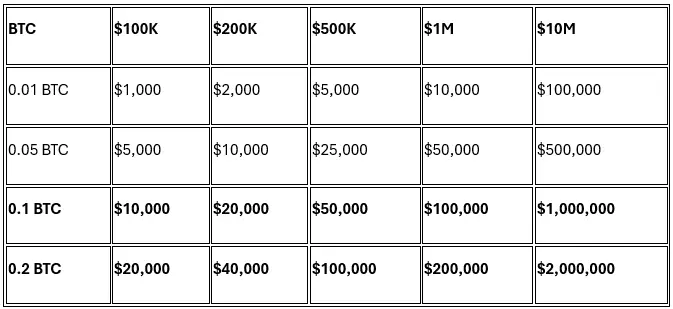
This is where the asymmetry becomes clear.
The amounts may look small today.
But depending on how adoption evolves, even modest holdings can scale in ways that are hard to intuit upfront.
Final thought
Most people focus on big numbers.
- 1 Bitcoin.
- Early retirement.
- Life-changing wealth.
But when you zoom out and look at the global math…
You realize something much simpler:
You don’t need a lot of Bitcoin.
You just need more than most people will ever be able to own.
And that number… is far lower than people think.
I’m personally building toward this over time.






