
Random thoughts were circulating in my head this morning, on my way to work, when it came to a topic to write on. Unrelated to my swirling thoughts I have been awake since before 3am (and no it wasn't the children either) and so my brain this morning lacks the capacity to do a deep dive, although I have something in mind for tomorrow - let's see if I can stay awake for now.
So, and I am going to kind of treat this as a case study and illustration at the same time, I was looking at my portfolio - which has dipped below the profit line now because I have made a big move on acquiring BitCoin during the current dip, and paying particular attention to my staked currencies and I found myself thinking about the value of staking. I also think my mind was focused on staking additionally after a comment by @LiaRio yesterday - so thank you for the prompt.
Staking sounds idea, pile your currency up and watch it grow passively with no need to touch it. What could go wrong!
You are talking to a former user of Celsius!
When a currency is struggling in the real world one solution that many regimes consider is the printing of money, but rather than solving the problem this just exacerbates it. What historically makes an asset (of any kind) valuable is relative scarcity - consider gold - and thus it follows that the opposite is also true. Printing money actually has a depreciating effect on the said currency, which in simple terms means that it becomes less valuable and consequently has less purchasing power. If this process runs away with itself it can lead to hyperinflation.
In Weimar Republic Germany, smart workers got paid at the beginning of each day (with prices rising hourly) and then rushed out to spend their wages immediately before it lost even more value and it was cheaper to burn banknotes than it was to buy firewood. To drive my point home, a loaf of bread which cost 250 marks in January 1923 cost 200 billion marks by November and the currency was so devalued that it was being loaded onto wheelbarrows.
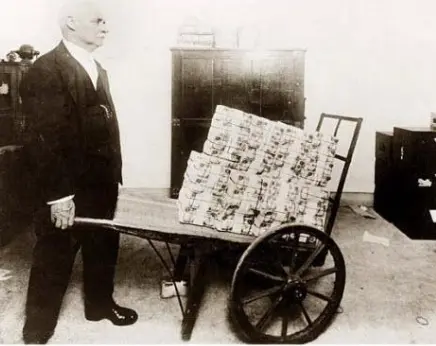
So what has this got to do with cryptoland and staking?
Since Coinbase has started offering staking rewards again I have been staking a whole load of COSMOS (ATOM) which I bought at about half of their ATH value and at the time my intention was to trade back and forth with USDC as a stable base, but then its price started eroding until now when it is worth about 15% of what I paid for it. At first I decided to hodl it out and it naturally followed when staking became available again that I should take advantage.
Only, and this is the rub, even though I am receiving the best part of a whole token each month (>0.8) is that while my asset pile is growing the over all value is still falling and thus more is actually becoming less.
So it naturally follows that I am asking why are they offering such a lucrative >14% rate (even on Coinbase!) unless the project owners are doing the crypto equivalent of printing money. Now, there may be legitimate reasons for choosing this path, for example to increase ownership, which will have a corresponding influence on people who will now be more likely to take a vested interest in ATOM's future. This will then create a snowballing effect (or so the theory goes) leading to a greater likelihood of project adoption which will in the long term lead to a greater uptake in real world usage with then endgame being the price of the token rising back into areas of reasonable profitability..
Alternatively, they could be just fighting for their lives!
So staking, as attractive as it might be is also a potential red flag. What do you think?
As always stay safe and well my friends.





