
With Mama_Rah and the boys being away I have been home alone all weekend and so I have taken the opportunity to binge-watch the new BBC adaption of William Golding's The Lord of the Flies. It is, of course, a story I am familiar with, given the broad themes it discusses and its place in popular culture. Although I have never actually read the book, I am also familiar with a relatively early episode of The Simpsons - "Das Bus" (Season 9 Episode 14) - in which the story is parodied. And so, with a familiarity born purely out of a general cultural awareness that lacked specifics, I found myself compelled to watch it.
From what I have read around it, but cannot directly bear witness to (having not read the book), the BBC four-part adaption is fairly faithful to the original book including an authentic 1950s setting with language ("spiffing" / "splendid") that is also time appropriate and it was refreshing to watch something British without that infuriatingly ubiquitous "innit".
To summarise (although it won't be brief), a plane crashes on a large deserted island with a lush forest, leaving no adult survivors and the children of which there are many have to fend for themselves. Soon they came together and "Piggy", a rather rotund serious boy with an older head on his shoulders, brings them together and attempts to establish some kind of order. He calls for an election of a chief while dismissing himself as a candidate and Ralph is voted in by a show of hands. Piggy also instituted the usage of the conch, a large seashell which doubled up as a horn, which represented when somebody could speak in a meeting. The boy (for there were only boys present) who was holding the conch had the right to speak without interruption and could hand it over when done.
Piggy
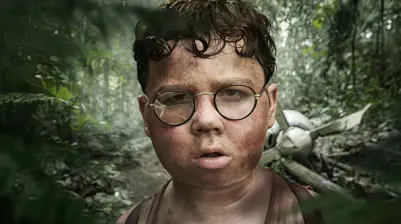
Piggy represented order.
Meanwhile Jack, who felt he should have been elected as chief, declared himself chief hunter. He surrounded himself with his own people, those fellow choristers who had been with him in a choir in a civilised place they knew as home, and after a few failed attempts the were able to bring down a wild boar. This infused Jack's sense of power and increased his frustration, claiming that the rules weren't fun and inevitably the group splintered into two factions. Those who stayed with Piggy and Ralph, predominantly the "young uns", tried to maintain some kind of order or rule of law while at the same time Jack's group became ever more primitive and aggressive and his main henchman was Roger a particularly brutal and sadistic boy.
Jack, just one of the boys, until darkness descended.
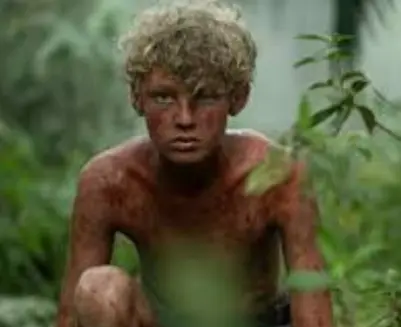
Many of the boys had a fear of The Beast, a real creature or so they believed, who was stalking them from the water. In the end, The Beast was actually a figment of their collective imagination and representative of all of their darkness and fears. This fear came to a culmination at the end of Episode Three. In what was a rather confusing scene, Jack's group murder Simon, in a frenzy that both seemed to be directed at "killing the pig" and "killing The Beast". Simon, for his part, was the one chorister who did not side with Jack when the group splintered and he seemed to represent a sensibility and he knew Jack for who he was, his insecurities and his weaknesses as much as his show of strength, much of which was bravado. While graphic, in showing the frenzy, it didn't actually show Simon's death, just his dead bloodied body floating in the sea.
Many of the boys have now gone over to Jack and his increasingly brutal tribe, leaving Piggy and Ralph pretty much isolated. They go to try to reason with Jack's tribe and try to use the conch as a means to maintain order. The conch is snatched from Piggy's hands and a few minutes later it is thrown at him and smashes into pieces as it cracks the back of his head. Piggy mortally wounded falls haplessly to the ground and briefly loses consciousness. The boys then turn on Ralph who bravely drags his fallen friend away just as he is becoming conscious and for a time they escape. Despite Ralph's best efforts, Piggy succumbs to his injuries and dies in the night.
Ralph later returns to Jack's tribe to tell them about Piggy's death and to appeal for some kind of order. Hiding in the bushes, he manages to exchange information with the twins, Sam and Eric, who are both fearful and tell Ralph to go away. Their warnings become more shrill, when they realise that Roger is on his way over and then - almost certainly out of a sense of fear and self-preservation - they shout out a warning that "Ralph is here".
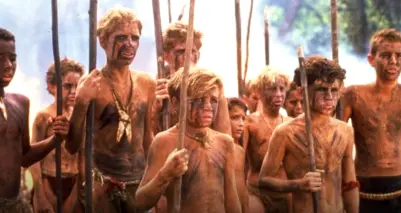
Galvanised by the news, Jack's tribe set out to hunt him down and given what had already happened, two boys murdered at their hands, there was no disguising their intentions nor any chance to reason with them. Ralph fled for his life and after a few near calls and a lot of frantic running, he finds himself on the beach where he meets an adult who appears to be some kind of naval officer. Ralph quickly understands that he had arrived by ship and the man starts asking if there were other survivors and when he found out that only children survived he almost joked that he hoped they hadn't killed each other. Ralph said that they had only "killed two" so far and again initially the man thought he was joking and then he was left in wide-eyed shock when he saw Jack's clan, now no more than howling savages, emerge from the forest in their pursuit of Ralph.
Ready to hunt - Jack's warlike tribe.
The story ends there and I am guessing that the appearance of an adult, brought about a restored sense of order and that Ralph was saved; but maybe the boys turned on the man too, who was on the beach on his own and outnumbered.
What was most shocking, and I kind of knew the outcome before the start, was that without the rule of law or some kind of reinforcement (namely consequence) that the mind reverts back to a more primitive way of being where brutality becomes the source of strength. I always knew Piggy was going to die (again I hadn't read it), but after the bringing down of the wild boar and the incessant chanting of "Kill the Pig" the direction seemed fairly obvious. So, I was caught by surprise, when it was actually Simon who fell during the "Kill the Pig" frenzy and not Piggy himself. Of course that came later and with Piggy's death, so died any sense of order or civilisation, because, Ralph the only one who still adhered to such ideals was isolated, alone and on the run.
The speed of the descent into disorder tells us a lot about the human condition and how we must constantly be vigilant, for it can often seem that order, democracy and decency - as represented by Piggy - is weak, and if that isn't a lesson for today then I don't know what is.
And on that sombre note, as always stay safe and well my friends.






