
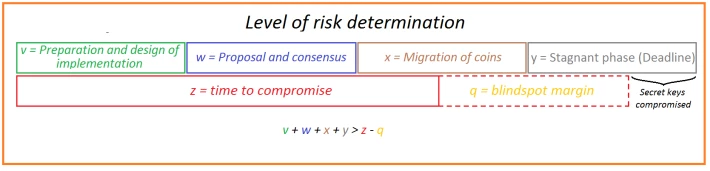
z = The time we have until a quantum computer of a critical level has materialized. Estimations are all over the place. From a couple of years to never.
Z is the great unknown.
q = is the margin we should deduct from z as a safe margin to compensate the blind spot caused by the fact that any assessment of the development curve of quantum computers is based on incomplete information. Additionally, q accounts for the fact that developments on other levels like algorithms improvements can contribute to a quicker reach of the moment a quantum computer can break the cryptography in question.
Q should be a certain percentage of Z.
Development in quantum computing is likely to speed up. Several credible organizations like the NSA, NIST, NAS advice to plan ahead of a possible emerging threat, rather than act reactively once the threat has materialized. The reasoning for a pro-active attitude is substantiated in the article in this link under the header “Timeline/ Plausibility”.
Summarized:
1. The hazard and the security disaster it would create is of such significance that one can’t afford to take any gambles.
2. Public and universal analysis of a possible critical date can only be done while reviewing public information. And because there are huge interests at stake (commercially and strategically), not all developments will be shared publicly. So, assessing the risk, you should assume the possibility of a blind spot. This means that in assessing the risk, you must seriously consider the idea that an estimate should be adjusted to an earlier timeline if you would have had all the information at your disposal in your analysis of the development curve. Adding to that, there are developments in other fields that can bring a critical date closer. To give an example: a new algorithm called Variational Quantum Factoring is being developed and looks quite promising. “ The advantage of this new approach is that it is much less sensitive to error, does not require massive error correction, and consumes far fewer resources than would be needed with Shor’s algorithm. As such, it may be more amenable for use with the current NISQ (Noisy Intermediate Scale Quantum) computers that will be available in the near and medium-term.” See for more information here.
3. An implementation period of new cryptography takes time. While the needed timeframe depends on the system, an analysis of this timeframe should be made. If this isn’t carefully done, there is no way to make a total risk analysis where you reflect the expected timeframe against the expected time the risk will materialize. V, w, x, y will need to be done for every single blockchain individually that is serious about risk determination.
There are some blockchains that have implemented quantum resistance from the launch of their genesis block. QRL is my personal favorite. But for other existing blockchains, the fact is that going from where we are now to fully quantum resistant cryptocurrency is a process that will take a serious amount of years.






