
image: Pexels / panumas nikhomkhai
Most Web3 projects start automation in a fairly simple way. At the early stage, the infrastructure is usually compact: a few bots, a limited number of API requests, one working region, and relatively small amounts of data. As long as the load remains moderate, the system works consistently and does not require complex network architecture.
The first difficulties appear later - when the project begins to scale. The number of requests gradually increases, additional services are connected, and the number of accounts, RPC connections, and background processes grows. Infrastructure becomes more distributed, while traffic behavior starts becoming less predictable.
At the same time, the problem is often not related to the code itself. APIs continue to work, request logic remains the same, and scripts may stay unchanged for months. However, the system itself gradually starts behaving differently: some requests become slower, certain connections lose stability, delays appear between regions, and automation starts depending not only on the application itself but also on the network behavior of the entire infrastructure.
This usually appears in the following ways:
- some requests become slower
- certain sessions unexpectedly terminate
- the number of errors increases
- connections between regions become unstable
- parts of the automation start working with delays
- data monitoring becomes less accurate
In many cases, this is related not to the application itself, but to how the system’s network behavior changes after traffic growth.
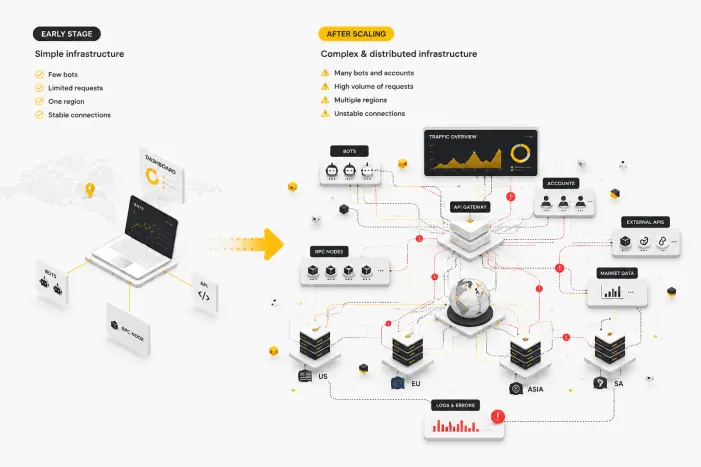
Why System Behavior Changes After Scaling
As traffic volume increases, Web3 infrastructure starts behaving differently not only because of the higher number of requests. The entire network behavior of the system changes as well.
When dozens of processes simultaneously connect to APIs, RPC services, analytics platforms, and market data providers, traffic patterns become more repetitive. The number of repeated connections increases, individual IPs receive more load, and different processes begin conflicting with each other.
At a certain point, a standard networking model is no longer sufficient. This is why Web3 projects start separating infrastructure for different tasks.
Why Web3 Projects Use Different Types of Proxies
After scaling, different processes begin requiring different types of connections.
For example, high-volume request tasks often use rotating residential proxies, where traffic is distributed across IPs and regions. Long stable sessions usually rely on static ISP proxies, while server-side processes and background tasks are commonly moved to datacenter infrastructure.
This approach is not just about changing IPs. It allows teams to manage connection stability, traffic distribution, and network behavior between processes.
In many cases, the network layer itself starts determining the overall stability of automation.
For such scenarios, Web3 projects increasingly rely on infrastructure services that allow multiple proxy types to be combined within a single system. One of these services is MangoProxy.
MangoProxy provides several proxy types for different traffic and infrastructure scenarios:
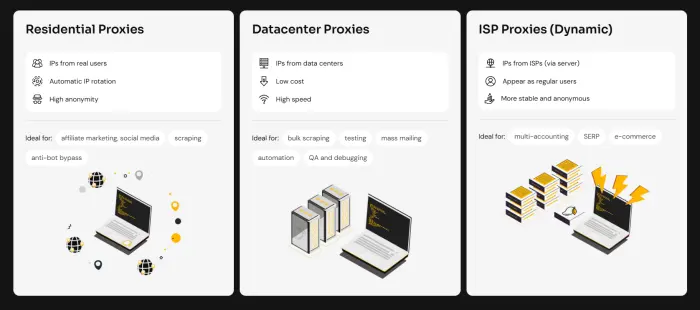
Residential proxies, dynamic ISP proxies, and dynamic datacenter proxies work as rotating connections, while static ISP proxies and static datacenter proxies are used as dedicated connections for more predictable network behavior.
The service supports both HTTP and SOCKS5, while the infrastructure itself includes more than 90 million IP addresses. Dynamic proxies are available in 200+ countries, while static connections are available in 30+ countries.
In Web3 environments, these models are commonly used for:
- API automation
- market monitoring
- distributed scraping
- background analytics
- multi-region services
- distributed account management
For projects where traffic is distributed across multiple processes and regions, not only IP rotation matters, but also connection quality. MangoProxy reports an average response time below 0.7 seconds and infrastructure uptime above 99.7%.
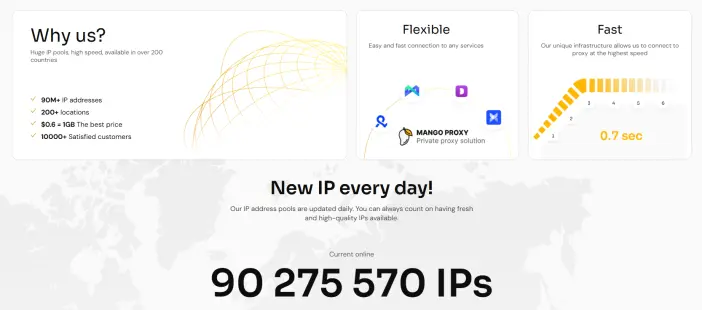
Additionally, the platform provides both a dashboard and API access for automated infrastructure management. This makes it possible to manage proxies at the distributed system level rather than through manual standalone connections.
As traffic load grows, these infrastructure models become increasingly important for maintaining Web3 automation stability.
Why Simple IP Rotation Is No Longer Enough
At an early stage, many teams try solving infrastructure problems through simple IP rotation. However, after scaling, this approach is usually no longer sufficient.
Excessively frequent IP changes can break connection consistency, reset long sessions, and create unstable behavior for APIs and distributed services.
This is why modern Web3 systems increasingly rely on combined infrastructure models:
- rotating proxies for distributed requests
- static connections for long sessions
- separate IP pools for different processes
- traffic distribution between regions
At this point, proxies stop being a secondary tool and become part of the overall network architecture of the project.
For these scenarios, MangoProxy provides multiple connection models within a single infrastructure. Rotating and static connections can be used simultaneously, allowing different types of traffic loads to be separated inside one system. For example, some Web3 processes may use rotating residential proxies, while long-session automation can run through static ISP or datacenter proxies.
Additionally, MangoProxy infrastructure supports HTTP and SOCKS5, while proxy management is available both through the dashboard and API. For distributed systems, this becomes especially important because after scaling, proxies usually become part of automated infrastructure rather than a manual connection tool.
Conclusion
As traffic load increases, Web3 automation becomes dependent not only on the application itself, but also on the network architecture of the entire system.
After scaling, the following factors become critical:
- connection stability
- traffic structure
- load distribution
- cross-region operation
- session management
This is why modern Web3 projects increasingly build infrastructure around multiple connection types and distributed networking models, where proxies become part of the overall automation architecture.
FAQ
Why does automation become unstable after scaling?
After scaling, the nature of traffic changes. The number of connections, parallel processes, and cross-region requests increases, making infrastructure stability dependent not only on code, but also on networking architecture.
Why does simple IP rotation not always solve the problem?
Because instability is often related not only to IP changes, but also to session behavior, load distribution, and connection consistency. Different processes usually require different connection models.
When are static proxies used?
Static and datacenter proxies are commonly used for tasks that require long stable sessions, predictable connections, and persistent IP addresses. For example, long-session automation, API integrations, and distributed services.
Why do Web3 projects combine multiple proxy types?
Different processes generate different traffic patterns. Rotating residential proxies are suitable for distributed requests and multi-region traffic, while static connections are better for tasks where connection stability is critical.
Note: This post was provided and published on behalf of a client. Publish0x does not guarantee the accuracy of the statements made in this post. The post should not be considered as an Publish0x endorsement of the products, services, or people mentioned. Readers should do their own research before taking any actions related to the company. Publish0x is not responsible, directly or indirectly, for any damage or loss caused or alleged to be caused by or in connection with the use of or reliance on any content, goods, or services mentioned in the press release or sponsored post.






