I recently started trying out a few new Web3 games, trying to keep up with what is coming out and looking for something a bit different than the typical TCGs I tend to play. I tired a bunch but one that got it's hooks into me pretty deep was Kuroro Beasts, specifically beast brawl. For those of you who have not played, it is a turn based 5v5 monster fighter, ala Pokemon. You collect beasts of various abilities, build a team, and try to out fight an opponent. They have another title that is more akin to a turn based RPG which seems to be coming out in dribs and drabs, but Beast Battle scratched my itch by getting right into the heart of what I like about these games, competitive play.
Now I'll admit it is early on in the lifecycle of the game, but they are doing a lot of stuff right. NFT's are shared between titles, so collecting one has utility across them. They are doing what they call an airdrop for their onchain currency $KURO, but that is honestly a bit misleading as it is really more of a limited time play to earn scheme that just has a very large timeframe, meaning it is still early to get in and earn rewards. I am also a sucker for this style of pixel art, which captures the movement that pixel artists like Paul Robertson are famous for with an art style evocative of the best 16-bit era titles.
So knowing that I am enjoying the game and wanted to go deeper, naturally I spent a bunch of time spreadsheeting the hell out of it.
Spreadsheets on the way to victory
The key to winning in Kuroro is understanding how damage works combined with an understanding of elemental resistances and weaknesses. They posted the combat math in the past and it is 100% transparent but a bit convoluted to calculate on the fly, though I believe that is intentional. I would not want to sit there with a calculator on my turns trying to game out damage range with the turn timer ticking away, though I suppose it is possible. In general all you should know is that your relevant attack value being higher than their relevant defense value is good, attacks that share your elements are more powerful, and hitting for weakness is generally going to get you the most damage.
Elemental weakness/resistance is really the key though. Most beasts will use attacks that match their elements for the damage bonus (though they can have off element attacks), and if you can quickly identify which of your beasts have the best resistances and can hit for the largest elemental multiplier you are likely on your way to success.
Each element has a number of modifiers attached to it against each other element, from completely immune to damage all the way to 2x weakness. If it was that simple though I don't think the game would be as strategically deep as it is, because each beast has 2 elements and the strengths and weaknesses compound. A beast who is totally immune to one element can cover a weakness in another, and being doubly weak risks a 4x multiplier which can spell a quick end in one attack. But calculating these can be tough, which is where the spread sheet comes in.
First, let's take a look at the base elemental chart
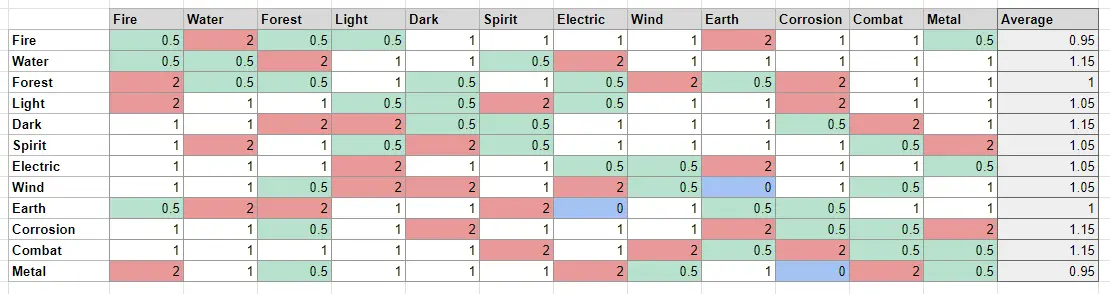
I reversed the order of these from the article above for my own sanity. The numbers in the chart represent the damage multiplier you will take from those type attacks. On the x-axis of this chart you can look up an element, and then on the Y see what it is strong/weak against. So if I go across Fire I can see it is resistant to Fire, Forest, Light, and Metal and weak to Water and Earth. 3 Elements also have total immunity (in blue). Each element is resistant to itself. So this is all good to know, but impractical because you are never going to face a one element monster (at least not yet). Since each beast has 2 elements, there are a total of 66 possible combinations in the game. That looks like the following chart
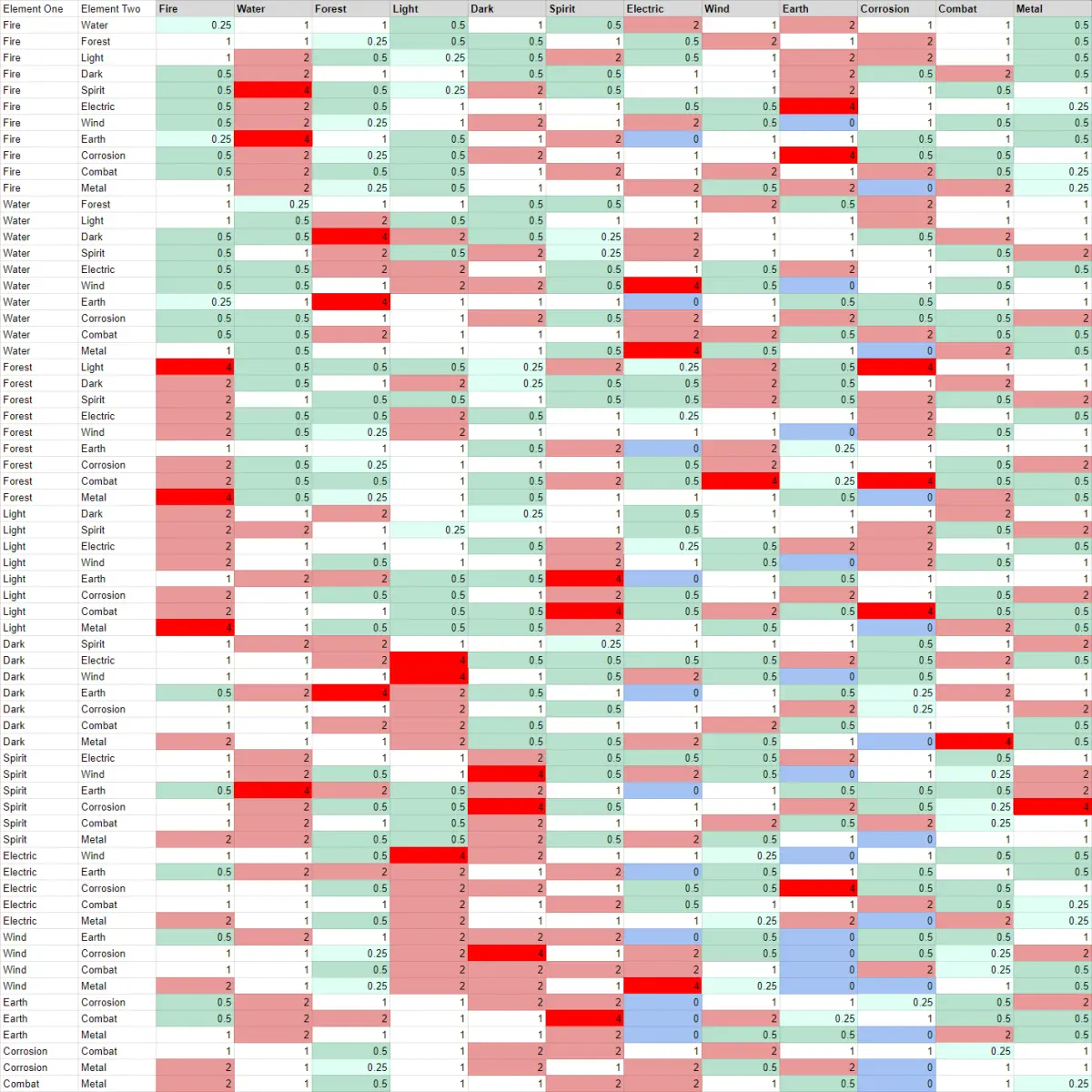
It's a lot to take in. No one is going to memorize this chart, nor should they because there are better charts to memorize. So what do we do with it?
Insights
While you can reference this chart while you are building a team to understand how to cover your bases, what combinations are more favorable to what you are trying to do than others, I find that by doing a little light data analysis on this we can come up with some relatively useful shortcut and heuristics that are a lot easier to memorize. Note that all of this data is being evaluated in a void and sorta assumes that all your beasts are competing at a equal level. Stats and abilities matter, so just because on the chart you seem like you are in a good spot does not mean you'll take the game, and vice versa.
Defensive Stats
➤ Best Average Across All Elements: Fire/Forest and Fire/Wind
Both of these combos average .9375 across the board, meaning they are broadly the most resistant. None of them have a 4x that can be applied against against them, though Fire/Forest has the least number of weaknesses in total. Fire/Wind has an immunity to Earth but a 3rd weakness overall.
➤ Worst Average Across All Elements: Spirit/Corrosion
Taking an average 1.4375 damage across the board, this configuration is generally going to take the most damage from the field. It comes from the fact that it has 2 super weaknesses and 2 regular weaknesses, which is a lot but not the most surprisingly. While it will be meta contingent, beasts with this setup are probably not going to be good tanks and you should more likely invest in speed and damage if you play them.
Malweave is the one beast thus far with this setup. He is a mystic attacker with pretty ok defense values but slow and looks to be mostly a supporter, which makes me think he is probably not a good competitive option since he is going to take big hits from anyone using normal attacks and before he can get his attacks off.
➤ Units with Double Super Weaknesses: Spirit/Corrosion, Light/Combat, Forest/Light, Forest/Combat
You are going to see as this analysis goes on that Forest and Combat are in sorta a rough spot. All of these take 4x hits from 2 elements, and in a game where you can represent 10 elements on your team, chances are your opponent will have something that can hit you for lethal. All of them also sport 2 regular weaknesses, meaning a 3rd of the games elements will be able to hit them for a lot, and it represents 23 of the 66 (34.84%) possible combinations to likely be using those attacks for the STAB bonus. Forest/Combat is in an interesting spot compared to the others because even though it has these weaknesses it resists everything else other than light, so in the right meta it could represent an absolute house or late game attacker, but that is going to be contingent on many factors.
➤ Most Weaknesses Overall: Wind/Combat
This one has the distinction of having 5 weaknesses overall. That can be misleading however because none of them are 4x and it has one immunity. While I do not think it's impossible to build a tank that works with this configuration, using abilities to boost defense values is probably a losing proposition since the 2x multipliers are going to outweigh that. It would not be uncommon to face teams where literally everyone can hit for double damage with at least one attack. That being said Wind and Combat are heavily resisted elements in this game, so even building this out as a glass cannon will give you trouble.
Zephyrus is currently the only beast with this elemental pairing. He is on the faster side with a decent attack value, so it is very possible he could function as a glass cannon sniper picking off key targets, just so long as you accept the fact that he is probably going to get knocked out on the counter attack.
➤ Most Resistances and Immunities: Forest/Combat
Like I said before, Forest/Combat occupies a strange space. Having 7 total resistances is a lot, but in a game where beast can hit for 2 STAB Elements it is very likely undone by the weaknesses. Forest/Combat is also one of the most resisted configurations, so your stab bonuses are going to get undone in a lot of cases purely by how many things not only hit you for weakness, but also resist you.
Entik is the only beast I can find that has this configuration, and he is a 2 star with roughly evenly distributed stats. If I wanted to make it work for him I would focus on defense stats and use him in a supporter role which he is suited for, the problem with that is generally you want supporters out early to actually support you, since they have trouble closing the game out pretty often. Probably best to pass on him most of the time.
➤ Least Resistances and Immunities: Light/Dark, Dark/Spirit, Dark/Corrosion, Corrosion/Combat
Each of these only has 2 resistances, one .5 and one .25. All of them have 3 weaknesses, though for my money the worst of the bunch is likely Corrosion/Combat. It's 2 resistances are to Combat and Forest which later in the analysis we will see are likely the worst attacking elements overall, and ones I think people will shy away from. While their averages are not the worst, if you assume those 2 elements don't see much play suddenly these units are terrible at tanking.
➤ Fewest Weaknesses: Water/Earth
This MAY be the best overall combination on paper in the game. Only 1 weakness at 4x but it is against forest which as I mentioned may be the worst attacker. The combo also carries an immunity to electric. It does not have a lot of resistances but even with out only taking normal damage from most elements goes a long way to make sure you are not OTKO'd. Water may be the best overall attacker in the game as well, so this is definitely a combo to look out for. Beasts with a good defense spread, good speed, and then a strong single attack stat are going to be good for many roles.
In case you are wondering, Kaiju King seems to be the only beast with this pairing thus far, and sadly I do not own him. I have no idea what his attacks look like but I think I would happily slam him against any opponent who did not present a Forest beast, since at least that way you know if you are going to get hit with a Forest attack it will lack the STAB bonus. He is dirt slow but has high defense values, hit points, and regular attack, so he makes for a reliably tanky unit that will often survive stuff that is directed at him for a big counter attack.
➤ Most Immunities: Earth/Metal, Wind/Earth, and Wind/Metal
All of these sport 2 immunities, which can make them great end of battle roadblocks if you are selective in who you knock out along the way. Earth/Metal is generally the best of the bunch with only 3 weaknesses and the best average resistance overall, while wind/metal has the distinction of being the only one with a 4x weakness here.
➤ Two Weaknesses with No Super Weakness: Fire/Forest, Fire/Water, Water/Forest, Forest/Earth, and Water/Light
5 combos to choose from here. These are generally the most stable units, but I would not qualify them as tanks. Fire/Forest is the best of the bunch with with 5 resistances and the best overall average resistance (also in the game) so maybe it is the exception to the rule. The damage they take will be more predictable and generally less likely to OTK.
Attack Stats
➤ Element that Hits the Least Resistances: Water
Water is the most reliable attacking element by far. Of the 66 combinations in the game Water hits 24 of them for weakness damage, is only resisted by 15 of them (with only 1 super resist) and there are no immunities to water. Build your lists with a water attacker and you are pretty much assured it is going to do reliable damage most of the time. Water/Forest is the only build that can really tank water attacks, just incase you hit it.
➤ Most Resisted Element: Combat and Metal
23 combinations resist Combat and Metal at half damage. That is more than a 3rd. I can sorta understand metal as it seems like it would be a defense based element, but one would think that combat focused beasts would be good at, well, combat. It seems like all that training has not taken them very far.
Chromantis is currently the only Beast to be both these elements, and seeing as how he is supposed to function as an attacker it does not bode well for him. Fast but not in the top tier and having a lot of his base points stuck in a still lackluster Mystic Defense makes me think it is going to be hard to make him shine, though he is a 4 star beast so he may very well still make up a lot of the slack in raw stat points. I would not completely discount him, but I probably would look elsewhere first to fill that role and only use him if I really needed coverage on these 2 elements.
➤ Most Super Resisted Element: Wind
Wind is resisted by 10 different combos at .25 damage. The next nearest attackers who are resisted like this are at 6.
➤ Most Overall Resisted Elements: Combat, Metal, Electric, and Forest
Each of these is resisted by 29/66 elemental pairings. The hat tip here goes to lightning however because 11 of those are complete immunities. Now just because they have low resists does not mean you cannot do things like status effects into shield with them to get some damage across, but these beasts have the toughest spread across the game.
What to make of it all?
Well, armed with all this knowledge, what does it all mean? It's hard to say. There are so many factors that go into building a team for this game including having the right attack stats against the right opponents and the correct pairing for your beasts. Speed is a huge factor as well, since getting your attack in first in many cases can mitigate a lot of defensive weaknesses, as is the role the unit is meant to play. I suspect that the mythic and legendary beasts are generally just going to be better than a 2 star one even given unfavorable pairings, as the stats go a good way towards mitigating the downsides.
There are also some status resistances that are not accounted for in this chart.
- Electric Beasts cannot be paralyzed.
- Corrosion and Metal Beasts cannot have venomous status.
- Fire Beasts cannot be burned.
- Forest Beasts cannot be put to sleep.
I have yet to play a game where paralysis is relevant and I don't think I have ever seen an attack that sleeps. Maybe this is limited to the RPG game and not battle arena. Resistance to venomous which I believe was renamed to corrosion is pretty relevant for tank units, and Metal seems to have a few of them so they may be better than the numbers here portray depending on how relevant those strategies are.
If I had my pick of the beasts in the game right now, 1 of legendries aside, Kaiju King would be the thing I was experimenting with for sure. Some of the double immune beasts like Metalodon have a good role to play that I would want to consider as well. For some reason Metalodons description says he is the best defensive creature in the game and only has one weakness, but according to their own chart that is not true. Perhaps it is just an outdated description.
Anyway, I hope all of this was useful to you or at least a good read. One last thing before I go. If you are wondering who I am and why I am qualified to even do an analysis, know that I have done game design work on some physical TCGs in the past, but also WEB3 game balance and analysis is one of my jobs. I happen to work for a game balance consultancy called SUPERPOWER and we are hired to get into games, understand them completely, and then break the hell out of them to try to fix it. We are always looking for the best players to be game balance consultants and high end Data/ML/AI people, so if you are interested check out the website and shoot us an application, we would love to hear from you.
Oh and drop like or a comment, tell me why I am wrong or whatever, I like that too.