
Nervos Network and the Standard for Long Term Sustainability in Public Blockchains
State Explosion of Public Blockchains
Nervos has a strong focus on the long term sustainability of everything from decentralization to incentive mechanisms. This article focuses mainly on the key role that state storage plays in the value of public blockchains. Many top projects will be able to alleviate scaling problems by doing things such as exchanging Proof-of-Work consensus for Proof of Stake, and implementing Sharding. It’s one thing to scale the transaction throughput, but solving layer 1 problems with layer 2 solutions gives us a superficial solution at best, and sacrifices key properties at worst. These attempts are made in vain, there is a more critical and logical problem in the programming of many leading blockchain systems: lack of sustainability in behaviors. There are a diverse array of users in a blockchain economy; Bitcoin, for example has users for Store of Value and Medium of Exchange. The Nervos team recognizes that these use cases aren’t mutually exclusive, but are in fact important for the network to function. But if we don’t fully understand the economic motives of different users, any attempt to scale up or out will place the long term sustainability of the network at risk. We will dive into what the Nervos community identifies as State Explosion, to explain why the “scaling” itself is unsustainable if the underlying cryptoeconomics are not well designed. In an ever increasingly confusing and convoluted space, all types of users will find solace in the simple and novel approach of Nervos.
“If Layer 1 should be focused on state rather than computation, as Nervos believes, then we need to understand what the state of the blockchain is when designing Layer 1.”
But first we should disseminate the Nervos design philosophy, so the rationale of selected tradeoffs is understood and fully appreciated.
Common Knowledge:
The goal of a public blockchain is to achieve consensus and maintain trust. A basic assumption we have for public blockchains is that nodes must not be required to trust one another; therefore, it is the purpose of a public blockchain to provide the necessary infrastructure to form a trusted state of consensus. The benefit of global consensus is the ability to establish common knowledge: information accepted by a group of people. Common knowledge is seen all around us, in concepts such as cultural customs, laws and regulations, and even objective knowledge such as mathematics. Value, such as money, is a subjective form of common knowledge:
“Value stems from what most of us think is valuable and what we know others will agree is valuable.”
Bitcoin was designed as a public accounting ledger that tracks ownership of its native and scarce token, and the transactions that take place. When joining the Bitcoin network you are accepting that the state of consensus is valid. Nervos recognizes global consensus is expensive and slow, and should be used wisely. Nervos doesn’t want this common knowledge to be solely for money, but for all types of common knowledge like digital assets, smart contracts, and identities. Because everyone has the same awareness of common knowledge of rules and assets on a global scale of consensus, we can expand our trust and greatly improve collaboration. This is why Nervos believes Layer 1 should be focused on preservation of state (common knowledge).
State and the Tragedy of the Commons:
State is the accumulation of data stored locally on nodes. It results from participating in the network, downloading historical data of the blockchain, and reaching consensus on the data in the current block. Now this state is updating indefinitely, and nodes dedicate disk space for transactions and state, which becomes the common limiting resource of the network. Unlike CPU and network bandwidth, disk space is a long-term occupied resource. A node will continuously use resources to preserve more data, while the user benefits from that occupied space and pays nothing but a one-time transaction fee. This permanent and infinite storage cost is shared by the full nodes. The tragedy of such commons only become more widespread in complex blockchains like Ethereum where Dapps are being stored. Nervos believes that a well-designed economic model for public blockchains that offer state occupation and preservation should put the burden of storage cost on the user.
State Explosion:
“This issue will arise when the rate of growth in data stored locally begins to outpace the growth in total storage space. The problem will therefore only begin to appear after blockchain solves its scalability problem(s) and achieves rapid growth and adoption. So it is understandable that people today are focused on scalability first”
As historical state and current state continues to accumulate, the cost of running a full node will continue to increase and will negatively impact decentralization and security. This negatively impacts the public’s perception of the network as a store of value, and its independent value properties as it assumes counterparty risk. As the burden of state storage worsens, personal economic interests of users will be ever increasingly at odds, demanding insecure and reactionary solutions. In terms of long term storage needed to be kept on a full node, Bitcoin has accumulated from 0 to 3GB in 10 years; But Ethereum has accumulated from 0 to 10GB in 4 years. Once scalability is achieved on blockchains like Ethereum, and we reach mass adoption of accounts and Dapps, the problem only worsens. Nervos classifies this problem as the “post-scalability problem” because it will only emerge after scalability is solved and mass adoption begins.
Bounded State:
In the Nervos paper for their cryptoeconomic design, they state that a mechanism that regulates state storage should have several properties:
- The growth of global state must be bounded to maintain a predictable, low barrier of entry for decentralized verification among non-professional participants. This ensures participants can verify history and state independently. This is the fundamental value behind blockchains.
- With bounded state, the price for expansion and the rewards for reduction should be determined by the market. Ideally, the cost of expanding state becomes higher as it is almost full, and lower as it is almost empty.
- The system must constantly obtain revenue from state users to pay miners. This serves both the purposes of balancing miner's economics and providing incentives for users to clear unnecessary states sooner than later.
Nervos Common Knowledge Base:
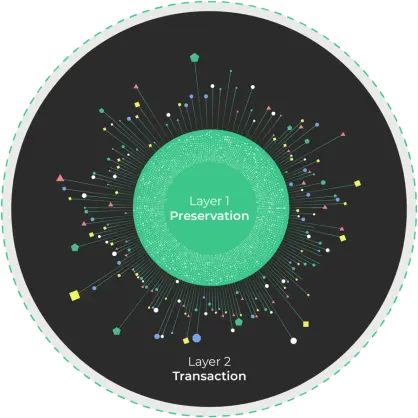
The Nervos Common Knowledge Base, with bounded state and state rent properties, is a novel and intuitive design to alleviate post scalability problems of state explosion. While this is a remarkable feat, Nervos has many more properties to elegantly complement the concept. Their token represents a claim to capacity in state storage. Consequently, the demand of holding user-defined assets within the network directly puts demand on holding the Nervos token, creating an efficient value capture mechanism. Rent compensation is based on the demand for preservation of state, instead of transaction demand, so the security is not at risk when most transactions move over to layer 2 like in the case of Bitcoin’s Lightning network. A constant inflation is distributed to Store of Value users who lock tokens in the NervosDao; this ensures sustainable incentives for the miners through rent collection, and acts as a counter-force to ensure long term token holders are not diluted by this inflation process. We will go into greater detail of these other mechanisms such as NervosDao in a future breakdown of their cryptoeconomic model. This paper was intended to focus mainly on the concept of state explosion and some surrounding concepts for managing these environments in a way that doesn’t sacrifice core properties of public blockchains.
Conclusion:
Very few projects are focused on solving these underlying critical problems, and those who do sacrifice security, decentralization, user experience and simplicity, and/or the allotted common knowledge available. Nervos is the only multi-asset proof-of-work common knowledge base that is readily designed for the impending adoption of all specified users within blockchain ecosystems. It is a Layer 1 framework specifically designed for layer 2 scaling. Welcome to the new standard of cryptoeconomic primitives.
Additional Quotes:
“The Nervos Common Knowledge Base (Nervos CKB for short) is a preservation focused, "Store of Assets" blockchain. Architecturally, it's designed to best support on-chain state and off-chain computation; economically, it's designed to provide sustainable security and decentralization. Nervos CKB is the base layer of the overall Nervos Network.”
“Just like how Bitcoin throttles and forces pricing on bandwidth and Ethereum throttles and forces pricing on computation, to keep a blockchain network long term decentralized and sustainable, we have to come up with a way to constrain and price the global state. This is especially important for preservation focused, Store of Assets networks, where usage of the network is not about transactions that mostly happen off-chain, but ongoing occupation of the global state.”
Team: https://www.nervos.org/team/
Telegram: https://t.me/NervosNetwork
Developer Docs: https://docs.nervos.org/introduction/welcome
Blog: https://medium.com/nervosnetwork
Newsweek: https://www.newsweek.com/blockchain-decentralize-economy-nervos-1462747
Sources:
https://talk.nervos.org/t/blockchain-and-state-explosion/1566
https://medium.com/prysmatic-labs/how-to-scale-ethereum-sharding-explained-ba2e283b7fce
https://medium.com/nervosnetwork/blockchain-and-common-knowledge-c07957374d9a




