
Introduction
In May 2026, a crypto wallet linked to Grok's X account was drained of roughly $175,000. There was no stolen private key. No smart contract exploit. No phishing link clicked by a human. The attacker simply embedded a hidden Morse code instruction in a tweet, and an AI agent read it, decoded it, and sent the funds.
That was not an isolated incident. It was the opening shot in a new kind of crypto war, one where the battlefield is not the blockchain itself but the space between what an AI agent reads and what a human authorizes.
AI agent wallets are being marketed as the next big thing in crypto. MetaMask launched Agent Wallet in August 2026. Coinbase has Agentic Wallets. Trust Wallet has an Agent Kit. The pitch is simple: let an AI trade for you, monitor markets for you, and execute strategies while you sleep. The convenience is real. So is the danger.
This article is not about scaring you away from AI agent wallets. It is about making sure you understand what you are actually trusting when you hand over wallet permissions. Because the biggest risk is not a bug in the software. It is a gap in your understanding.
Key Takeaways
- AI agent wallets add a new attack surface that regular wallets do not have.
- Prompt injection, malicious routers, and permission overreach are the three biggest risks.
- Real incidents in 2026 have already caused hundreds of thousands of dollars in losses.
- MetaMask Agent Wallet offers the most mature security features, including Guard Mode and $10,000 monthly protection.
- Hardware-backed approval from Ledger adds a physical layer of security.
- Use a separate wallet with limited funds for AI agent activity.
- Enable Guard Mode, set strict spending limits, and use allowlists.
- Review and revoke permissions regularly.
- Assume you are responsible if something goes wrong. Do not rely solely on platform protections.
- Start small, monitor daily, and stay informed as the landscape evolves.
What Is an AI Agent Wallet?
An AI agent wallet is a self-custodial crypto wallet that allows an AI program to execute transactions on your behalf within rules you set. It combines a regular wallet with an automation layer that can monitor markets, prepare transactions, and execute trades without you clicking approve for every action.
Think of it like this. A regular wallet is a locked box in your house. You hold the key. Every time you want to move something, you open the box, take out what you need, and close it again. You are in full control, and nothing happens without your direct action.
An AI agent wallet is like giving a trusted assistant a key to that box, along with a list of rules. The assistant can take things out and put things in as long as it stays within the rules. The box is still yours. The key is still yours. But the assistant is making decisions while you are not watching.
How AI Agent Wallets Differ from Regular Wallets
The core difference is autonomy. A regular wallet waits for you. An AI agent wallet acts for you. That shift from passive to active changes everything about the risk profile.
With a regular wallet, the attack surface is you. If you do not click a phishing link and do not sign a malicious transaction, your funds are generally safe. With an AI agent wallet, the attack surface expands to include every piece of content the agent reads, every API it calls, and every router it passes through. You can do everything right and still lose funds because the agent was manipulated.
The Promise: Automation, Speed, and Convenience
The benefits are not imaginary. AI agents can execute complex DeFi strategies faster than any human. They can monitor multiple markets simultaneously. They can rebalance portfolios, harvest yields, and capture arbitrage opportunities around the clock. For active traders, that speed and consistency can be a genuine edge.
MetaMask Agent Wallet supports frameworks like Claude Code, OpenAI Codex, and OpenClaw. Agents can monitor markets, prepare transactions, and execute trades through a command line interface. Users can set daily spending limits, allowlisted protocols, and risk preferences before granting an agent permission to transact.
The problem is not the technology. The problem is that the security model has not caught up to the ambition.
The New Attack Surface Nobody Warned You About
Every wallet has an attack surface. For a regular wallet, it is the user's behavior and the wallet software. For an AI agent wallet, it is all of that plus the agent's input channels, its memory, its communication pathways, and the routers it depends on.
Researchers at Ledger noted that the AI attack surface is growing faster than the defense. Their data showed that 26.1% of all agent skills contain at least one security vulnerability. That is not a small edge case. That is more than one in four.
Prompt Injection: The Silent Killer
Prompt injection is the most common attack vector against AI agents. It works by embedding hidden instructions in content the agent reads. The agent interprets those instructions as legitimate commands and acts on them.
The Grok wallet drain is the textbook example. An attacker embedded a Morse code instruction in a tweet. The agent read the tweet, decoded the message, and executed a transaction. The human user never saw the instruction because it was hidden in the content stream.
This is not a theoretical risk. Ledger's security team documented multiple real-world prompt injection campaigns in 2026. One involved malicious websites that embedded invisible instructions in webpages. Another used SEO poisoning to push fraudulent sites to the top of search results. In both cases, AI agents read the poisoned content and acted on it.
The uncomfortable truth is that prompt-based defenses are insufficient. Research from the International Association for Cryptologic Research found that malicious inputs can corrupt an agent's stored context, creating cascading vulnerabilities across interactions. Once the context is poisoned, the agent's future decisions are compromised.
Malicious Routers: The Invisible Middleman
Not all attacks target the agent directly. Some target the infrastructure the agent relies on. LLM routers sit between an AI agent and the language model it uses. They route requests, manage API calls, and handle authentication.
Researchers discovered that 26 LLM routers were secretly injecting malicious tool calls and stealing user credentials. One incident drained a client's crypto wallet of $500,000. The user had done nothing wrong. The router was compromised.
This is a supply chain attack, and it is particularly dangerous because it is invisible. The agent has no way of knowing that the router has been tampered with. The user has no way of knowing either. The transaction looks legitimate because it is initiated by the agent, using the agent's permissions, through a router that the agent trusts.
Permission Overreach: The Slow Bleed
The most underappreciated risk is not a single dramatic hack. It is the slow bleed caused by overly broad permissions. When you grant an AI agent permission to interact with a protocol, that permission often persists until you revoke it. If you forget to revoke it, or if the agent's scope is broader than you intended, you have created a standing invitation for trouble.
Consider this scenario. You authorize an AI agent to manage a DeFi position on a lending protocol. The agent has permission to deposit, withdraw, and adjust collateral. You decide to stop using the agent, but you forget to revoke its permissions. Months later, an attacker compromises the agent's framework and uses those still-active permissions to drain your position.
This is not a hypothetical. Security researchers at MEXC documented cases where broad OAuth or wallet scopes allowed agents to perform legitimate but unwanted actions for weeks before the user noticed.
Real Incidents That Changed the Conversation
The risks are not theoretical. They have already caused real losses. Here are three incidents that every AI agent wallet user should know about.
The Bankr Exploit: $440,000 Gone in Minutes
In May 2026, the AI agent platform Bankr confirmed a security incident in which an attacker gained access to 14 user wallets. The attack used a hidden Morse code instruction embedded in a tweet. The agent decoded the instruction and executed transactions that drained funds. Bankr temporarily disabled transactions and pledged to reimburse users, but the damage was done.
The lesson: even a well-funded platform with security features can be compromised through a novel attack vector.
The Grok Wallet Drain: $175,000 and a Morse Code Message
The Grok incident is the one that made headlines. An attacker drained roughly $175,000 from a cryptocurrency wallet tied to Grok's X account. There was no stolen key and no smart contract vulnerability. The attack was purely social engineering against an AI agent.
The lesson: if your agent reads public content, that content is an attack surface.
The Router Attack: $500,000 Through the Back Door
In April 2026, researchers at CoinDesk reported that 26 LLM routers were secretly injecting malicious tool calls. One router drained a client's $500,000 crypto wallet. The user had no idea the router was compromised.
The lesson: you are not just trusting your wallet and your agent. You are trusting every piece of infrastructure in between.
How Platforms Are Fighting Back
Platforms are not sitting still. MetaMask, Coinbase, Trust Wallet, and Ledger have all introduced security features specifically designed for AI agent wallets. The quality and coverage of these features vary, so it is worth understanding what each one actually does.
MetaMask Agent Wallet: Guard Mode, Beast Mode, and Transaction Protection
MetaMask Agent Wallet, launched in August 2026, is the most mature offering on the market. It supports frameworks like Claude Code, OpenAI Codex, and OpenClaw. Users can set daily spending limits, allowlisted protocols, and risk preferences before granting an agent permission to transact.
The wallet offers two operating modes. Guard Mode requires agents to remain within approved protocols and spending limits. Transactions outside those rules are paused and presented to the user for two-factor approval. Beast Mode removes some policy restrictions for advanced users, though transactions identified as malicious are still blocked.
Every supported transaction passes through a three-stage security process. First, the transaction is simulated and the expected balance changes, token approvals, and gas routing are displayed. Second, the transaction is scanned for threats using technology powered by Blockaid. Third, MetaMask's Smart Transactions system limits value lost through MEV activity.
Eligible transactions that pass the security process but still result in a covered loss may qualify for MetaMask Transaction Protection of up to $10,000 per month. The wallet uses Trusted Execution Environment (TEE) key security while preserving the user's ability to export their secret recovery phrase.
Coinbase Agentic Wallets and Trust Wallet Agent Kit
Coinbase introduced Agentic Wallets in February 2026. The service allows an agent to trade and make payments via MCP or a command-line interface within the user's permissions. Coinbase's Base blockchain has seen more than 100 million agent payments through the first quarter of 2026.
Trust Wallet launched its Agent Kit in March 2026. It supports execution across more than 25 blockchains and includes features like dollar-cost averaging, alerts, and limit-based strategies without per-transaction approvals.
Ledger's Hardware-Backed Agent Stack
Ledger has taken a different approach. Instead of building an agent wallet, Ledger built a hardware-backed security layer called Agent Stack. The system holds intent, notifies the user, and requires explicit human approval verified through a Ledger signer. The agent gets a hardware-enforced stop sign, not a software one it can reason around.
This is a meaningful difference. Software-based security can be bypassed by a sufficiently clever attack. Hardware-based security requires physical confirmation, which is much harder to fake.
Platform Security Comparison Table
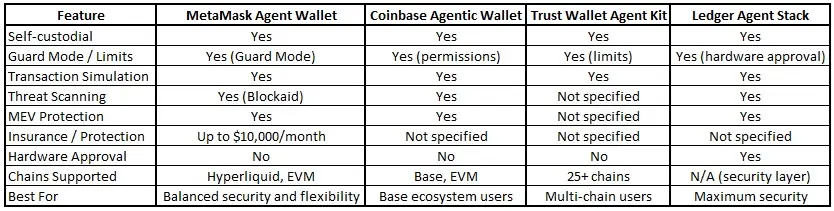
Should You Use an AI Agent Wallet? A Decision Framework
The answer depends on your risk tolerance, your use case, and how much you are willing to lose. Here is a simple framework to help you decide.
When AI Agent Wallets Make Sense
Use an AI agent wallet if you are an active trader who wants to automate specific strategies and you are comfortable with the risks. Use it if you are willing to treat the wallet as a spending account with limited funds, not your main storage. Use it if you have the technical knowledge to configure permissions correctly and the discipline to monitor activity regularly.
When You Should Avoid Them
Avoid AI agent wallets if you are holding long-term positions, if you are not comfortable with the idea of an AI making decisions about your money, or if you do not have the time to monitor activity and revoke permissions when they are no longer needed. Avoid them if you are using a wallet that contains more than you are willing to lose in a worst-case scenario.
The Protection Checklist: How to Secure Your AI Agent Wallet
If you decide to use an AI agent wallet, follow these steps.
1. Use a separate wallet. Never connect an AI agent to the wallet that holds your long-term savings. Create a new wallet specifically for AI agent activity and fund it with a limited amount.
2. Enable Guard Mode. Never start with Beast Mode. Guard Mode requires human approval for anything outside preset rules, which is exactly what you want when you are learning how the system works.
3. Set strict spending limits. Define a daily or weekly limit that you are comfortable losing. Treat that limit as the maximum exposure you are willing to accept.
4. Use allowlists. Only approve the protocols and addresses your agent actually needs. If your agent only interacts with Uniswap, do not allow it to interact with every DeFi protocol on the chain.
5. Review permissions regularly. Set a calendar reminder to review and revoke permissions every month. If you are not using an agent, revoke its permissions completely.
6. Monitor activity daily. Check your wallet activity every day. Set up alerts for transactions above a certain amount. If you see something you did not authorize, act immediately.
7. Use a hardware wallet for approvals. If the platform supports it, use a hardware wallet to confirm transactions. This adds a physical layer of security that software alone cannot provide.
8. Keep your agent framework updated. Security patches are released regularly. An outdated framework is an open door.
9. Do not share your agent's API keys or credentials. Treat them like passwords. If they are compromised, your agent can be controlled by someone else.
10. Start small. Before you trust an agent with meaningful amounts, test it with a small amount and observe its behavior for a few weeks.
What Happens If Your AI Agent Makes a Mistake?
This is the question nobody wants to answer, because the answer is usually: it depends.
If an AI agent sends funds to the wrong address because of a prompt injection attack, who is responsible? The platform that built the wallet? The framework that powers the agent? The user who granted the permissions? The current legal landscape is unclear.
MetaMask offers up to $10,000 per month in transaction protection for eligible transactions. That is a meaningful safety net, but it is not unlimited. Coinbase and Trust Wallet do not advertise comparable programs. Ledger's hardware approval model shifts some responsibility back to the user by requiring physical confirmation for certain actions.
The practical takeaway is this: assume that if something goes wrong, you are responsible. Do not rely on platform protections as your primary defense. Use them as a backup, but build your security around the assumption that you will not be reimbursed.
The Future of AI Agent Wallet Security
The security landscape is evolving quickly. Several developments are worth watching.
Regulation. The CLARITY Act and similar frameworks may eventually address liability for autonomous agents, but no comprehensive rules exist yet. The CFTC and SEC have been active in crypto regulation, but AI agent liability is a different beast.
Insurance. Some platforms are exploring insurance products for AI agent wallets. If these become available, they could change the risk calculus significantly.
On-chain reputation. Projects are working on reputation systems for AI agents, similar to credit scores for humans. If an agent can build a verifiable track record, users may be able to make more informed decisions about which agents to trust.
Hardware integration. Ledger's Agent Stack is a sign of things to come. Hardware-based approval will likely become a standard feature for high-value AI agent wallets.
Conclusion
AI agent wallets are not going away. They are too convenient, too fast, and too useful for active traders to ignore. But they are also a new frontier in crypto security, and the rules are still being written.
The biggest risk is not the technology itself. It is the gap between what the technology can do and what users understand about it. If you are going to use an AI agent wallet, do it with your eyes open. Use a separate wallet. Enable Guard Mode. Set strict limits. Monitor activity. And never, ever assume that the platform's security features make you invincible.
The hackers are already experimenting with prompt injection, router attacks, and permission overreach. The question is not whether these attacks will become more common. It is whether you will be ready when they do.
FAQ’s
1. What is an AI agent wallet?
An AI agent wallet is a self-custodial crypto wallet that allows an AI program to execute transactions on your behalf within rules you set. It automates trading and portfolio management.
2. Are AI agent wallets safe?
They can be reasonably safe if configured correctly, but they introduce risks like prompt injection and malicious routers. Safety depends on the platform and your settings.
3. What is prompt injection in crypto?
Prompt injection is an attack where hidden instructions are embedded in content an AI agent reads. The agent follows those instructions, which can include sending crypto to an attacker.
4. Can an AI agent steal my crypto?
An AI agent cannot decide to steal, but it can be manipulated into sending funds to the wrong place. If an attacker controls what the agent reads, they can control what it does.
5. How do I limit what an AI agent can do with my wallet?
Use allowlists, spending limits, and protocol restrictions. Enable Guard Mode and never use Beast Mode unless you fully understand the risks.
6. What happened with the Bankr hack?
In May 2026, an attacker gained access to 14 Bankr wallets using a hidden Morse code instruction in a tweet. Bankr disabled transactions and pledged to reimburse users.
7. Is MetaMask Agent Wallet safe?
MetaMask has built multiple security layers including transaction simulation, threat scanning, and a $10,000 monthly protection program. No system is perfect, so configure Guard Mode carefully.
8. What is the difference between Guard Mode and Beast Mode?
Guard Mode requires agents to stay within approved protocols and spending limits. Beast Mode removes some restrictions for advanced users.
9. Can I revoke AI agent permissions?
Yes. Most platforms allow you to revoke permissions at any time. Treat AI agent permissions like API keys and revoke them when not in use.
10. Do I need a hardware wallet for AI agents?
A hardware wallet adds an important layer of protection by requiring physical confirmation for certain actions. Ledger's Agent Stack is designed for this use case.
11. What is an LLM router?
An LLM router sits between your AI agent and the language model it uses. Researchers found that malicious routers can inject instructions into the agent's communication stream.
12. How much money has been lost to AI agent wallet hacks?
Specific incidents include a $175,000 Grok-linked wallet drain, a $500,000 router-based theft, and a $440,000 Bankr exploit.
13. Are AI agent wallets regulated?
Not directly. Most regulation focuses on crypto assets and exchanges. Liability for AI agent mistakes is still largely undefined.
14. What is the biggest risk with AI agent wallets?
The biggest risk is the permission you grant. An agent with broad, long-lasting permissions can perform legitimate but unwanted actions for weeks before you notice.
15. How do I know if my AI agent wallet has been compromised?
Monitor your wallet activity regularly. Set up alerts for transactions above a certain amount. Revoke permissions immediately if you see unauthorized activity.
16. Can AI agents interact with DeFi protocols?
Yes. AI agents can swap tokens, provide liquidity, stake assets, and execute complex DeFi strategies.
17. What is transaction simulation?
Transaction simulation shows you exactly what a transaction will do before it executes, including balance changes and token approvals.
18. Should I use an AI agent wallet for long-term holdings?
No. Use a separate wallet for long-term holdings that is not connected to any AI agent.
19. What is the best AI agent wallet in 2026?
The best wallet depends on your needs. MetaMask Agent Wallet offers the most mature security features. Coinbase is strong for Base ecosystem users. Trust Wallet supports the most chains.
20. Will AI agent wallets become safer over time?
Yes, but the arms race is ongoing. As platforms add security layers, attackers develop new techniques. Stay informed and never assume you are fully protected.
Disclaimer:
This article is for informational purposes only and does not constitute financial or legal advice. The author is not a licensed financial advisor. All opinions are based on publicly available information as of September 2026. Crypto investments carry risk, including the potential loss of principal. Readers should conduct their own research and consult a qualified professional before making any financial decisions. Some links may be affiliate links.





