
Zen blog post in Russian
https://dzen.ru/a/agBVcpEN6HRJeOHL
Every time Rosstat reports an increase in the average salary, the same picture appears in the comments.: "Where is this money?", "We were counted together with Moscow again", "No one gets that much."
The irony is that both are right.
The official statistics don't lie. It's just... not about you personally. And not about the majority. And about the "average temperature in the hospital," where a top manager of an oil company and a teacher at a Ryazan school are side by side.
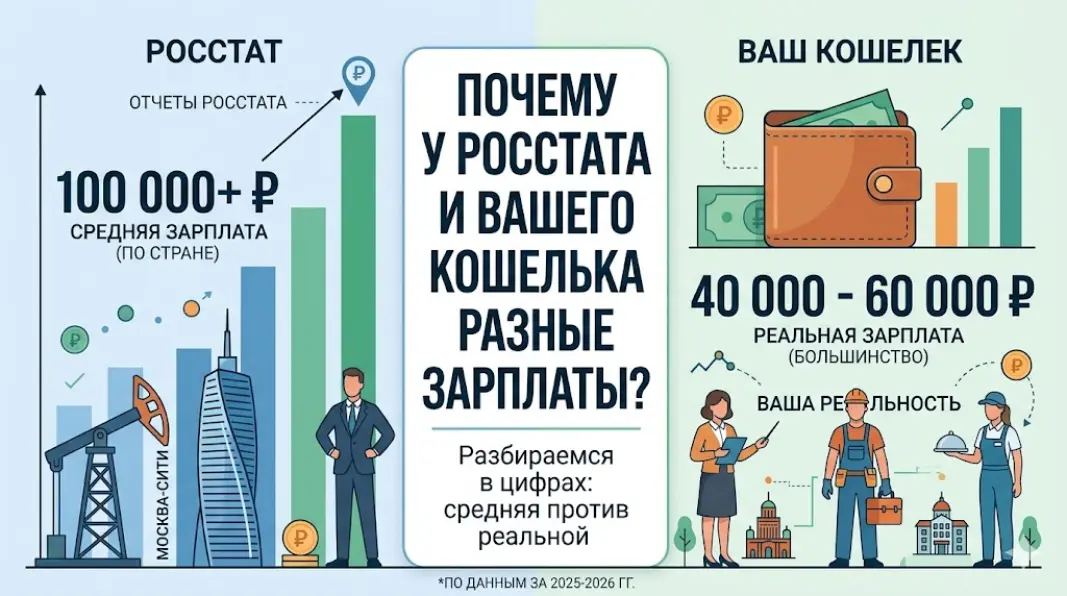
Let's calmly figure out why the average salary has exceeded 100,000, but in reality half the country lives on 40-60 thousand. With numbers and meanings.
The main paradox is that one indicator means two realities. According to Rosstat data for 2025, the average accrued salary in the country has crossed the psychological mark of 100,000 rubles.
But if you ask the people around you, most will say the amount is one and a half to two times lower.
And this is not a "conspiracy of statisticians." This is a feature of the arithmetic mean, which works great for homogeneous groups and terrible for a country with a huge gap between regions and industries.
A classic example that explains everything. Imagine a room of ten people. Nine of them receive 40,000 rubles each, and one is a top manager with an income of 5 million. The average salary in this room will be more than 530 thousand rubles. Statistically, everyone is rich. In fact, nine people are barely making ends meet.
It's the same math, just on a nationwide scale.
What do economists look at when they want the truth? If the goal is to understand how much an ordinary person really earns, they use the median salary rather than the average.
The median is exactly the "middle": half of the people get more, half get less. She barely reacts to ultra-high incomes. And here the picture becomes completely different.
According to Rosstat data for 2025, the median salary in Russia was about 73 thousand rubles. But there are alternative calculations. For example, the Sberindex analysis for February 2026 gives a figure of 61,972 rubles. The variation is explained by different methods, but the main thing is that the lower limit of reality lies well below the loud "100+".
And if we go down one more level, to the modal salary, that is, the most common, we will get into the range of 40-60 thousand rubles. This is how much a very large part of working Russians receive after deducting all taxes.
For comparison, the median salary offered in recent vacancies in the country is 86 thousand rubles. But this is no longer what people actually get, but what employers are willing to pay new employees — and here the competition for personnel really accelerates the numbers.
The main source of the gap is geography. When someone says "the average salary in the country", he mixes five different economies in one phrase.
There are leading regions. Where oil and gas are produced, financiers work or large federal agencies sit. For example, in the Sakhalin region, the average salary reaches 328 thousand rubles. There are about 310 thousand in the Moscow financial sector. Slightly more modest, but still cosmic in comparison with the rest of the country, are the figures in the Yamalo-Nenets Autonomous District, the Magadan Region and the Nenets Autonomous District, where average salaries confidently range from 140 to 150 thousand rubles.
And there are regions where the majority of Russians live. In a typical industrial or agricultural area, the average salary is 60,000 rubles. These are the data for the Chelyabinsk Region, Saratov Region, and Murmansk Region. And it's still not bad.
There are also outsider regions. These are primarily the republics of the North Caucasus, as well as some regions of Central Russia. In Ingushetia, Chechnya, Dagestan, the average salary, even according to official data, does not exceed 45 thousand rubles. And in the Ivanovo, Bryansk and Kostroma regions, figures of about 28-30 thousand rubles are recorded at all.
The gap between leaders and outsiders reaches a fivefold value. With such a difference, the arithmetic mean loses its practical meaning for assessing the life of the majority. Moscow and the oil regions live in the same reality. The rest of the country is completely different.
Industry section: where the "hundred thousand" live and where they don't. According to official statistics, high salaries are not "the average for a hospital," but specific sectors of the economy.
Incomes are really high in finance and insurance, in IT and communications, in oil and gas production, in aviation and space transport, as well as in tobacco production. 150-200 thousand rubles there is not exotic, but a common practice for a qualified specialist.
At the same time, in education, agriculture, light industry and mass service in the regions, the norm is 35-45 thousand rubles. The two sectors of the economy live with a difference of 4-5 times. And they live inside the same country.
Why is this not a hoax, but an accounting feature? It is important to understand that Rosstat really does not "draw anything from the ceiling." He takes the official accounts of employers: the total salary fund is divided by the number of employees. The methodology is transparent and standard for global statistics.
But there are three nuances that the headlines are silent about.
First: the accrued amounts before personal income tax deduction are taken into account. If the news talks about 100 thousand, then a person gets 87 thousand "on hand". The difference is not drastic, but significant.
Secondly, gray schemes and informal employment are not taken into account. According to various estimates, this represents tens of percent of the labor market in many regions. A person's official salary may be 30,000, and their real income may be 50, but only the first figure will be included in the statistics.
The third and most important one is that the average value, by definition, ignores inequality. This is its mathematical property. And it is precisely this that generates the main claim to statistics.
Therefore, two statements are simultaneously true. First, the average salary in the country exceeds 100,000. Secondly, most people don't see that kind of money. There is no contradiction here. It's just that different measurement tools show different truths.
What is the result? 100,000 is a good indicator of the total money supply divided by the number of employees. An indicator for macroeconomics, for budgets, and for analysts.
60-70 thousand is a much more honest guideline for a typical Russian. That's how much, according to various estimates, the median salary is. This is money that really reflects the lives of the majority.
At the same time, the situation is gradually changing. The shortage of staff, which lowered unemployment to a historic low of 2.2 percent in 2025, is forcing employers to raise rates. Low salaries are slowly becoming a thing of the past. In some industries and regions, growth is already noticeable not only in reports, but also in wallets.
But as long as Moscow and the oil regions live in the same reality, and the rest of the country lives in another, the phrase "average salary" will cause irritation. And that's okay. This is not about statistical error. It's about different economies within the same country.
If you want an objective picture, look at the median and your region. If you want big news, leave the average one. Both indicators have the right to life. It's just that one is for reports, the other is for your wallet.
Prepared on the basis of data from Rosstat, Sberindex and industry reviews for 2025-2026.

I write and shoot. Join me
Author's video content
https://www.youtube.com/c/ViolettaWennman
Political trash
https://www.youtube.com/@Ship-Shard
I invite you to the telegram channel
https://t.me/shipshard
Highly Social on Zen
https://dzen.ru/shipshard
For goodies
https://dzen.ru/shipshard?donate=true
My hobbies are history, philosophy, psychology, music, economics, politics, and sociology. I write about this and much more. Professional model. She has performed at international music festivals (vocals, dancing, imitation of vocalists). I am studying at the Academy of Arts - the film and art industry, I am a producer and the owner of a video studio.
I am glad to see all of you on my blogs.

You won't lose me here. https://t.me/shipshard






