
Zen blog post in Russian
https://dzen.ru/a/adKtTT0Pwgsc6DCF
Russian Russians wanted to protect Russians and the Russian language in Ukraine. Both propagandists and ordinary citizens constantly repeat this, that the Nazi Kiev authorities banned everything Russian.
To be honest, it's unclear how this compares to the fact that until 2022, most Ukrainians spoke Russian and many still do.
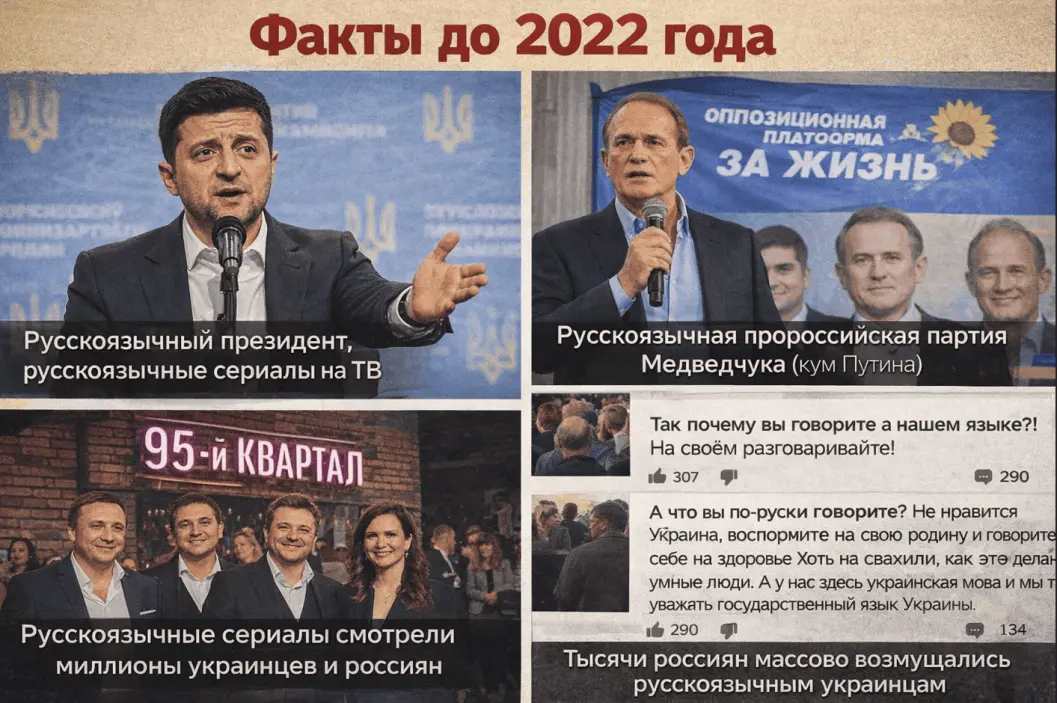
How did Ukraine choose a Russian-speaking president whose company 95th Quarter filmed TV series in Russian and broadcast them on official television? Which Russians also watched, by the way.
How was there an entire pro-Russian party of the Russian-speaking Medvedchuk (Putin's friend) in the Nazi government, and in second place?
How many Russian-speaking and even pro-Russian officials have served as mayors of cities and spoken in Russian on TV and on the Internet?
Well, these are facts and easily verifiable.
Let's say we assume that the Kiev regime has somehow strangely banned everything Russian.
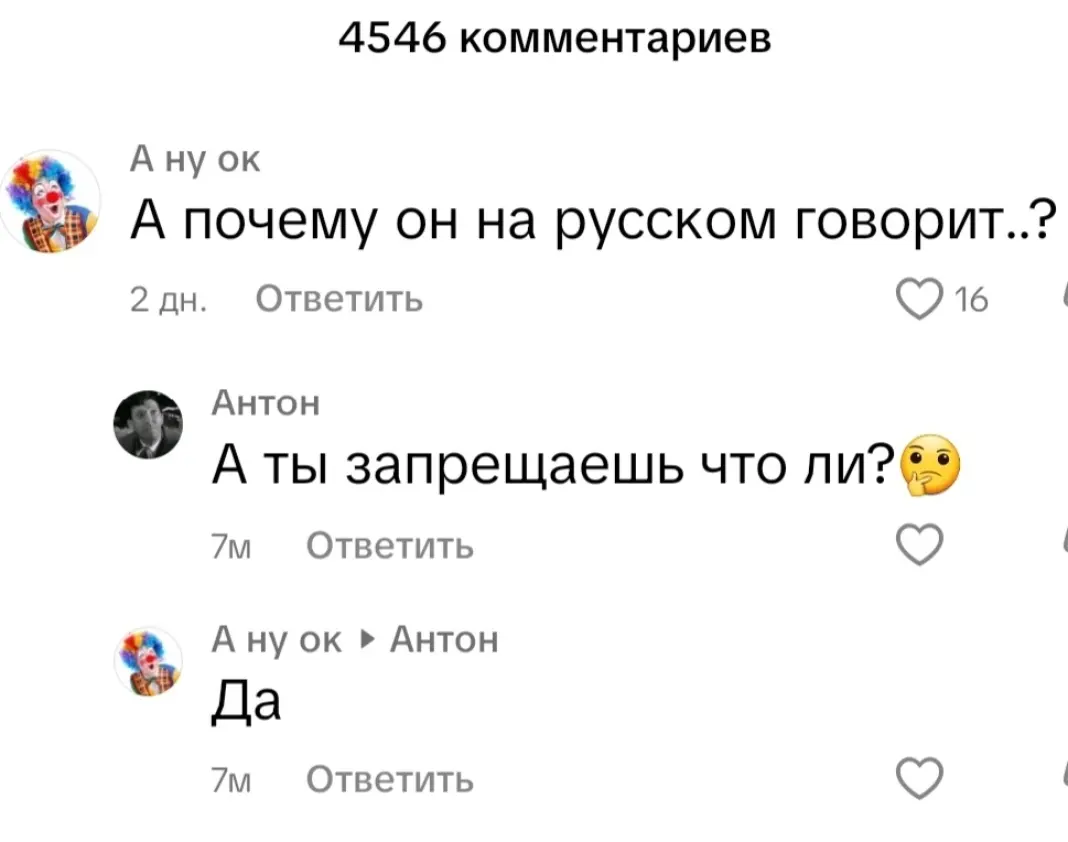
Russian Russians, who were so worried about the genocide of the Russian language, forbid Ukrainians to speak Russian themselves, I don't understand. There are thousands of videos of Russian-speaking Ukrainians on the Internet before 2022 and after, and almost every third comment under all videos is: "Why do they speak our Russian? Let them speak their own language!"
So who forbids the Russian language more?
Isn't that fascism? Not hypocrisy?
The hypocrisy of Russian rhetoric is that Russian propaganda has created an image of "oppressed compatriots," but:
- In Russia itself, there is no law on the protection of the Russian language abroad — only political statements.
- After 2014, Russia imposed strict restrictions on the Ukrainian language in Crimea and Donbas (closure of Ukrainian schools, ban on Ukrainian books and media).
- And after 2022, the Russian language is forcibly imposed on the "liberated"-occupied territories, and the Ukrainian language is squeezed out of schools, libraries and public space. This is pure linguistic assimilation under the guise of "protection".
In Russian social networks, under the videos of Ukrainians speaking Russian, they really often write: "Why don't they switch to Ukrainian?", "They were banned from Russian." This is a manifestation of imperial arrogance.:
- When Ukrainians speak Russian, they are reproached: "You are the same as us, why do you need a separate country?"
Russian Russians - When Ukrainians speak Ukrainian, they are reproached: "You see, you hate the Russian language and Russians."
Ukrainians cannot win in this kind of game, because its goal is not to protect the language, but to deny Ukrainians the right to their own state.
And I remind you that Fascism is an ideology that:
- Denies the right of another people to exist.
- Builds politics on the myth of "victim" and "retribution."
- Uses violence to destroy dissent.
The rhetoric of "protecting the Russian language" in Ukraine has all these features when:
- Reality is ignored (Russian is not prohibited).
- An image of the enemy is being created (the "Nazi junta").
- Violence is justified as "liberation".
But the most important hypocrisy is that the Russian language does not threaten anyone inside Russia. His "protection" in Ukraine is a tool for the destruction of Ukrainian statehood, and not a real concern for the language.
Russian Russians and the Russian language are being cynically manipulated to "Protect Russians and the Russian language". This is a convenient excuse to:
- To mobilize society within Russia.
- To justify aggression in front of an international audience.
- Hide the true goals (control over Ukraine, preventing its European integration).
These are facts and they are irrefutable. Ignoring them does not speak to a "complex reality", but to the fact that propaganda works on the total denial of the obvious. Remember, propaganda is never based on internal consistency: it appeals to emotions, not logic. Any narrative can be analyzed in the same way. Any such propaganda often does not stand up to verification by facts. In propaganda, you can find a whole knot of contradictions that catch your eye if you look at the facts rather than the slogans.
1. Russian language in Ukraine until 2022:
- Russian was widely used in everyday life, especially in the cities of the south and east.
- Vladimir Zelensky is Russian—speaking by birth, and his studio Kvartal 95 Studio really produced content in Russian.
- There were Russian-oriented forces in politics, for example, the structure around Viktor Medvedchuk.
That is, the picture of the "total ban on all Russian" does not correspond to reality. There were language laws (for example, strengthening the role of Ukrainian in the public sphere), but this does not equal a ban on domestic use.
2. Where did the narrative about "language protection" come from?:
The thesis about the "protection of Russian speakers" is a political justification that was used by the Russian authorities. Such arguments are, in principle, typical of international politics: the protection of "compatriots," "culture," and "language." The problem is that:
- it is based on partial facts (there were indeed language restrictions in the public sector),
- but it is expanding to the maximum ("genocide", "total prohibition"), which is no longer confirmed by reality.
An important point: if the language was allegedly "oppressed", why was it so widespread? This is one of the main logical inconsistencies of this narrative. The widespread use of language usually does not go well with the thesis of its destruction.
Why does this create hostility towards Russian-speaking Ukrainians?
- In conditions of war, language begins to be perceived as a marker of "friend/ foe", even if it is irrational.
- A part of Russian society has a reaction: "if you are against us, don't use our language."
- This is an emotional, not a logical position, and it really contradicts the original thesis about the "protection of language."
What is important to understand in general:
Did not have:
- the prohibition to speak Russian.
- criminal liability for the Russian language.
- prohibition of Russian culture in private life.
It was:
- gradual strengthening of the Ukrainian language as the state language.
- the displacement of Russian from the official and public spheres, but not from everyday life.
It is a normal policy of the state to strengthen its language. But according to the propaganda version, this is discrimination and the displacement of the Russian language. The truth is that there really were restrictions in the public sphere. But until 2022, the Russian language remained widely used and socially dominant in many regions. The laws of Ukraine did not prohibit the Russian language until 2022, but consistently reduced its role in the official sphere, strengthening Ukrainian. It is this discrepancy — between real (partial) restrictions and the rhetoric of a "total ban" — that has become the basis for opposing interpretations. The interpretation of the Russian language's concern looks like a tool for political mobilization and justification of war.
Until 2014, the Russian language had a strong position, including the official ones. After 2014-2019— the gradual strengthening of the Ukrainian language. At the same time, the Russian language was not banned, but was ousted from the state sphere, but remained in everyday life.:
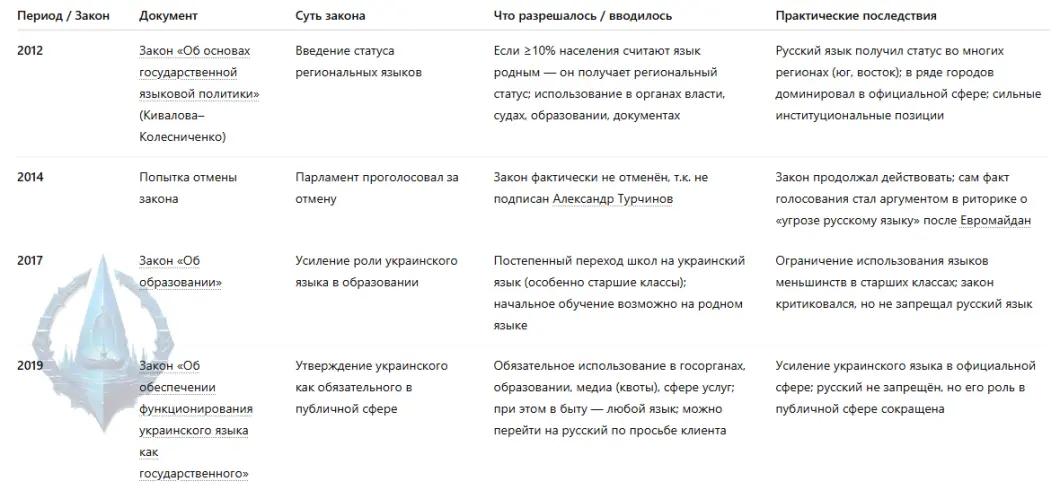
Which is important in terms of facts. Being Russian by itself does not make a person “pro-Russian,” and Ukraine has long remained essentially bilingual in real life, especially in the eastern and southern regions. At the same time, after 2019, Ukrainian legislation did strengthen the role of the Ukrainian language in the public, educational and public sectors, but did not ban the Russian language in private communication.
The fact that Zelensky was Russian-speaking and his studio 95th Quarter made Russian-language content just shows that before the full-scale war, Russian-speaking was not a barrier either to the election of the president or to the mass popularity of media projects. The presence of pro-Russian figures and parties in Ukrainian politics, including Medvedchuk, also confirms that the “ban on all Russian” was not a reality in the simple sense of the word.
Where the manipulation begins. Russian propaganda usually mixes up three different things: the state status of the Ukrainian language, restrictions on the public sphere, and the complete “prohibition of the Russian language" in general. This is not the same thing: you can strengthen the Ukrainian language in government institutions and at the same time not prohibit people from speaking Russian at home, on the Internet or in everyday life.
Speaking strictly about the slogan of protecting the Russian language, hypocrisy is that claiming to protect Russian speakers while bombing Russian—speaking cities and hating Russian-speaking Ukrainians themselves is not language protection, but political demagoguery. This is imperial propaganda, which replaces people's rights with the thesis of “protecting compatriots.”
Everything for the protection of the Russian language in Ukraine (first edition)
I write and shoot. Join me
Author's video content
https://www.youtube.com/c/ViolettaWennman
Political trash
https://www.youtube.com/@Ship-Shard
I invite you to the telegram channel
https://t.me/shipshard
Highly Social on Zen
https://dzen.ru/shipshard
To buy caramels to ruin your teeth
https://dzen.ru/shipshard?donate=true
My hobbies are history, philosophy, psychology, music, economics, politics, and sociology. I write about this and much more. Professional model. She has performed at international music festivals. I dance, I sing, I parody the voices of the performers. I am studying in the Netherlands at the Academy of Arts, Faculty of Film Industry and Arts. Co-owner of a video studio in St. Petersburg.
I am glad to see all of you in my blogs.


Please support me, like-minded people, join the telegram channel https://t.me/shipshard






