
Publication on the Zen blog in Russian
https://dzen.ru/a/afCvb82oKFJMTkqQ
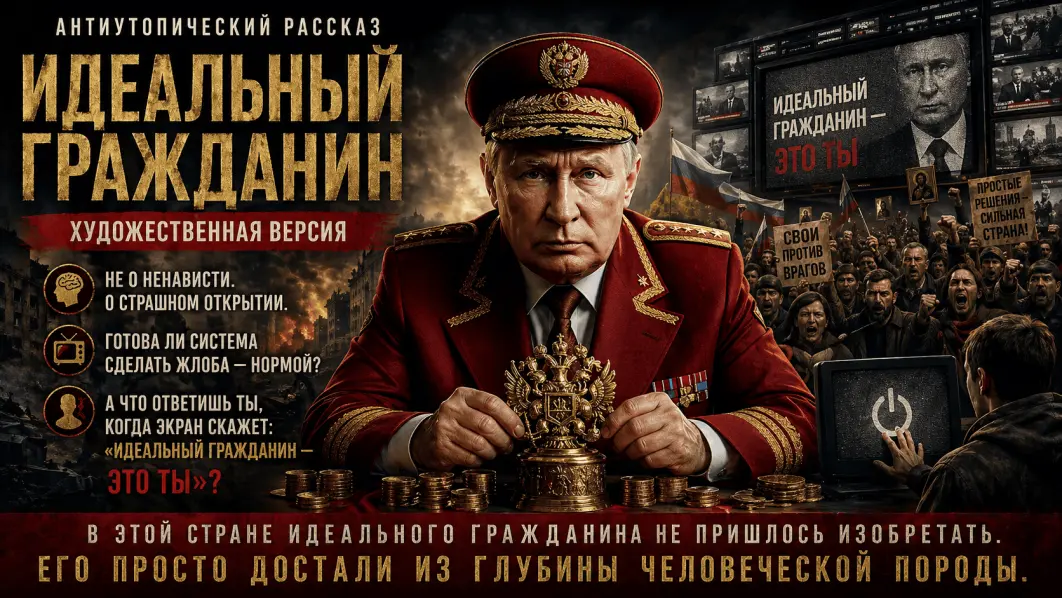
According to numerous negative and sometimes positive requests in the comments, the artistic version of "The Ideal Citizen of Modern Russia" is a dystopian story "The Ideal Citizen".
This dystopia is not about hating "others." It's about a terrible discovery: an ideal citizen can live in any of us if the state stops demanding complexity and starts rewarding simplicity. The question is not "who's the greedy guy". The question is: is the system you live in ready to make greedy people its norm? And what will you say when the screen says, "You are the perfect citizen"?
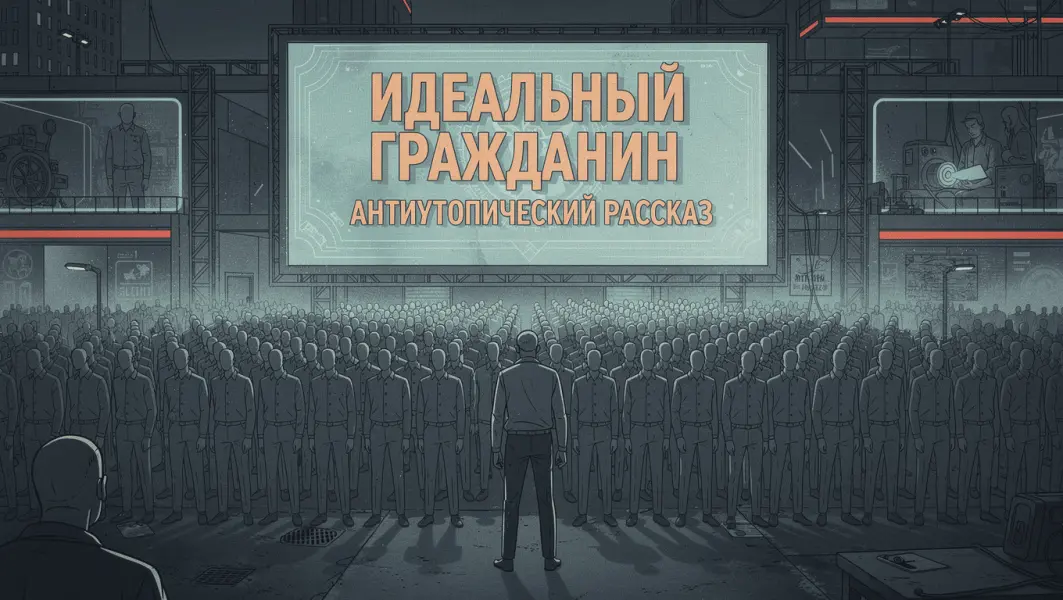
The ideal citizen. (a dystopian story).
In this country, the ideal citizen did not have to be invented.
They just pulled him out of the depths of the human race, shook him off from shame, gave him a flag, an icon, a TV, a certificate of proper anger — and the right to hate.
On the first page of the certificate it was written:
"You're not a mistake. You are the people."
And he believed it.
With pleasure.
He was not a people.
He wasn't a class.
He didn't have a passport, nationality, age, or profession.
He was a state of consciousness.
He was called in various ways: "a simple man", "salt of the earth", "deep man", "majority", "pillar of the state". In official documents, he was described as an "Ideal Citizen."
And in private conversations, in whispers, when there were still private conversations, they called him easier.:
"Greedy."
Not as a domestic insult.
As a human model.
Like a being who feels humiliated even when he stands with his feet on someone else's neck. As a person to whom the complexity of the world seems like a personal attack. As a bearer of resentment, transformed into a worldview.
He didn't want to understand.
He wanted to explain.
Or better yet, blame them.
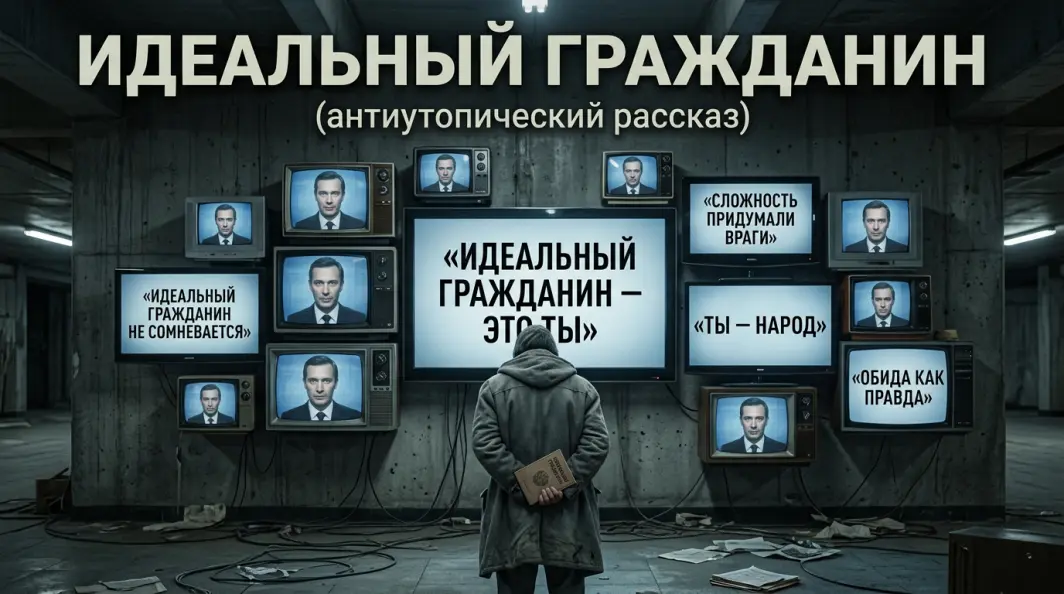
Every morning, the screens in the city turned on. They turned on themselves: in apartments, entrances, minibuses, elevators, clinics, schools, and even in the mirrors of public toilets.
The announcer's calm face appeared on the screens.
"The ideal citizen has no doubts,— the announcer was saying. — Doubt is the first step to betrayal.
The ideal citizen nodded.
He liked it when he didn't have to choose. The choice was hard. The choice required internal work. And the inner work reminded him of humiliation: as if someone is smarter, thinner, freer - and this is already insulting.
Therefore, the state has abolished complexity for him.
At first, the shades disappeared from the language.
There are only:
"friends" and "enemies",
"patriots" and "traitors",
"truth" and "lies",
"we" and "them".
Then the questions disappeared.
They didn't teach you how to think in schools anymore. They taught me how to react correctly. The children passed the indignation test: in thirty seconds it was necessary to identify the enemy, condemn him and explain why the authorities were right again.
Departments of Folk Authenticity have been opened at universities. They studied the main axiom of the epoch there:
"if you don't like thinking, it means that the one who makes you is to blame."
The libraries have been preserved, but their purpose has been changed. Now books were given out not for reading, but to confirm pre-prepared conclusions. There was a poster at the entrance to each library.:
"Knowledge should strengthen confidence. Everything else is enemy influence."
The ideal citizen was satisfied.
Before, it seemed to him that he didn't understand something. Now it was explained to him: there was no need to understand anything. It's enough to feel right.
And the right feeling was resentment.
Resentment has become the air of the country.
It was breathed in kitchens, in television studios, in school classrooms, in temples, in doctor's queues, in trenches, in the offices of officials. It was bottled, sewn into anthems, glued onto cars, and printed on children's backpacks.
The greedy guy liked to say that he was always humiliated.
He was humiliated by the story.
He was humiliated by the West.
He was humiliated by his neighbors.
Ukrainians humiliated him by resisting.
The liberals humiliated him by asking questions.
His teachers humiliated him by demanding that he read.
He was humiliated by the doctors because they knew more.
The intellectuals humiliated him by not shouting.
He was humiliated by the poor with his plaintiveness.
He was humiliated by the rich with their wealth.
He was humiliated by the living by not asking him for permission to live.
Resentment was convenient.
Through her, the world became simple.
If it's bad, the enemies are to blame.
If it's scary, we've been attacked.
If we're ashamed, we've been lied to.
If it hurts, you have to hit first.
If someone does not agree, it means that he is not a person with a different opinion, but an agent, scum, traitor, fascist, alien.
The government quickly realized that this was not a defect. It's a resource.
And one day it said to the Greedy:
"You're not mean. You are the authenticity.
"You're not being rude. You're blunt.
"You're not being cruel. You are a force.
"You're not jealous. You are justice.
"You're not hate. You are the love of the Motherland.
That's how the Greedy guy got promoted.
He was led from the cellars of the human soul to the main square.
They gave him a microphone.
He spoke, and the country heard its new anthem in his wheezing.
From that day on, everything changed.
Shame used to be a boundary. Now shame has been declared someone else's invention. Previously, cruelty had to be justified. Now she was justifying herself. Previously, an ignoramus could be accused of ignorance. Now he was proud of it as an independence from the "smart guys."
The program "Simple Truth" was launched on state channels. The presenter went out to the audience and explained the same thing in different words every evening.:
— The difficulty was invented by the enemies to confuse you.
The audience applauded.
The ideal citizen applauded the loudest.
He didn't just want to win.
He wanted the defeated one to give thanks.
It was his deepest dream.
So that the one he humiliated would say: thank you.
For someone who's had their house taken away to call it liberation.
So that the one who was forced to remain silent would recognize silence as the world.
So that the one who was beaten would smile and talk: "You're right, it's my own fault."
It was here that the Greedy coincided perfectly with the state.
The state also wanted more than just submission. It wanted love from those it was suppressing.
Thus, a new formula of power was born.:
"We will save you. If you resist, we will save you more strongly."
When the Big Operation to Force Reality into Submission began, the screens were working around the clock.
"We're not attacking," they said. "We're defending ourselves.
"We don't destroy," they said. — We are releasing.
"We don't kill," they said. "We're cleaning up.
"We're not lying," they said. — We are at war with lies.
The ideal citizen listened and felt great.
He was sitting in the kitchen, drinking cheap beer, flipping through a tape and writing under photos of destroyed cities.:
"It's your own fault."
"There was nothing to resist."
"But now they will understand.
" "We will regret that we were too kind."
He's never been there.
He didn't know anything.
But that's why I was especially confident.
When the names of the cities after which the language should have stopped appeared — Bucha, Borodyanka, Mariupol — the state did not flinch. It just added a new layer of words.
Fake.
Performance.
A provocation.
Not everything is so clear.
Where have you been before?
The greedy man repeated these words with relief. They saved him from the main horror — from having to see a man where he was told to see an enemy.
That's how the country reached its peak.
The state and the Greedy have merged into one organism.
Power gave him an enemy, meaning, and permission to be his worst self.
He gave the authorities mass, brute force and moral justification.
They needed each other.
The state without Greedy people would remain a mechanism of violence.
A greedy person without a state would remain a private darkness.
Together they became an era.
But every era has a weak point.
This one's weak point was the signal.
The greedy man was not autonomous. He didn't create meanings. He absorbed them. He didn't build the world. He was looking for a boss who would explain who to hate today.
And one day the signal disappeared.
It didn't happen solemnly. Not to the sound of revolutionary marches. Not as a result of the sudden epiphany of millions.
I just ran out of money.
Then there's electricity.
Then patience.
Then the fear.
The screens went silent.
At first, no one understood what had happened. The city woke up to an unusual silence. There was no morning announcer. There was no face that explained who to despise. There was no running line with another victory. Even the Narodny Wrath mobile application was displaying a server error.
The ideal citizen sat in front of a black TV and waited.
One hour.
Two.
Three.
Then I got scared.
Not because the world was falling apart. But because no one said how to properly treat his crash.
In the evening, he went out into the courtyard.
People like him were already standing at the entrance. Men in camouflage who have never been to the front. Women with icons and badges. Former commentators, security guards, minor officials, bloggers, voluntary informers, professional outraged.
Everyone was silent.
Then someone said:
"It's a betrayal.
Everyone breathed a sigh of relief.
The word was found.
A week later, the city split.
Yesterday, the united country began to disintegrate into small principalities of resentment.
In one area, a former police officer declared himself the Commissioner of Order and introduced access passes from the entrance.
In another telegram blogger, who lost the channel after the servers were turned off, proclaimed the People's Republic of the Right Words.
At the market, sellers have joined forces to form a Fair Tribute Union.
A squad of parents appeared at the school, demanding that the children return to "normal upbringing": shouting, fear, and marching.
Each entrance became a border.
Every yard has a front.
Every offense is a constitution.
The greedy man was no longer one. It split into a multitude of small-time greedy people, each of whom dreamed of becoming a state.
They were swearing at each other with the same words.
— The traitor!
— the traitor himself!
"You sold out!"
"You're the one who sold out!"
— I am a real people!
— No, I'm a real people!
No one wanted freedom.
Everyone wanted a new boss, preferably someone they could become themselves.
On the outskirts of the city, in the old library building, others gathered.
There were few of them: teachers, programmers, doctors, students, migrants, artists, former military personnel who had seen too much to continue repeating slogans. People who are tired of the obligatory anger.
They named their place simply:
"The City of Questions."
There was a sign on the library door.:
"You can make mistakes here."
For the new era, it was almost a terrorist inscription.
Inside, the books were opened again. Not as a weapon. Not as a confirmation of one's own correctness. And as a way to discover that the world is bigger than your annoyance.
They argued there in the evenings.
They didn't shout, they argued.
The first rule of the City of Questions was:
"A person begins where he admits that he may be wrong."
The second:
"You can't build a new society out of old humiliation."
The third:
"Don't turn the enemy into a function. Even if he spent his whole life turning you into a function."
This rule was the hardest to come by.
Because outside the walls of the library there were those who yesterday laughed at the pain of others, denounced, justified the destruction, demanded blood and called it love for the Motherland.
It was impossible to forgive them.
To understand is almost unbearable.
But becoming one was even scarier.
The greedy guy found out about the City of Questions quickly.
It wasn't what they said that offended him. He didn't understand much.
He was offended that they were doing without him.
People lived, read, argued, taught children, treated the wounded, shared bread without asking his permission. They didn't hate him enough. They weren't afraid of him loudly enough.
It was unbearable.
"They despise us,— Greedy told his men.
—With what?" "What is it?" someone asked.
— By not obeying.
And everything became clear.
At dawn, a crowd moved towards the library.
They carried flags of the old country, new homemade coats of arms, portraits of the long-lost Leader, icons, metal pipes, hunting rifles and posters.:
"LET'S FREE YOU FROM YOUR COMPLEXITY."
"STOP THINKING, IT'S TIME TO LOVE THE PEOPLE."
"DIALOGUE IS WHEN WE TALK."
An Archivist came out at the library gate, a thin man in an old coat, holding a megaphone in his hands.
"We are not your enemies,— he said. — If you want to talk, come in unarmed.
The crowd roared.
The greedy man stepped forward.
"Without a weapon?" "What is it?" he asked. — And if you deceive us?
"Conversation is always a risk,— the Archivist replied.
— Here! — Greedy shouted, turning to his own people. "Did you hear that?" They want us to take risks! Humiliated again!
The crowd roared.
— We have come to free you!
"From what?"
— From yourself!
— And if we don't want to?
— Then you haven't understood freedom yet!
The assault started ridiculously.
Someone threw a stone. Someone slammed the door in response. Someone screamed. Someone fell. Smoke from the set-on-fire tires crept down the street. The old familiar music of disintegration hung over the square: fear, rage, confusion, the desire to strike first.
But in the middle of it, a young guy from the crowd came up to the gate.
There was an old war badge on his jacket. He has a tattoo on his arm with a slogan that no one has said out loud anymore. His face was gray, as if he hadn't slept in a long time.
"I don't want to storm," he said softly.
—Then leave," the gate guard replied.
— I have nowhere to go.
- why?
— You have to hate there. And I'm tired.
Silence fell inside the library.
Someone said:
— Don't let them in. He was with them.
Someone added:
— Let him repent first.
Someone suggested putting him in front of everyone, forcing him to tell them what he wrote, who he bullied, and what he was happy about.
The archivist looked at the guy for a long time.
Then he said:
— If we start with humiliation, we will build the same thing. Only with other posters.
And the gates were opened.
Not widely.
For one person.
The crowd outside howled.
"Traitors!
— We bought it!
"They're poaching ours!"
— They want to deprive us of our people!
The greedy man looked at the open gap in the gate and for the first time felt not rage, but emptiness.
One of them went to a place where it was possible to make mistakes.
It was worse than defeat.
Because defeat can be explained by enemies.
But the fatigue of hatred is not allowed.
The siege lasted three days.
Then the crowd dispersed. Not because I understood. Not because she repented. The food just ran out, quarrels began, and a new enemy appeared nearby: the neighboring district declared itself the only legitimate representative of the real people.
The greedy guy left.
A month later, he called himself a proponent of renewal.
Two days later, he talked about the need for dialogue.
Three years later, he created the Committee of National Accord, where only those who agreed in advance had the right to vote.
He changed the sign.
But I didn't change the device.
So it became clear: the fall of the state does not destroy the Ideal citizen. It only deprives him of a central voice. And then he's looking for a new one.
A new flag.
A new pack.
A new grudge.
A new form of the old "us versus them."
The City of Questions has survived.
But no one in it celebrated the victory.
Because the real victory wasn't to fight off the Greedy Guy outside. The real problem is not to grow it inside.
One evening, the Archivist wrote down the first line of the future constitution on the library wall:
"There is no such thing as an ideal citizen."
Below, someone added:
"A citizen begins with the right to doubt."
And below that, in a child's handwriting:
"Complexity is not the enemy. This is life."
It was getting dark outside the walls.
The screens were turning on again somewhere. Small, portable, homemade. New faces appeared on them and almost old words were spoken.:
— People demand simple solutions.
— Too many questions destroy unity.
— Doubt is dangerous in difficult times.
— Real freedom is when everyone thinks correctly.
The people in the library listened to this in silence.
They knew that dystopia does not end on the day of the fall of the regime.
It ends only when a person stops looking for a boss to whom they can deposit their conscience.
Until then, the Ideal Citizen will be coming back.
In a different suit.
With a different slogan.
With a different flag.
With a new word instead of the old hate.
And every time he will say:
"I'm not evil. I'm just for the order.
"I'm not violent. I'm just for justice.
— I'm not afraid to think. I just don't want to listen to my enemies.
And each time the answer will have to start over.
Not by shouting.
Not revenge.
Not mirror rudeness.
And in a difficult, almost unbearable phrase:
"I could be wrong. Let's figure it out."
Because a world that cannot be doubted always turns into a barracks one day.
And a country where the bearer of resentment becomes an ideal citizen does not produce a future, but an endless past armed with a baton.
That night, the screens flashed again.
An old inscription appeared on one of them.:
"You are the perfect citizen."
But for the first time, someone came up and turned off the screen.
Not out of fear.
Out of responsibility.
The ideal citizen of modern Russia
https://www.publish0x.com/professional-videoproduction/the-ideal-citizen-of-modern-russia-xmggqzx
The Dark Art of Dystopia by Violetta Wennman
https://dzen.ru/suite/085f26ec-b4f0-45cf-9460-107ff5035ef4
PARSING, SYMBOLS, MEANINGS.
WE ANALYZE, COMPARE, AND UNDERSTAND.
Welcome to a world where the future is already written.
I write and shoot. Join me
Author's video content
https://www.youtube.com/c/ViolettaWennman
Political trash
https://www.youtube.com/@Ship-Shard
I invite you to the telegram channel
https://t.me/shipshard
Highly Social on Zen
https://dzen.ru/shipshard
To buy caramels to ruin your teeth
https://dzen.ru/shipshard?donate=true
My hobbies are history, philosophy, psychology, music, economics, politics, and sociology. I write about this and much more. Professional model. She has performed at international music festivals (vocals, dancing, imitation of vocalists). I am studying at the Academy of Arts - the Film and Art Industry, I am a producer and the owner of a video studio.
I am glad to see all of you in my blogs.

Please support us, like-minded people, join the telegram channel https://t.me/shipshard






