Publication in Russian on the Zen blog
https://dzen.ru/a/aZBwA-kaFVSDVxb5
How do the British feel about their history: with common sense and without idealization.
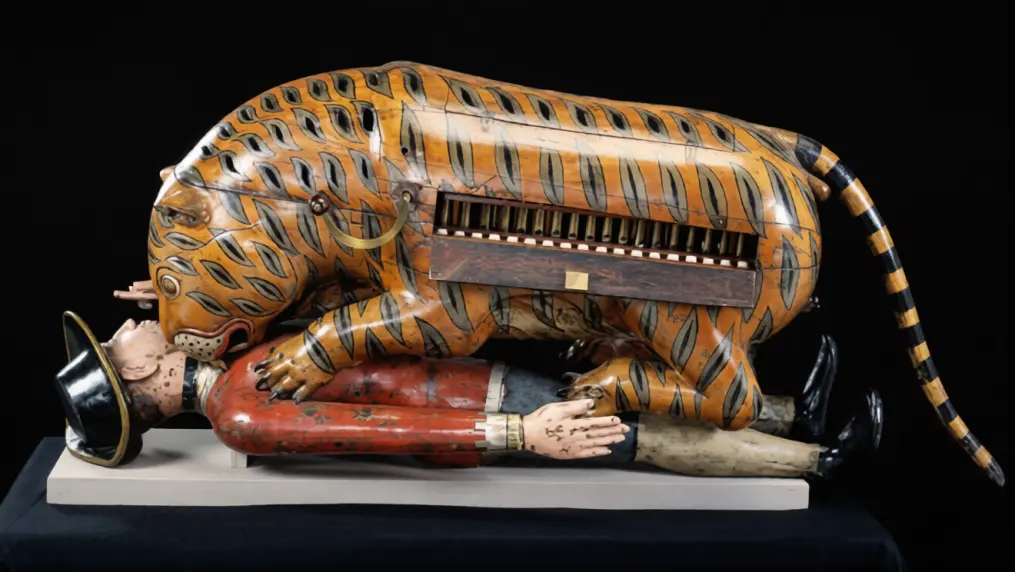
So, in one of the main museums in London, the Victoria & Albert Museum, in the most prominent place, you can find such an exhibit where a tiger attacks a colonizer.
Tipu Tiger is an 18th—century mechanical toy created for the ruler of the principality of Mysore, Tipu Sultan in India.
Tipu Sultan went down in Indian history as a national hero, although many historians tend to point out his inhuman brutality in dealing with opponents.
In alliance with the French, Tipu fought against the East India Company to prevent the British from trading in India.
A tiger was depicted on Tipu's personal coat of arms as a symbol of irreconcilable struggle, in addition, a wooden tiger toy was made specifically for Tipu, ready to bite a British soldier to death.…
The wooden toy was discovered on May 4, 1799, when the British finally managed to capture the principality of Mysore.
British soldiers were looting Tipu Sultan's treasures, and suddenly this toy was discovered in the music room of his palace.
Both the tiger and the soldier are made in full size, the animal furiously bites into the neck of the unfortunate, while emitting a threatening roar.
A special mechanism sets the soldier's arm in motion, it seems that he is desperately resisting. On the side of the mechanical toy is a primitive 18–note organ.
Tipu the tiger became the embodiment of the hatred that the Sultan had felt for the British since childhood. Tipu's father, Hyder Ali, began to feud with them, swearing that they were his blood enemies.
In 1792, the British conquered half of the principality of Mysore from Tipu, and it was then that he ordered the construction of such a sinister machine, which became a visualization of his hatred.
Tipu Sultan constantly surrounded himself with images of tigers: he painted the image of this powerful animal on his coat of arms, decorated his throne, weapons and armor.
Tigers could be seen on the painted walls and on military uniforms.
Several live tigers were kept in the palace. To express aggression towards the enemy, the Type often pressed the keys on the side of the mechanical tiger, but instead of music he heard the heart-rending screams of the victim.
The British seized the toy, calling it another confirmation of the barbaric cruelty of the Indian sultan.
The wooden tiger was shown to everyone in the reading room of the East India Company library.
The visitors pressed the keys with interest, until one day they broke the handle.
In 1880, the tiger was moved to the Victoria and Albert Museum in London.
The exhibit was one of the most sought-after among the visitors. The accident happened during the Second World War: the roof of the museum was damaged by a shell, the ceiling collapsed on the toy, and the tiger broke into many pieces.
After the war, the sculpture was assembled, but it no longer worked.
I recommend a selection of Oxford Notes in the blog for those who are interested in England.
Ekaterina Sveshnikova, England, London, Oxford University