
Publication in Russian on the Zen blog
https://dzen.ru/a/aFvHZHcO9UeeZNi4
Russia's real debt is 400% of GDP - that's the proof of that.
Russia claims to be one of the most financially stable countries in the world, with a debt-to-GDP ratio of less than 20%. But this myth is based on selective accounting, hidden obligations, and a shrinking real economy. In this publication, I will reveal the full scale of Russia's debt burden, including regional obligations, obligations of state-owned enterprises, military-industrial spending, social guarantees, and circular loans issued through state-controlled banks.
If you subtract the government's share of GDP and calculate only what the real Russian market produces, the figures reveal a shocking reality: Russia is arguably one of the most heavily indebted countries in the world, perhaps exceeding 400% of the real GDP of the free market.
This is not just an economic problem. It is a geopolitical house of cards based on oil revenues, the printing of the ruble, and controlled narratives.
 The Russian economy
I want to talk about the Russian debt, why it is the largest in the whole world, and if we are the only world where there is intelligent life, then this debt is the largest in the entire universe. The other day, the Russian president made two ridiculous statements that Ukraine and Russia are one, and it looks ridiculous because there is no unity in language, culture, history, religion, identity, self-identification. The second ridiculous statement, which is just a rumor, is that Russia has the lowest debt in the world. So, let's take this statement apart. When it comes to debt, it is always necessary to correlate it with income, debt in relation to GDP, for example, someone who has a debt of $ 5,000, but earns one million dollars a year, is a low indicator of debt. But if someone has a debt of $5,000 and earns $12,000 a year, that's a financial burden. And if a person earns only $2,000 a year with a debt of $5,000, then this is a huge financial burden. This is exactly the situation in Russia. When it comes to debt in general, there may be errors in calculations, several overstatements and understatements. Inflation may be an overestimation, because interest payments are made in nominal terms. Another overestimation may be related to capital (long-term) budgeting, which is considered an expense when you create a government project, such as building a bridge or a school, which depreciates over time. When budgeting capital investments, we know that this is just a write-off of expenses. Also, the business cycle can lead to overestimation or underestimation of debt. There are economists who want to ensure full employment and full debt, because during booms you have one statement based on earning income, and during recessions you have another because of the lack of income and the ability to collect taxes. On the other hand, on the negative side of government debt, you have what are called unaccounted for, undisclosed, off-balance sheet obligations. In countries with transparent democracies, for example, in the medical field and in social security, this is a mandatory factor. And there are also obligations that cannot be accounted for, such as student loans, potential financial assistance, so all this is a significant underestimation of physical debt. There is a similar situation in Russia. And the first thing to do is to set market prices. But in Russia, nothing is tested by the market, because Russia has a centrally planned economy, and there is no transparency in it, it is run by an autocratic central bureau. When this happens, then you need to understand that all this is not included in the budget. In Russia, there are banks owned by the state or quasi-state, they have debt, debts are transferred from the balance sheet of the government to the balance sheet of state-owned enterprises, and this is a cyclical process, a circular movement. The debt is transferred from the government's balance sheet to the private balance sheet. But it is still a duty, which is an obligation of the state. The same thing happens in contrast to, for example, the United States, where regions can raise taxes, and each locality bears individual responsibility for this, in Russia it also exists, but in fact it is not so, because in reality everything is subordinated to the idea of centralized state planning. So the debt is greatly underestimated because it is a national debt. As for military expenses, these are not only personnel expenses, there are obligations to these personnel, be it pensions, healthcare, and if one of the personnel has moved to another world, then there are obligations to the family that do not appear on the balance sheet when you calculate the debt. Therefore, when Russia expects that the country has the lowest debt, we can say with great confidence that this is a propaganda statement. What is the true information, what is the true value of Russian debt, if we exclude the falsification of financial statements, funny accounting and artificial debt obligations, what will remain on Russia's balance sheet? In fact, there is nothing on the balance sheet. If we bring pension provision and healthcare to transparency, we can shed light on the truth of the Russian debt-to-GDP ratio. So, we have an estimate of official sovereign debt of about 17% of GDP. The debt of state-owned enterprises ranges from 30 to 50%. The regional and local debt is 15%. Government loans and bank obligations range from 20 to 30%. The military-industrial complex is between 30 and 40%, and I think this is a huge understatement, in fact it should be more than 60%. Pensions are social security obligations - 60-80%. Healthcare and social obligations - 30 - 40%. And I won't wish anyone to go to a hospital in Russia. Contingent liabilities, this is what I was talking about with respect to student loans, is assistance in the form of foreign exchange reserves of 20-30%. Currency devaluation, trust and scarcity, where rubles are just ridiculous money, artificial, they are not tested by the market, bonds are not tested on the market because foreign governments and individuals do not take loans, they do not buy them. So there are intermediate estimates on a conservative basis that it is 300% debt to GDP. 300% to GDP is based on a realistic debt to GDP ratio. And to be more aggressive, it will be a 500% debt-to-GDP ratio. Japan has the highest debt of 260% of GDP. In the USA - 30%. The debt-to-GDP ratio in Russia is potentially 500%, to be honest, and if there were market prices in the country that would check this, and if there was transparency that would look like someone earns $1,000 a year and has a debt of $5,000. It doesn't look like a healthy economy. Statements that GDP is 2.2 trillion are an overestimate, a realistic estimate of GDP is 800 billion, but most likely 600 billion, and the real debt to GDP is 500%. What the Russian president says is the opposite of the truth, there is some truth that is mixed with lies, which he does when it comes to the economy. When you have high debt relative to GDP, it displaces private investment, leading to the opportunity cost of creating a public good compared to a private good. Public goods are bridges, something that adds value to the economy, but they do it in a less efficient way, but if there is something called capital destruction, then Moscow eats up the future capital of future generations, taking on high debts. What we really need to think about here is whether Russia will ever be able to recover. To understand what is happening with the Russian economy, we need to be honest, and if we are honest, we will check this with the help of so-called market prices, the correct market prices of any product or commodity that are checked for compliance with market prices. When they can be low, if it's the season, or high. There are no market prices in Russia. But as someone who understands economics and is guided by statistics and figures, I can say with great confidence that the debt-to-GDP ratio of 17% is a lie. According to the most conservative estimates, we are talking about 250-300%, according to my rough estimates more than 500%, which displaces private investment. Just think about it. For example, there is regular mail and a private fast delivery company that aims to increase efficiency, which has industrial engineering that shows how a single movement of the human body can save time if you sum up all the movements of all your people. I don't think regular mail will work as efficiently. Therefore, the entire economy slows down, stops and turns into ruins. Such an economy steals the future of children, Russia has no future. If we want to make the world a better place, then we must be honest. The Russian economy is in decline, and it is probably the worst place to live on planet Earth. Maybe there are worse places. For example, Africa? Kenya is quite nice, there are many beautiful places, there are fields for growing tea. In Russia, there are high debts, and this is not even taking into account the overwhelming debts of consumers. Therefore, my statement is that the Russian government transfers what would be an official debt to its state-owned companies, and there are and still are countless debts in Russia, a huge number of undisclosed and unaccounted for obligations.
So, when Russia writes off debt from the balance sheet, it's like hiding credit card debt under the couch. The debt is real, but the statements are not visible. That is, a "sane" Russia hides its problems. Russia takes everything out of balance and declares victory.
Russia's debt is cyclical, which means that the government borrows funds from institutions that it also controls, which makes the debt look low-risk on paper, but in fact it is structurally fragile. Here is a breakdown of who owns the Russian debt and why it is cyclical: Russian state-owned banks (the main holders), the Russian Central Bank (CBR), Domestic pension funds and insurance companies, Russian corporations (especially state-owned enterprises) - what does it all mean - the Russian state borrows from itself to finance budget deficits and wars.
There is no market discipline - there is no real signal about the interest rate, there is no test of investor confidence.
Prices and markets matter. And this leads to: 1) hidden inflationary risks; 2) a false sense of financial stability; 3) lack of external control over overspending (especially for military purposes); 4) vulnerability to banking crises in the event of a weakening of confidence.
In conclusion, I will leave here a quote about the state of the Russian economy - directly from the head of the Russian Central Bank.
Speaking at the St. Petersburg International Economic Forum, Elvira Nabiullina said: "We have experienced relatively high growth over the past two years because we have been able to tap into untapped resources and labor.
Reserves have been largely used up, and many companies are now facing labor shortages. In addition, we had financial resources accumulated in the National Welfare Fund, which were used for investments. We had capital reserves in the banking system, which served as the basis for accelerated lending. But many of these resources have indeed been depleted."
Thus, Russia has run out of all the reserves they could turn to, and from that moment on, everything is going downhill. They still have gold and some funds, but using them would be a death sentence.
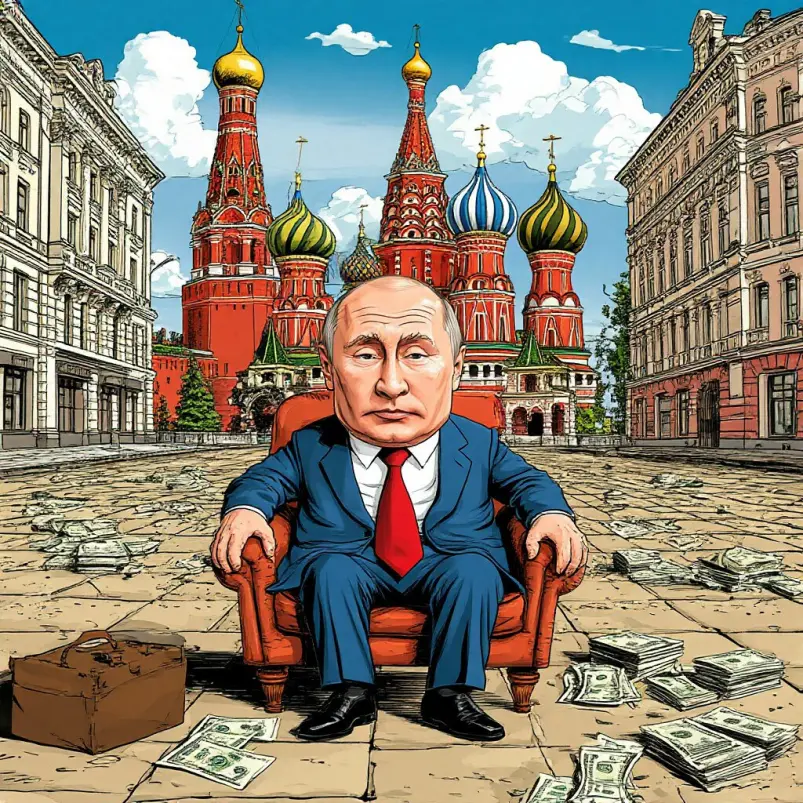
In Russia, they report the same GDP every year. This is a propaganda figure against sanctions. At first, they claimed that sanctions were increasing their income, which made no sense. But having exactly the same GDP in these turbulent years with their economy upside down can't be true either. When Putin feels the need to make a bold statement, he probably does the opposite. Bots pick up on this and spread this misinformation. People who do not understand economics indiscriminately quote and repeat it.
I argued in my publications last year that we would start to see cracks in the Russian economy sometime in June or July of this year. More recently, the Russian Economy minister said that they were on the verge of recession. It will happen, but the timing is difficult to predict. I think we will see tension this summer, and by the end of 2026, in all likelihood, the situation will be different.
The burden of personal debts is so great that the inhabitants of Russia are up to their ears in debt and become serfs.
Currently, Russia is leading a "wartime economy." Russia has no access to foreign investment, no one in their right mind would invest a single euro in Russia, and large multinational corporations have left the country. Russia is barely breathing, depleting its internal resources (people and equipment). Okay, there's some help from China, but it's a trickle.
"The destruction of capital is not economic progress. There is no more subtle, more persistent, and more dangerous illusion than the fiction that military prosperity is genuine prosperity. This is the prosperity that arises from the destruction of capital." — Ludwig von Mises, "Human activity" (1949, p. 827).
I write and shoot. Join me
Author's video content
https://www.youtube.com/c/ViolettaWennman
Political trash
https://www.youtube.com/@Ship-Shard
Highly Social on Zen
https://dzen.ru/shipshard
I invite you to the uncensored telegram channel.
https://t.me/shipshard

From the author's telegram channel:
Oh my God, he is not only a historian, he is also a distinguished economist: "The price for such economic growth was inflation" - Putin at the SPIEF.
Look at Nabiullina's face when an old, crazy gopnik talks about the growth of the economy. Who understands anything about numbers: Nabiullina and Siluanov are totally fucked.
Oh, what a wonderful state of the economy in the Russian Federation.
How many times have I seen in the comments or in personal messages the same level of knowledge in economics from all of Putin's sect, this is really a gopnik, a loony and a cattle idol. No intelligence, no knowledge, zero! What a stupid fucking disgrace this scum has seized power in Russia
https://t.me/shipshard/4335
I invite you to the uncensored telegram channel.
https://t.me/shipshard





