
Publication in Russian on the Zen blog
https://dzen.ru/a/ad_f_IUyT2yYFG66
The future is not determined solely by poll numbers. It is created by our actions here and now.
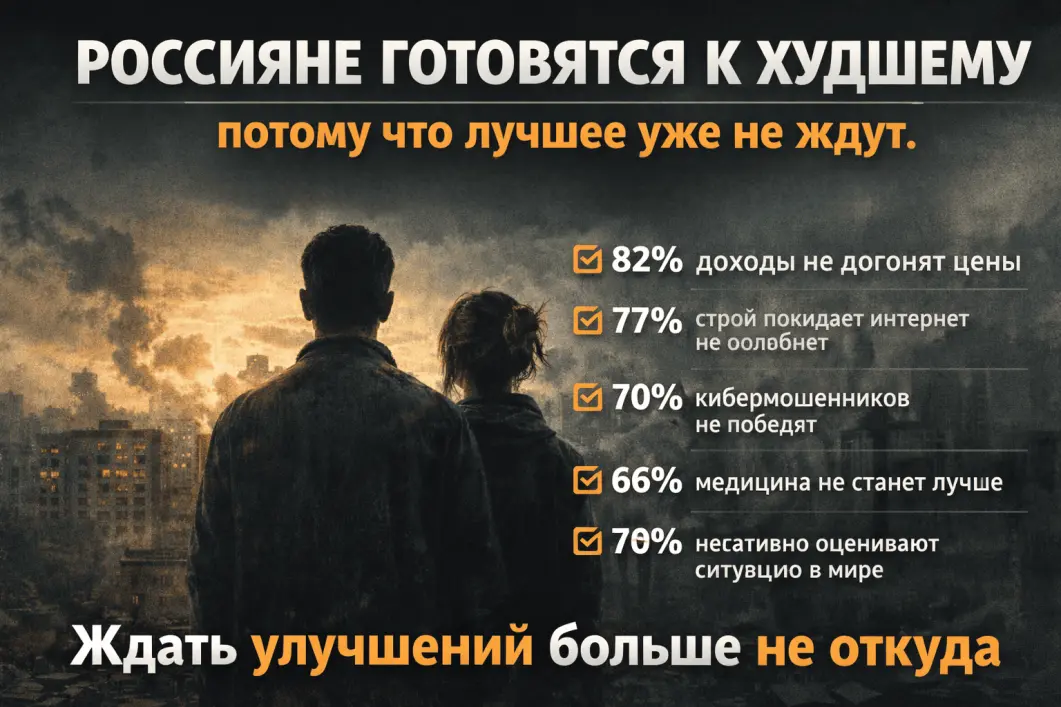
According to surveys from the CSP "Platforma" + "OnIn", "Map of Faith and Hope", for March 2026 and published by RBC, April 13, 2026:
- 82% — incomes will not catch up with prices (28% are completely confident)
- 77% — control over social networks and media will not weaken
- 70% — cyberbullying will not win
- 66% — medicine won't get better
- 78% — negatively assess the situation in the world
The conclusion of the authors of the study:
"Such confidence is a key marker of inflationary anxiety and reflects a fundamental distrust of the ability of personal income to compensate for the rising cost of living,"
Data — publicly available, RBC, 04/13/2026
This is not "pessimism" or "difficult times." This is a fixed state of society. 82% of Russians are confident that their incomes will not catch up with the price increase. Not "maybe." There is no "risk". And it's almost guaranteed. This is the main diagnosis — people no longer believe that they can at least maintain their standard of living. And it's not an emotion. This is a behavioral attitude. When the majority knows in advance that they will become poorer, they stop spending, postpone life "for later", and reduce the planning horizon to a minimum. The economy does not fall sharply in such a situation. She starts to suffocate slowly. A pessimist is someone who expects a bad outcome. But what is happening now is the absence of expectation itself. People don't expect things to get worse. They have already stopped waiting for improvement. These are different things. Pessimism is an emotion. The absence of a horizon is a structure. And when the majority of society does not see the horizon, it stops working for the future. An economy built on such a foundation does not collapse — it freezes.
But it's not just about money anymore. 77% do not believe that control over the Internet will weaken. And the key here is not even the control itself. And the reaction to it. More than half do not support locks. But at the same time, almost no one believes that they will be canceled. This is not consent. It's a surrender. This is a condition that has an accurate name — learned helplessness. And it's not about weakness. This is probably the most difficult point in the entire survey. Learned helplessness is not laziness or cowardice. This is a state where the psyche saves resources by ceasing to respond to stimuli that cannot be changed. The man did not obey the system. He just stopped wasting energy on resisting things beyond his control. Blockages? It's useless to get angry. Scammers? It's useless to complain. Prices? It's useless to be indignant. A person shrinks to the size of his apartment, family, and salary. The outside world becomes just a "background". And this background is almost unanimously assessed as hostile or hopeless.
Further — even more revealing. 70% are confident that cybercriminals will not be stopped. 66% do not expect improvements in medicine. That is, people do not believe that the state is capable of performing even basic functions: to protect, cure, provide. Not complicated reforms. Not breakthroughs. Basic things. People don't expect help from the state - it's very dangerous. The state, in theory, should guarantee security and survival. People say: "You can't protect my savings from inflation, you can't protect my phone from scammers, and you can't treat me in a clinic." But they don't protest. They simply stopped turning to the state as a source of solutions. It's a silent breakup. And it is much more dangerous for the authorities than rallies.
78% believe that the world around them is bad. It's not about the news anymore. It's about the background in which society lives. When the majority sees the world as hostile and deteriorating: long-term thinking disappears, the demand for "at least some kind of stability" grows, and trust in those who should ensure this stability decreases, and here is the most unpleasant conclusion. People are not just unhappy. They stopped expecting improvements in principle. Everything related to the state and institutions is in the red: economics, medicine, security, and the digital environment. Plus, it remains only in the zone of personal control, where a person still controls the situation himself: family, work (not career), personal life. Everything else is a zone where nothing depends on you. This is the new normal. Not a crisis. Not a temporary slump. A slow habituation to deterioration. Don't panic. Without protest. Without illusions. This is a classic survival model in an era of stagnation: retreating into the private. Politics, economics, and society are "foreign" spheres. My life is something that I can touch with my hands. Therefore, "preparing for the worst" is not an alarmism. This is a rational strategy. When:
- 82% do not believe in income.
- 77% do not believe in freedom.
- 70% do not believe in protection.
- 66% do not believe in medicine.
Most people have only one thing left to do: stop waiting for things to get better and learn to survive in a system that doesn't believe in it itself. This is not paranoia. This is a rational calculation based on the only information available: there will be no improvements. The main thing now is for all of us to remain people who refuse to lie to ourselves. There is ostentatious optimism, there is panic. This is the third state: sobriety. And it sounds scarier than any panic. Because panic is energy. And sobriety is silence. And in this silence, you can hear millions of people making a decision.: "I'm on my own. And I have nowhere to wait." This is not a defeat. This is the last frontier. When there is no one else to rely on, a person begins to rely only on himself.
Mass pessimism is not just a mood, but a signal of real problems. It reflects the accumulated distrust of stability and fear of the future. To change the situation, we need not only economic measures, but also work with public trust: transparency, support for vulnerable groups, and real steps to improve the quality of life.
I write and shoot. Join me
Author's video content
https://www.youtube.com/c/ViolettaWennman
Political trash
https://www.youtube.com/@Ship-Shard
I invite you to the telegram channel
https://t.me/shipshard
Highly Social on Zen
https://dzen.ru/shipshard
For goodies
https://dzen.ru/shipshard?donate=true
My hobbies are history, philosophy, psychology, music, economics, politics, and sociology. I write about this and much more. Professional model. She has performed at international music festivals (vocals, dancing, imitation of vocalists). I am studying at the Academy of Arts - the film and art industry, I am a producer and the owner of a video studio.
I am glad to see all of you in my blogs.
Stay with me everywhere. https://t.me/shipshard






