
Publication in Russian on the Zen blog
https://dzen.ru/a/ZjuJoR2EnHXyVhsY
If it weren't for the USSR's victory in World War II, there wouldn't be this myth about Russia's invincibility.
Russia lost a bunch of wars to the French, lost the Crimean War to Britain and France, lost the Russo-Japanese War, lost the First Chechen War.
Many Russians don't even know anything about Napoleon.
If you ask a random Russian who Napoleon was, he'll say either "I don't know" or "he wanted to conquer Russia, but Kutuzov defeated everyone."
In Russian history, propaganda draws parallels everywhere, where Napoleon is equal to Hitler in the 19th century, who wanted to kill all Russians.
And people are lazy, they simply can't even open Wikipedia, starting their search for the truth from this source.

Did you know that the Russians lost to Napoleon not only in 1812-1814, but also in 1805-1807? Napoleon defeated the Russian army in 3 years, after this defeat, Emperor Alexander I waited for 5 years for new soldiers to grow up to take revenge in a new war. As a result, the Russian army suffers defeat for the second time.
I will give an example of the famous Russian scientist-historian Evgeny Ponomarenko, who debunks conspiracy theories in history.
Evgeny Ponasenkov is a famous historian, director, author of the bestselling monograph "The First Scientific History of the War of 1812" (900 pages), singer (dramatic tenor) and collector. Director of the "House of Friends of the Olympics" during the 2008 Olympic Games; the concert anniversary of opera diva Elena Obraztsova at the Bolshoi Theater; productions at the Taganka Theater, the Meyerhold Center, etc.
Evgeny has created the largest collection of books and art objects from the Napoleonic era in Russia. Evgeny is a frequent guest at public receptions at the embassies of the USA, France, Germany and other countries; acts as an expert on history and politics in the most significant media: a long-standing author's column in Kommersant-Vlast, Radio Liberty, TVC, Ekho Moskvy, Moscow-24, NTV, Sovershenno Sekretno, Dozhd, First Channel of Germany (WDR), Le Figaro, CNN.
The historian's books can be found separately here.
Maestro Ponasenkov tells how Napoleon won all the battles against the Russian army. All the soldiers and generals fled from the French army to the Moksha swamps, and Napoleon with his army came to Moscow, stayed in the capital for more than a month, while the Russian troops hid in the swamps in the forests.
What is the Treaty of Tilsit? It is a peace treaty between France and Russia from 1807. For a couple of decades, Napoleon defeated anti-French coalitions, which included the Russian Empire, after which Alexander I signed a peace treaty with Napoleon, but the Russian emperor still did not comply with the treaty and continued to fight against Napoleon. There were 6 anti-French coalitions (Prussia, England, Switzerland, Spain, Bavaria, Italy), which attacked France in order to capture and enslave it. And in each coalition there was Russia, which sent Russian troops to war. It all began at the end of the 18th century, when the young general Bonaparte, seeing how the people in power were leading his country to the bottom, took the initiative and seized this power. After that, he defeated the Italians, who declared war on France, then Prussia, Austria, and, of course, the Russian army. And he forced Emperor Alexander I to sign a peace treaty on France's terms, after which the empire became angry and prepared for a new war.
A brief history lesson for truth-seekers on the channel. Napoleon and the anti-French coalition:
After the civil revolution of 1789 in France, uprisings against the slave-owning monarchy and the bourgeoisie spread throughout the country.
(in Russia, serfdom was abolished only in 1861, 72 years later)
All the countries of Europe where monarchs and boyars ruled were worried that they would be swept off the throne by revolutionaries, so they spent all their resources on destroying the civil revolution in France.
A young officer of the French army, Napoleon Bonaparte, fighting against slave owners in the provinces of France, already at the age of 24 received the rank of brigadier general for outstanding success in the war.
From 1792 to 1799, the army of free France fought with the first coalition of Europe and Russia, which wanted to extinguish the civil free society. But Bonaparte defeats the bourgeoisie.
But already in 1798 the bourgeoisie formed a new second coalition against France, and Napoleon saw corrupt officials in the government of France, and eventually seized power with his loyal soldiers, putting loyal consuls in charge.
In 1802 he defeated the second coalition.
In 1804 the free people of France elected Napoleon Emperor of the French.
In 1805 the third coalition of Prussia, Austria, Russia and others declared war on Napoleon. And in 3 years Napoleon defeated Austria and Prussia, and the army of the Russian Empire, and in 1807 forced Russia to sign peace on the terms of France (Treaty of Tilsit).
The Russian emperor signed, but still continued to plot.
In 1811 Russia gathered an army at the border of Poland, where help was expected from the King of Prussia, and again declared war on Napoleon. But the King of Prussia backs down, and the Russian army retreats.
Then, from autumn 1811 to spring 1812, the Emperor of Russia Alexander I threatens Napoleon and sets conditions to stop fighting against slavery. He sets conditions for Napoleon, who had already defeated him in 1805-07.
In six months, Napoleon gathers an army of 130 thousand and deploys it in Vilnius, but the Russian army retreats again. And accepts battle at Borodino.
Napoleon comes to Borodino, where Kutuzov is waiting for them with an army of 155 thousand, and utterly defeats the Russian army, from which the army of the Russian Empire retreats to the Mokshan swamps and further away.
According to losses in the battle of Borodino:
France out of 110 thousand - 22 thousand wounded and killed.
Russia out of 155 thousand - 53 thousand wounded and killed.
These are the largest losses in all the wars in Europe, where the Russian army lost 53 thousand Russian soldiers in one battle.
Napoleon then goes further and wins a victory near Smolensk. The Russian army retreats again.
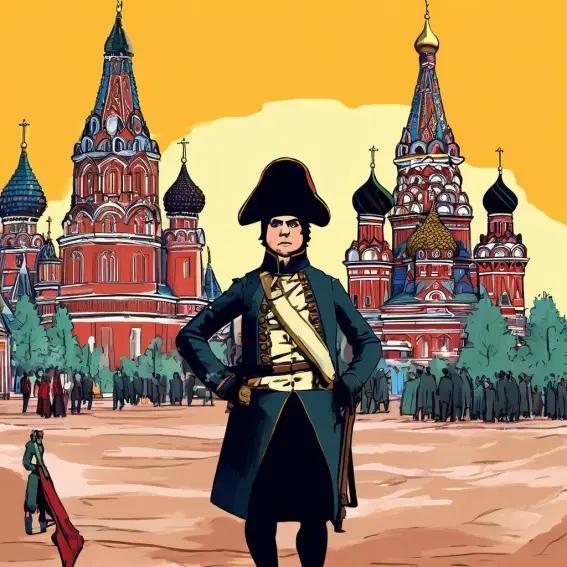
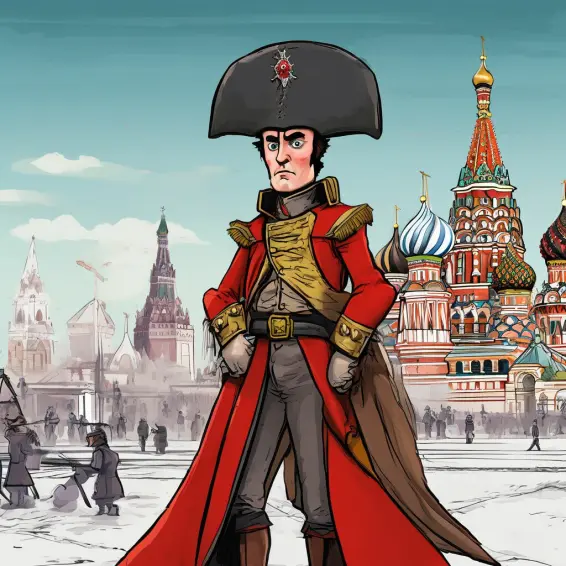
Napoleon enters Moscow WITHOUT A FIGHT and the French are in the capital of the Russian Empire for 36 days.
The French army was in the heart of the Russian Empire for 36 days, while the Russian troops were hiding in the swamps somewhere in the forests.
Napoleon sat in Moscow for more than a month and waited for the Russian army and the emperor to arrive for battle or negotiations, but no one arrived.
Emperor Alexander 1, Kutuzov and the entire Russian army were hiding in the forests and swamps of Karelia.
Napoleon and the French army got tired of waiting for the Russian representatives, their wives and children were waiting at home, and the French got ready and went home, and on the way they met a Russian ambush in Maloyaroslavets, destroyed this ambush, and then everyone knows what happened next.
As a result, Napoleon lost about 30 thousand wounded and killed in the campaign against Moscow, and the Russian troops lost more than 100 thousand wounded and killed!
About 20 thousand Russian soldiers turned out to be marauders and stole food, clothes, horses, and even women's clothing from the peasants. More than 100 thousand statements from peasants about Russian marauding soldiers. After the defeat by the French, the Emperor of Russia fled to England to his bourgeois allies.
All this information is open in the archives and anyone can check and study it.
But Russians are not very interested in their own history, because they are much more willing to believe in the propaganda and the lies that we are instilled with from school years, as a result, we do not even understand what country we live in and what we are being led to.
All talk about the greatness of Russia is a lie to raise patriotism, thanks to which people who do not know how to think will give their only life for the palaces and yachts of the bourgeoisie

Recommended reading:
In the Footsteps of Russian Revolutions. Inspired by
On the creation of the Russian Orthodox Church, Substitutions and the National Idea
Author's video content.
In collaboration with CMCproduction & SmartREC video studios
https://www.youtube.com/c/ViolettaWennman
https://ok.ru/shipshard1
https://vk.com/shipshardvk
https://www.pinterest.ca/omegagirs/
https://dzen.ru/shipshard
https://t.me/shipshard
I INVITE YOU TO THE TELEGRAM CHANNEL
UNCENSORED
https://t.me/shipshard
Publication in Russian on the Zen blog
https://dzen.ru/a/ZjuJoR2EnHXyVhsY






