
Publication in Russian on the Zen blog
https://dzen.ru/a/afo0iRadCT2fdqBr
FILMS WHERE EMOTIONS, NOT FACTS, CONTROL THE MASSES.
Films where politics is like manipulation.
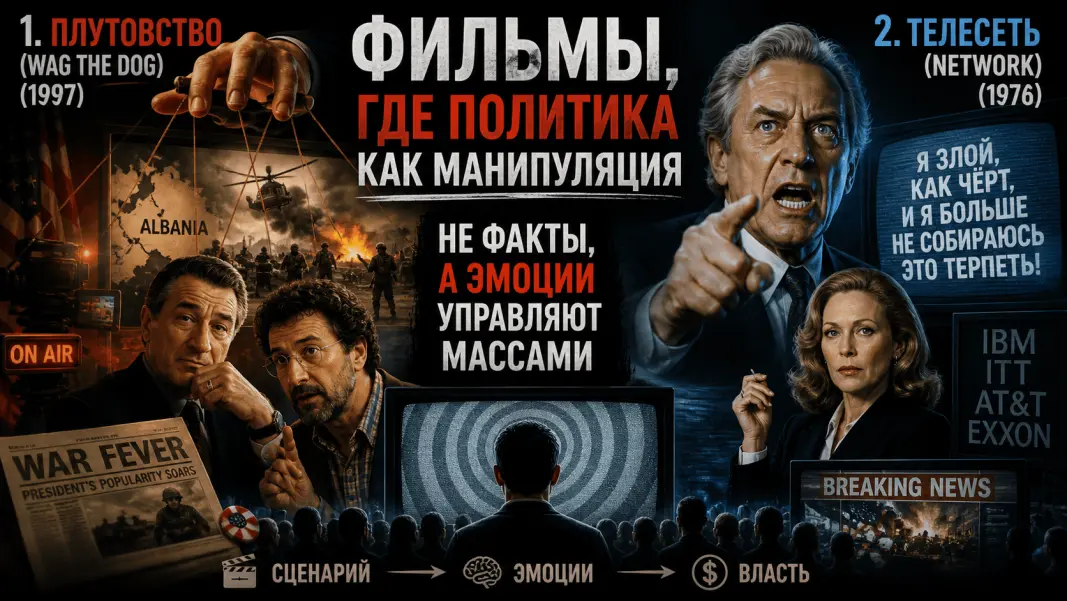
1. Cheating (Wag the Dog) (1997). How "realities" are created for society. Mechanics of information campaigns. Reality is what is shown to us.
While you're drowning in the morning news, sincerely believing that you're forming your own opinion, smart people are quietly renting out your emotions behind the scenes.
If you want to understand how obedient plasticine is made from the human mind, wash off the information noise and watch Barry Levinson's masterpiece "Cheating" (the original and much more accurate name is Wag the Dog).
It's not just a movie. This is a surgically precise autopsy of public independence. This is a manifesto of the post-truth era, filmed before the term came into use.
To save the president's rating before the election, a brilliant cynical political strategist (Robert De Niro is as cold as a scalpel blade) and a Hollywood producer (Dustin Hoffman is mad as a genius who has lost his mind) invent a war with Albania in seven days.
Out of nothing.
With the help of chromakey, an orphaned white cat, and a purchased patriotic anthem.
They don't have guns. There is no front. There is no enemy.
But they have a camera, a corrupt broadcast, and a herd that wants to believe.
After 72 hours, America is crying over a fake soldier.
The president is re-elected in a week.
Albania? Which Albania? She wasn't there.
They are not selling facts to the crowd — they are selling an emotional surrogate.
And the crowd devours him with the appetite of a hungry dog.
The film ingeniously formulates the law of media epoch: "If it's not on TV, then it didn't exist."
Today, the TV has moved to your smartphones, but the essence has not changed. Real tragedies are packaged according to the laws of Hollywood drama, and fictional crises are directed so that you cry at the right minutes.
They show us the "victim" — and we are obliged to have compassion. They show us a "hero" — and we should be proud. The film proves that your tears and your anger are a monetizable resource. You don't empathize. You're just reacting to the right triggers.
The filmmakers described the technological algorithm. The one according to which the geopolitical map of the world is being cut before your eyes today.
Note with what grace the authors show the cynicism of the elites. Hoffman's character is genuinely proud of his work. For him, war is not about blood and dirt, it is "his best production work."
The film demonstrates a terrifying paradox: the most terrible tragedies of mankind are created by people in expensive suits, with perfect manicures and a glass of expensive whiskey in their hand.
Their dialogues are the poetry of manipulation, where a national tragedy is played out on their lap like the script of a cheap sitcom.
ABOUT THE SCARIEST THING THAT THE FILM IS SILENT ABOUT. That we don't need soldiers for war. We need a script. That you don't need a threat to panic. We need a soundtrack. That the crowd is not citizens. This is the material. Director Barry Levinson did not make the film. He uncovered a mechanism that still works.
Do you think Wag the Dog is about America in the 90s? No. It's about your feed today. About yesterday's tantrum. About tomorrow's fake. About the enemy you've come to hate in 48 hours without even asking why. We live in a world where the tail doesn't just wag the dog — he amputated it unnecessarily. We were turned into viewers of an interactive shadow theater, where everyone sincerely shouts "I believe!", pointing at a cardboard wall.
The tail cannot wag the dog. But if the dog is you, it can.
This movie is for those who still confuse the evening news with reality. Wag the Dog shows a simple, almost cynical formula: if reality is inconvenient, it is replaced. They don't refute it, they don't hide it, but they rewrite it. Like a bad script that suddenly decided to make a blockbuster. The most disturbing point is not even that someone is able to "create a war out of thin air." The point is that the audience has long been ready to accept it — if the story is presented beautifully, emotionally and at the right moment. This movie is not about manipulation. This is a film about voluntarily agreeing to be deceived if the deception looks more convincing than the truth.
Watch this movie not for pleasure, but for vaccination. If you still trust the TV after watching it, then you are not a viewer. You are a decoration. If you return to the news feed with the same reverence after watching it, it means that I wasted the letters, and the director wasted the film.

2. The television Network (1976). Television and manipulation of public opinion.
Do you really believe that your thoughts belong to you? Wake up. You have long been turned into a limp biomass, mindlessly chewing digital silage and obediently floating with the flow in a plastic basin, sincerely considering yourself captains.
If you want to see exactly how you were tamed, you must dissect your brain with Sidney Lumet's masterpiece "The Network" (Network, 1976).
The year is 1976. The pistons of the industry are roaring, America is carelessly munching hamburgers, and director Sidney Lumet is not just making a movie — he opens the skull of the century and pours the pure, liquid poison of truth into the lens. This is a ruthless anatomical atlas of the very information plague that is devouring the remnants of your critical thinking right now. The film, shot almost half a century ago, turned out to be neither utopia nor satire, but a cold-blooded, sadistically accurate prophecy a week before the apocalypse. Lumet and screenwriter Paddy Chayefsky looked into the abyss and saw our digital present there.
What are you watching in the evenings, staring at the screens? Baby talk about superheroes? The Teleset is a circus on a completely different scale, a circus where clowns bite off the heads of tamers, and the audience enthusiastically eats popcorn with blood.
In the center of the plot is the dying lion of the news broadcast, Howard Beale. The presenter, who one day breaks down and shouts at the camera: "I have nothing to lose. So I'll tell you the truth: life is shit." He is not a character, he is a naked nerve, a pure, sincere cry of despair. But the enormity lies not in his madness. The enormity lies in the reaction of the media bosses. Instead of firing the madman, they put a gold collar around the mad dog's neck. Why? Because mental agony on live TV sells better than shampoo ads. Holy rage, pain and thirst for truth are instantly wrapped in a glossy wrapper, provided with a sponsor's logo and sold to you in the evening prime time. The TV screen is not a window into the world. It is a neon altar that requires the daily sacrifice of your individuality.
Look at Faye Dunaway's character, Diana Christensen, a predatory, dazzling, androgynous being devoid of even the rudiments of empathy. This is the perfect, frightening prototype of every modern hype producer and social media algorithm. For her, love, death, revolution and human tragedy are just the ranking lines and fuel for the bonfire of vanity. She is a surgeon without anesthesia, dissecting public opinion for the sake of minute coverage.
The Teleset hits back with verbal cascades that sound like a judicial verdict against humanity. The monologue of the head of the corporation, Arthur Jensen, that there are no more nations in the world, but only "IBM, ITT, AT&T and Exxon" is the purest, distilled poetry of capitalist fascism, which makes the blood run cold. Today it doesn't even sound like a dystopia, but like a boring and mundane summary of financial news. The world has become a giant meat grinder that grinds fear and anger into a convenient content format.
We live in the era of the "TV Network" on steroids. The screen has become smaller, the algorithms are smarter, and the illusion of choice is thinner. That's your point, modern viewer: you go to the window, see that the world is burning, and the first thing you do is grab your phone to beautifully film the dawn of the fire. You are a gaping void in the Instagram smile suit, a herd that has voluntarily given itself a chip in the form of a like. They learned how to sell fire in cans, and how to pack smoke in bags.
And the final scene... Oh, this scene breaks the spine of everyone who naively believes in happy endings. In this system, the truth is not killed by a bullet. She is being killed by a new show, rating protocol, and the matter-of-fact voice of an announcer switching the channel to an advertisement for mayonnaise.
If you still think that you are consuming content, and not content is consuming you, lock yourself in a room and turn on this movie. Get rid of your illusions. Smoke out every drop of this poison. This movie is for those who are not afraid of a harsh intellectual slap in the face. After the "TV Network" you will start watching any news like a criminal chronicle, thinking frantically.: Who is the victim here, and who is the director?
"I'm angry as hell, and I'm not going to take it anymore!" Beale shouted fifty years ago. But the main irony is that you're being patient. Every single day. And if you know this phrase, but you don't change anything in your life, congratulations: You are the main character of this movie. The one who never realized that he was already in hell.
Turn it on. And then don't be surprised: the silence after the credits will be too loud.

Reviews of serious cinema by Violetta Wennman
I am studying at the Academy of Arts at the Faculty of Film and Arts Industry, I am a producer. And I'll tell you about a serious movie. If the movie is not serious, I will tell you how it got into this collection. Look at the truth before you become part of the lie.
I write and shoot. Join me
Author's video content
https://www.youtube.com/c/ViolettaWennman
Political trash
https://www.youtube.com/@Ship-Shard
I invite you to the telegram channel
https://t.me/shipshard
Highly Social on Zen
https://dzen.ru/shipshard
For goodies
https://dzen.ru/shipshard?donate=true
My hobbies are history, philosophy, psychology, music, economics, politics, and sociology. I write about this and much more. Professional model. She has performed at international music festivals (vocals, dancing, imitation of vocalists). I am studying at the Academy of Arts - the film and art industry, I am a producer and the owner of a video studio.
I am glad to see all of you in my blogs.

Stay with me everywhere. https://t.me/shipshard






